
Yes, lightning does help grass grow in a small, indirect way, but not in any manner you can count on or control. The science behind it is real: lightning converts atmospheric nitrogen into reactive nitrogen oxides (NOx), some of which eventually deposit into soil via rain and help feed plants. But the actual boost any given lawn gets from a passing thunderstorm is so minor and inconsistent that it cannot meaningfully explain why your grass looks greener after a storm, and it certainly cannot replace a proper fertilization program. If your lawn is struggling, lightning is not the answer.
Does Lightning Help Grass Grow Faster? What to Do Instead
Marcus Volkmann
23 Apr 2026
What lightning actually does to grass (the real science)
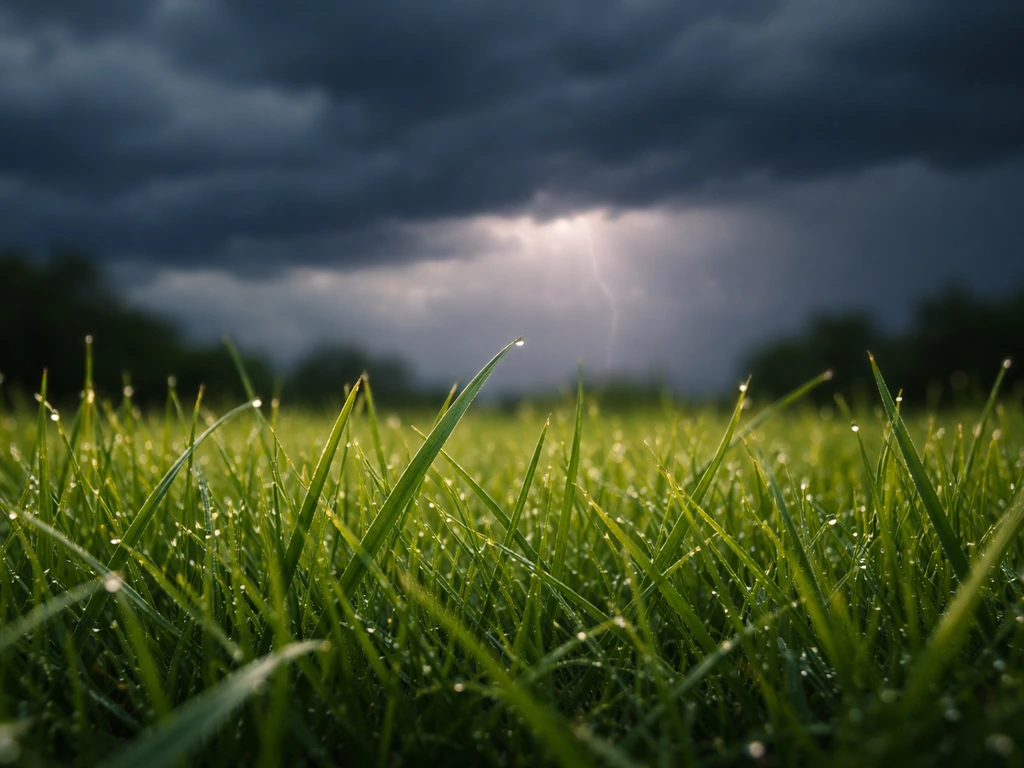
The connection between lightning and plant growth traces back to nitrogen chemistry. A single lightning flash produces roughly 90 moles of NOx on average, which works out to about 1.3 kg of nitrogen per flash. That sounds significant until you realize it is dispersed across a massive atmospheric column, not deposited directly onto your lawn. What happens next is that those nitrogen oxides combine with oxygen to form nitrogen dioxide, which atmospheric chemistry eventually converts into nitric acid and nitrates. When rain follows a thunderstorm, some of those nitrates wash down to the soil surface, giving grass a small, free dose of fixed nitrogen.
Lightning-fixed nitrogen is a recognized input to terrestrial ecosystems, and researchers have studied how it contributes to total reactive nitrogen alongside biological nitrogen fixation and fertilizer inputs. There is also research showing that lightning-like electrical events near soil can influence rhizosphere microbial communities and plant metabolite activity, which is genuinely interesting. But none of this translates into a homeowner-actionable tool. The nitrogen arriving at your lawn from any individual storm is trace-level compared to what a single bag of fertilizer delivers in a targeted, predictable way.
The reason your lawn sometimes looks noticeably greener after a storm is mostly the rain itself, not the lightning. You might also wonder whether grass grows on cloudy days, and the answer comes down to how much light reaches the lawn and whether the soil stays moist grass on cloudy days. Grass that was mildly water-stressed snaps back quickly when moisture is restored. Rain also washes dust off blades, which makes them reflect light differently. Some of the effect is also timing: summer thunderstorms often break heat, dropping temperatures into a range where cool-season grasses photosynthesize more efficiently. Lightning is a small contributor in that mix, not the star.
Does lightning make grass grow faster? What's real vs. myth
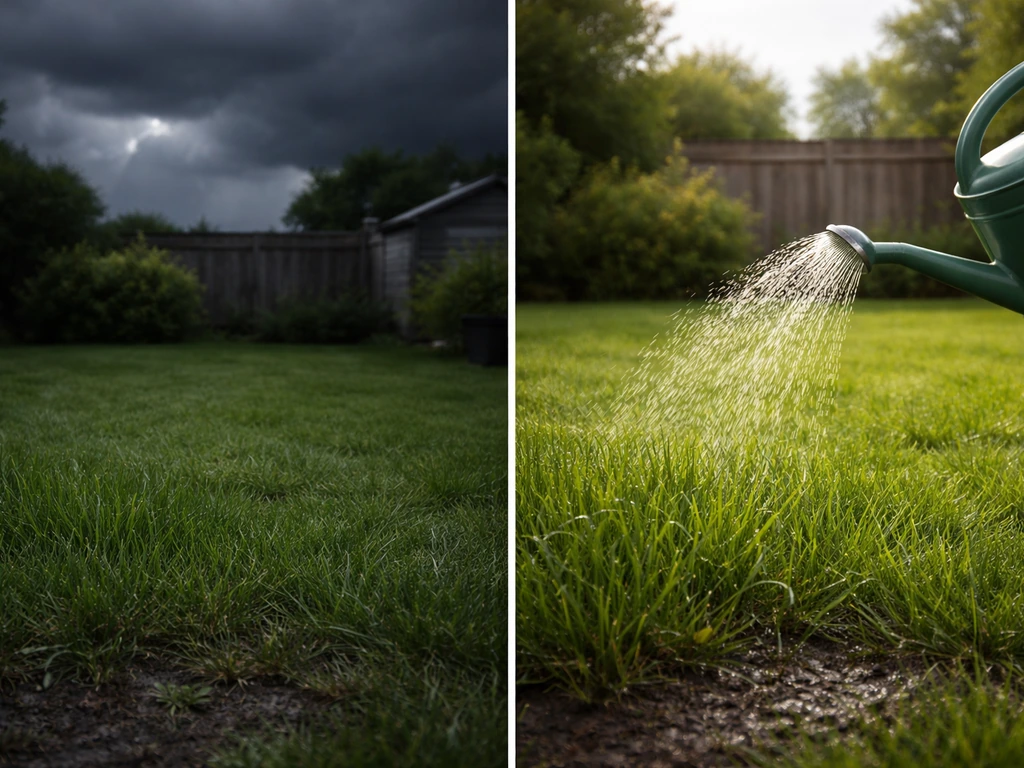
Here is the honest answer: no, not in any practical or measurable way for a home lawn. If you are trying to make grass grow faster, a more reliable question to check is whether does humidity make grass grow faster, since moisture and growing conditions drive the growth rate more than lightning.
Urine may add nitrogen, but it does not reliably make grass grow as well as proper lawn fertilization and water management no, not in any practical or measurable way for a home lawn. The idea that lightning supercharges grass growth is a popular claim, and the underlying chemistry is technically accurate, but the dosage is the problem.
The nitrogen contribution from lightning across a growing season is a fraction of what your lawn needs, and it arrives unpredictably, inconsistently, and spread thin across the landscape. No controlled turf research establishes that lawns near frequent storm activity grow faster in a way attributable to lightning rather than rainfall.
Grass growth rate is governed by soil temperature, moisture availability, nitrogen status, root-zone oxygen, mowing height, and species-specific growing seasons. Purdue Extension notes that cool-season grasses do most of their rooting in April through May and again in October through November. That seasonal biology is far more influential than any single weather event.
If lightning were genuinely making your grass grow faster, you would expect to see a measurable growth spike in the days after a storm, above and beyond what the rainfall alone explains. Rain can help grass grow, but it typically works through added moisture and does not reliably speed growth beyond what normal weather and soil conditions allow rainfall alone. Lawn managers who track growth rates don't see that pattern.
What to do today if you want faster grass growth
This is where the real leverage is. If your lawn is thin, slow, or struggling, there are several things you can actually control that will produce visible results within days to weeks. I rank these by how often they explain poor growth in my experience.
- Test and correct soil pH first. If pH is below 6.0 or above 7.0 for most turf species, nutrient uptake shuts down regardless of what you apply. UGA Extension confirms that incorrect pH directly reduces the availability of nitrogen, phosphorus, and potassium to grass roots. A simple soil test costs under $20 and tells you exactly how much lime or sulfur to apply.
- Fertilize with actual nitrogen. Apply 1 lb of actual nitrogen per 1,000 square feet during active growing periods, as Purdue Extension recommends. This delivers in one application what lightning might contribute in an entire season, in a targeted and measurable way.
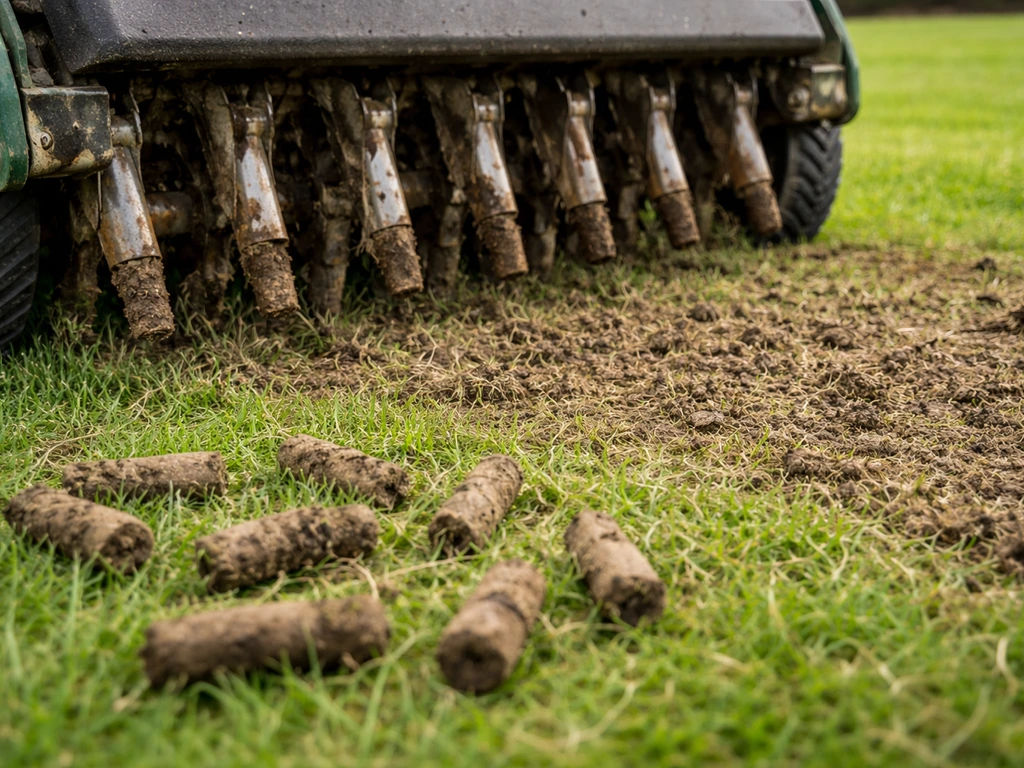
- Aerate compacted soil. If your soil is hard and water pools on the surface, a core aerator is the most effective fix available to homeowners, according to Penn State Extension. Aeration opens the root zone to air, water, and microbial activity, all of which directly accelerate growth.
- Manage thatch. NDSU Extension flags thatch over half an inch as a growth inhibitor. Thatch blocks water and air from reaching roots, and dethatching followed by aeration restores the flow.
- Water correctly. Deep, infrequent watering encourages deep roots and outperforms daily shallow watering. Grass that is mildly drought-stressed responds dramatically to a good soaking, which is part of why rain makes grass look greener fast.
- Match your timing to the species. Seeding or fertilizing outside the active growing window for your turf type yields slow or no results. Cool-season grass seed germinates best in late summer to early fall; warm-season grasses respond to fertilizer from late spring through summer.
Troubleshooting a lawn that just won't grow
If you have tried the basics and grass still isn't growing, work through these common culprits systematically rather than guessing.
| Problem | Symptoms | Fix |
|---|---|---|
| Soil compaction | Water pools, soil feels brick-hard, poor germination | Core aeration; repeat annually for heavy clay soils |
| Wrong pH | Fertilizer applied but no response, yellowing, moss present | Soil test then lime (too acidic) or sulfur (too alkaline) |
| Shade stress | Thin, patchy grass under trees or on north-facing areas | Switch to shade-tolerant species or use ground cover instead |
| Excess thatch | Spongy feel underfoot, water beads on surface | Dethatch mechanically, then aerate |
| Nitrogen deficiency | Pale or yellow color, slow growth during growing season | Apply balanced fertilizer with slow-release nitrogen |
| Watering issues | Drought stress or root rot from overwatering | Water deeply 1 to 1.5 inches per week, check drainage |
| Poor timing | Seed sown during heat of summer or deep winter | Reseed during species-appropriate window |
Shade is one of the most commonly underestimated obstacles. If you are wondering whether grass can grow without rain, the key factor is whether the soil can hold enough moisture to keep plants supplied between dry periods. Trees that have grown over the years change the light environment dramatically, and grass that once thrived may now be getting too little sun to sustain itself. If you can't prune enough canopy to restore adequate light, switching turf species or accepting a ground cover in that area is a smarter long-term solution than fighting nature. Rain and humidity help grass respond to its conditions, but no amount of rainfall or atmospheric nitrogen fixes a fundamental light deficit.
Low nitrogen shows up most clearly as slow, pale growth during the peak growing season. MU Extension notes that low nitrogen status is directly associated with reduced turf health, and that consistent nitrogen levels matter far more than occasional natural inputs. Purdue Turfgrass Science further explains how fertilizer label analysis is converted into the actual pounds of nitrogen applied, including a worked example of about 1 pound of actual nitrogen per 1,000 ft2 at appropriate product rates Purdue turfgrass science explains that fertilizer labels specify nutrient percentages (analysis). If you are already fertilizing but not seeing results, check that your pH isn't locking the nutrients out before roots can access them.
Safety: please don't try to 'use' lightning on your lawn
I want to be direct here because the internet occasionally produces creative ideas. There is no safe, practical, or effective way for a homeowner to harness lightning for lawn care. Lightning is a high-energy atmospheric discharge that kills dozens of people in the United States every year. NOAA's guidance is straightforward: when thunder roars, go indoors. The CDC echoes this with the same message, emphasizing that the threat is real even when a storm appears to be passing or distant.
There are no lawn rods, grounding systems, or DIY setups that safely capture lightning's nitrogen benefit for turf. If you’re wondering, does lime help grass grow, the answer depends on your soil pH and whether lime corrects an acidity problem rather than supplying nitrogen directly nitrogen benefit. The scale doesn't work: even if you could safely redirect a strike, the nitrogen it produces disperses across a weather system, not into a 1,000-square-foot lawn. Any experiment along these lines puts you and anyone nearby at serious risk. The practical payoff is zero. Spend that energy on a soil test and a bag of fertilizer instead.
The bottom line
Lightning does technically contribute small amounts of fixed nitrogen to the soil through atmospheric chemistry and rainfall. That is real, documented science. But the contribution is too small, too unpredictable, and too diffuse to meaningfully accelerate your lawn's growth in a way you can observe or plan around. The post-storm green-up you notice is mostly the rain doing its job. If you're curious whether that same rain-driven effect also answers does grass grow when it rains, the post-storm green-up is mainly the moisture working. If you want faster, healthier grass, a targeted fertilizer application, a soil pH correction, and a session with a core aerator will do more in one afternoon than all the lightning in a summer season.
FAQ
Can I tell if lightning is helping my lawn by watching for growth after storms?
Not reliably. If you do see a green-up, it is usually moisture and temperature shifts, plus possible dust wash-off. A better test is to compare growth in two nearby areas that get the same rainfall but different sun and traffic patterns, and see whether symptoms like pale color or patchy thinning match light, compaction, or nutrient issues instead of storm timing.
Does frequent thunderstorms mean my lawn needs less fertilizer?
Usually no. Even though lightning generates fixed nitrogen, the amount delivered to your specific yard is too small, inconsistent, and spread out. Fertilizer schedules should still be based on grass type, growth season, and soil test results, because the largest limiting factor for many lawns is often availability (pH, compacted soil, or depleted nutrients), not total atmospheric inputs.
Are there any safe ways to benefit from storm nitrogen without trying to capture lightning?
The closest safe approach is to support what storms already provide, mainly rainfall and reduced heat stress. Let rain soak in when possible, avoid mowing while blades are wet, and manage runoff so it actually reaches the root zone instead of washing fertilizer-free soil away. If flooding or puddling is common, aeration and improving drainage will usually outperform any “nitrogen from storms” expectation.
Why does my lawn sometimes look greener after a thunderstorm even if lightning is not the cause?
Often the storm brings cooler temperatures that keep cool-season grasses photosynthesizing more efficiently, plus moisture that relieves mild drought stress. Rain can also remove surface dust that reduces light reflection and can temporarily improve blade color. If the greening fades within days, that points more to water and light conditions than to nitrogen delivery.
Will lightning make grass grow if my soil is very sandy or very compacted?
Lightning-fixed nitrogen would still be trace-level, but the bigger issues are water holding capacity and root-zone oxygen. Sandy soil tends to drain quickly, compacted soil limits oxygen and rooting, so even if a little nitrate lands on the surface, plants often cannot use it effectively. Improving aeration, infiltration, and moisture consistency usually gives more measurable improvement.
Could a thunderstorm after fertilizing be the reason my fertilizer seems to work better?
It can, but not because of lightning itself. Rain after fertilizing helps dissolve and move nutrients into the root zone, reducing the chance of nutrient burn from dry granules sitting on the surface. If you want a predictable result, water-in fertilizer according to the label instead of relying on storms.
If lightning is dangerous, should I do anything special with lawn equipment during storms?
Yes. Keep everyone indoors when thunder is audible, do not use powered tools outdoors during the storm, and avoid sheltering under trees or near metal equipment. For irrigation and sprinklers, turn them off during storms to prevent waterlogging and runoff, especially on slopes or poorly draining areas.
What is the best next step if my grass is not growing, instead of blaming lightning?
Do a soil test and check the “most common limiters” in order. Start with soil pH and nitrogen status, then evaluate sunlight, compaction (footprints and spongy areas often hint at it), and irrigation uniformity. If growth is slow during the peak window, add core aeration when the soil is workable, because improving root-zone oxygen and contact with amendments often produces faster visible change than any weather-triggered theory.
Next Articles
Does Rain Make Grass Grow Faster? Here’s What Happens
Learn when rain speeds grass growth and when it stalls, plus after-rain steps for mowing, fertilizing, and fixing proble
Does Lime Help Grass Grow? When and How to Use It
Learn if lime helps grass grow by fixing soil pH, when to apply it, and how fast results can be.
Can You Grow Grass Over Gravel? How to Do It Right
Learn when you can grow grass over gravel and follow a step-by-step method for soil depth, drainage, seeding or sod, and