
Yes, grass can grow without rain, but only if it has another water source to draw from. Irrigation, stored soil moisture, groundwater capillary rise, and even dew can keep turf alive and growing. The real issue is how long and how well. Without supplemental water of some kind, growth slows, color fades, and cool-season grasses eventually go dormant within a week or two of dry conditions. Warm-season types like bermudagrass hang on longer. But "surviving" and "thriving" are two very different things, and the gap between them comes down to soil type, rooting depth, your grass species, and how quickly you act.
Does Grass Grow Without Rain? Practical Answers for Homeowners
Marcus Volkmann
12 Jul 2026
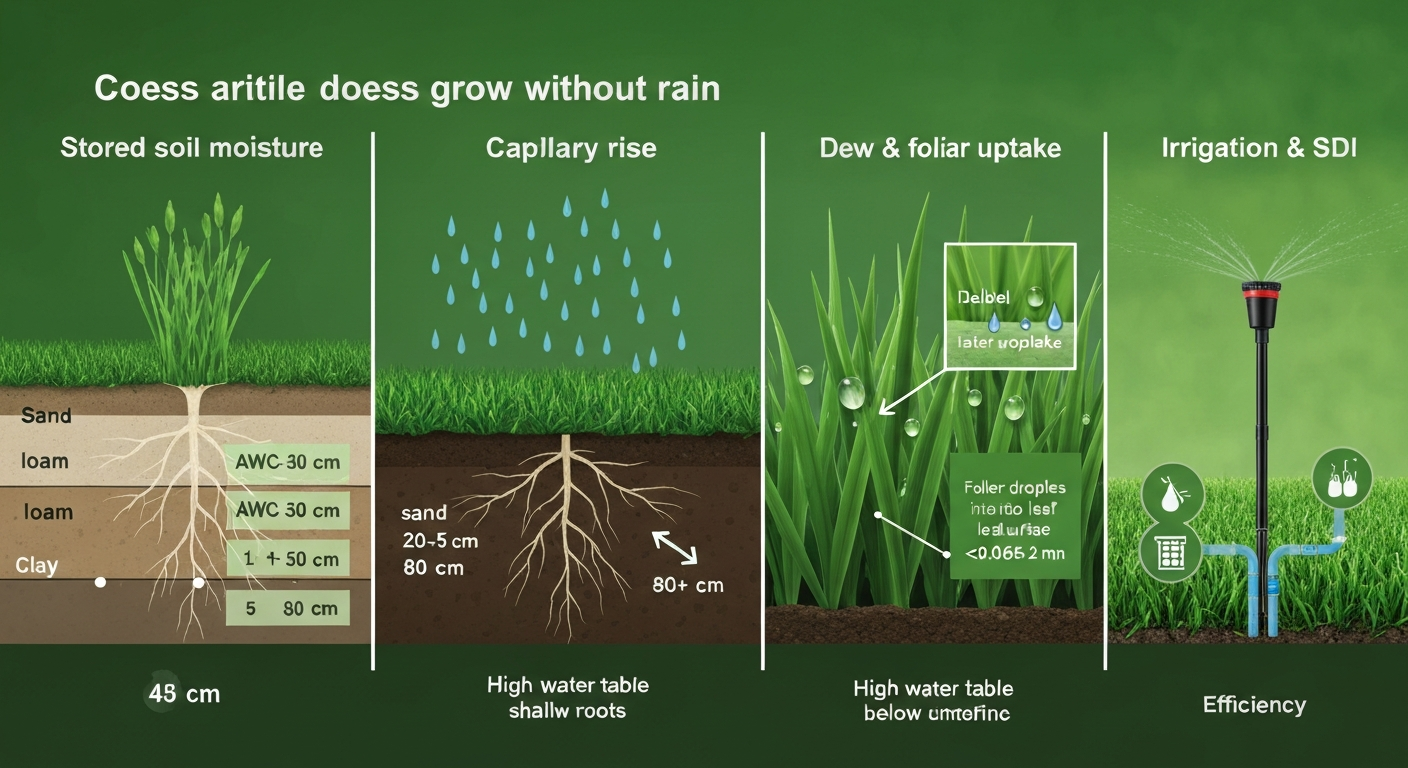
Where grass finds water when rain stops
Rain is the most obvious source, but it is far from the only one. Grass pulls moisture from several places simultaneously, and understanding those sources tells you a lot about how long your lawn can hold out.
Stored soil moisture
After rain or irrigation, soil holds water between two thresholds: field capacity (the maximum it can hold without draining) and permanent wilting point (the point at which roots can no longer extract water). The volume between those thresholds is called available water capacity (AWC). A sandy loam holds roughly 125 mm of available water per meter of soil depth. A loam or silt loam holds 125 to 192 mm per meter. Clay loam soils store 145 to 208 mm per meter. That reserve is what your lawn lives on between rain events. Deeper-rooted grasses like tall fescue, which can push roots 90 cm or more under good conditions, access a much larger reservoir than shallow-rooted Kentucky bluegrass, where 70 to 80 percent of root mass typically sits in the top 10 cm.
Capillary rise from groundwater
If you have a high water table, capillary rise can lift moisture upward into the root zone even when the surface is bone dry. How much lift you get depends almost entirely on soil texture. Coarse sands deliver only 20 to 50 cm of rise, which often doesn't reach shallow roots. Fine silts and clays can move water upward by 80 cm or more, and in some very fine-textured soils, capillary rise exceeds a meter. This is why lawns on heavy clay soils sometimes look surprisingly green during a dry spell while nearby sandy-soil yards turn brown fast.
Dew, fog, and foliar water uptake
Grass leaves can actually absorb water directly through their surfaces, a process called foliar water uptake (FWU). Research has confirmed this in tall fescue, perennial ryegrass, and Kentucky bluegrass. It is not a large contribution: a saturating dew or fog event delivers roughly 0.06 mm of water under experimental conditions, and long-term measurements in semi-arid grasslands put average dewfall at about 0. Long-term measurements in semi‑arid grasslands show average dewfall of about 0.2 mm/day (with individual events up to ~0.7 mm), supporting findings in The importance of dew in the water balance of a continental semiarid grassland, ScienceDirect (2019) The importance of dew in the water balance of a continental semiarid grassland — ScienceDirect (2019). 2 mm per day with exceptional events hitting 0.7 mm. That won't keep a thirsty lawn going on its own, but in dry seasons it meaningfully supplements soil moisture and delays stress, especially in coastal or high-humidity regions where dew is reliable overnight.
Irrigation and collected water
Sprinkler systems, soaker hoses, drip lines, collected rainwater, and greywater all substitute for rainfall when managed correctly. These are the most controllable and often most reliable substitutes, and I will cover them in detail in the irrigation section below.
How weather shapes growth rate: rain, humidity, and cloudy days
Rain does more than just water grass. A good rainstorm delivers water slowly enough for soil to absorb it, leaches surface salts, and often coincides with the cooler temperatures and higher humidity that reduce evapotranspiration (ET) demand on the plant. For more on whether rain helps grass grow, see does rain help grass grow. That combination means grass genuinely does grow faster after rain compared to the same amount of water delivered by a midday sprinkler in 90-degree heat. The reason is ET: on a hot, sunny, low-humidity day, a lawn can lose 5 to 7 mm of water to evaporation and transpiration before you even factor in what the roots are pulling up. Rain typically arrives with cloud cover and cooler air that cuts that loss dramatically.
Humidity plays its own role. High atmospheric humidity reduces the vapor pressure difference between the leaf and the air, which slows transpiration and keeps the plant from losing water as fast. For a deeper explanation of how humidity affects growth rates, see does humidity make grass grow faster. Cloudy days work similarly: less direct solar radiation means less heat load on the canopy and lower ET. A stretch of overcast, humid days without rain can actually sustain decent growth if the soil still has moisture, because the plant is spending that moisture reserve much more slowly than it would on a clear, hot day. See our deeper discussion on does grass grow on cloudy days.
What limits grass when rain is absent
It is never just "no water" that kills a lawn. Several factors combine to determine how quickly stress becomes permanent damage.
- Soil type and AWC: sandy soils drain fast and hold little reserve; clay soils hold more but can restrict root growth if compacted
- Root depth: shallow-rooted grasses exhaust the top soil layer quickly and cannot reach deeper moisture; tall fescue's deep root system gives it a meaningful edge over Kentucky bluegrass in a dry spell
- Temperature and evapotranspiration rate: a cool, overcast week burns through soil moisture far more slowly than a hot, sunny stretch; peak summer ET in many U.S. climates runs 5 to 7 mm per day
- Soil compaction and thatch: compacted soil and thick thatch layers block water infiltration, so even when you irrigate, water runs off instead of reaching roots
- Shade: trees and structures reduce solar heat load, which lowers ET demand and slows moisture depletion, though heavy shade brings its own growth challenges
- Mowing height: grass cut too short has reduced leaf area for photosynthesis and shallower roots, making it far more vulnerable to drought stress
Is your lawn surviving or suffering? Signs to watch for
There is a real difference between dormancy and damage, and catching the transition early is the only way to avoid a full reseeding job. Here is what I look for when checking a client's lawn during a dry stretch.
Early stress signals (reversible)
- Footprinting: grass blades fail to spring back within 30 to 60 minutes after you walk on them — the clearest early warning sign
- Leaf rolling or folding: blades curl lengthwise to reduce surface area and slow water loss
- Blue-gray tint: turf loses its green and takes on a dull, bluish-gray cast before it goes fully brown
- Uneven dew: stressed patches dry out faster in the morning and show dew loss earlier than healthy areas
- Slower growth rate: you stop needing to mow as frequently
Dormancy vs. death (check before you panic)
Brown grass is not always dead grass. Cool-season lawns like Kentucky bluegrass and perennial ryegrass go dormant and turn brown under extended drought while the crown and roots stay alive. To tell the difference, tug firmly on a brown clump. If it resists and the crown at the base is still firm and slightly green or white, the grass is dormant and recoverable. If the clump pulls up easily with no resistance and the crown is slimy or completely dry and brittle all the way through, that section is dead. In dormancy mode, extension guidance recommends applying roughly 1 to 1.5 inches of water every two weeks just to keep those crowns viable, even if you are not trying to green the lawn back up.
Emergency checklist: what to do right now if your lawn is stressed
When I get a call from someone whose lawn is in trouble mid-drought, this is the order I walk them through. Sequence matters because some actions make others more effective.
- Stop mowing low immediately: raise your deck to the highest setting appropriate for your species (typically 3 to 4 inches for cool-season grasses). Taller grass shades the soil, reduces evaporation, and encourages deeper rooting
- Apply emergency irrigation: if the lawn is already showing stress, water deeply — 1 to 1.5 inches — early in the morning to minimize evaporation loss and give leaves time to dry before evening
- Check for compaction and thatch: probe the soil with a screwdriver. If you cannot push it 6 inches without serious effort, compaction is limiting water infiltration and you need to aerate before more watering helps
- Reduce foot traffic: stressed grass cannot recover cell damage from physical pressure; keep people and pets off the worst areas
- Pause all fertilizer: do not apply nitrogen to drought-stressed turf. High-N fertilizer pushes top growth at the expense of root development and increases water demand exactly when the plant cannot meet it
- Apply a thin layer of compost (optional but helpful): a 6 mm top dressing of finished compost on bare or thin spots improves surface moisture retention almost immediately
- Identify dead vs. dormant zones: use the tug test described above to decide which areas need only water and which will need overseeding or replacement later
- Set a minimum maintenance irrigation schedule: 1 to 1.5 inches every two weeks keeps dormant cool-season crowns alive even if you are not actively trying to grow the lawn
Irrigation alternatives and watering schedules
Overhead sprinklers are the most common replacement for rain, but they are also the least efficient. Water applied at midday in summer can lose a significant portion to evaporation before it even reaches the soil. Here are the options, roughly in order of water efficiency.
Drip and subsurface drip irrigation (SDI)
Subsurface drip systems deliver water directly to the root zone, eliminating surface evaporation almost entirely. Trials have shown SDI can maintain comparable turf quality to overhead irrigation with meaningfully lower applied water volumes. The trade-off is installation cost and the need for careful lateral spacing matched to your soil type and grass species. SDI works best in established turf and is harder to retrofit without some disruption.
Soaker hoses
A practical middle ground for smaller lawn areas. Soaker hoses run at low pressure and deliver water slowly along the soil surface, giving it time to infiltrate rather than run off. They work well in garden borders and narrow turf strips but are less practical for large open lawns.
Overhead sprinklers: timing is everything
If sprinklers are what you have, run them between 4 a.m. and 9 a.m. Wind is lower, temperatures are cooler, and evaporation is minimal. Watering in the evening leaves turf wet overnight and increases disease risk. For actively growing cool-season lawns in summer, the general target is 1 to 1.5 inches per week total (rain plus irrigation). For warm-season grasses like bermudagrass, 0.75 to 1 inch per week is often sufficient depending on your climate's ET rate.
Collected rainwater and greywater
Rainwater barrels and cisterns are straightforward and cost-effective for supplemental irrigation. Greywater (from sinks, showers, and laundry) is usable for landscape irrigation in many jurisdictions, but regulations vary significantly by state and municipality. The EPA's national guidelines for water reuse set the framework, and most states layer additional requirements on top. Check your local rules before routing any household water to your lawn, especially regarding surfactants in laundry water that can affect soil structure over time.
Drought-tolerant grasses worth planting
If you are repeatedly fighting drought stress with the same grass, it may be the grass that needs to change, not just your watering habits. Species selection is the single highest-leverage drought-resilience decision you can make.
Warm-season options
- Bermudagrass: one of the most drought-tolerant warm-season options available; roots can reach well beyond 30 cm under good conditions, accessing deep soil moisture; goes dormant in cold but recovers fast in heat
- Buffalograss: native to the Great Plains, extremely low water needs, handles extended dry periods better than most turf species
- Zoysia: moderate drought tolerance, dense growth that crowds out weeds, slower to establish but very durable once rooted
Cool-season options
- Tall fescue: the clear drought winner among cool-season grasses; deep root system (up to 90 cm-plus under favorable conditions) accesses soil moisture other grasses cannot reach; stays greener longer into summer drought
- Fine fescues (creeping red, hard, sheep): low water and fertilizer requirements, excellent for low-maintenance situations and partial shade
- Kentucky bluegrass: moderate drought tolerance, survives through dormancy but needs at least minimal maintenance irrigation to keep crowns alive
Overseeding tips for drought resilience
Overseeding stressed or thin turf with a more drought-tolerant variety is often cheaper and faster than a full renovation. For cool-season lawns, the best window is late summer to early fall (late August through mid-September in most of the U.S.) when soil is warm enough for germination but air temperatures are cooling. Scalp the existing turf, core aerate, spread seed at the recommended rate, and keep the seedbed consistently moist until germination. This is also an ideal time to work in any soil amendments.
Soil amendments and moisture-retention tactics
Changing your soil's ability to hold water is slower than irrigation but more permanent. These tactics pay dividends through every future dry stretch.
Compost
Annual top-dressing with 6 to 12 mm of finished compost is the most reliable long-term soil improvement strategy I know. In sandy soils, organic matter increases water-holding capacity directly. In clay soils, it improves structure and drainage, which paradoxically also improves drought tolerance by allowing deeper root penetration. Compost is not a fast fix, but two to three seasons of consistent application creates a noticeably more resilient lawn.
Mulch and organic top-dressings
A light mulch layer around the edges of lawn areas and on garden beds adjacent to turf significantly reduces surface evaporation and moderates soil temperature. For turf itself, finely shredded organic material left after mulching mowing (grasscycling) keeps some organic matter on the surface and slows moisture loss.
Biochar
Biochar amendments have shown genuine promise in research: meta-analyses report field capacity and available water content increases on the order of 15 to 30 percent in many experiments. The catch is that responses are highly variable depending on soil type and biochar source, and multi-year field trials show the effect can diminish over time. I would treat biochar as a promising supplement on sandy or low-organic-matter soils, not a guaranteed fix.
Wetting agents
Surfactant-based wetting agents (sold as soil penetrants) reduce surface tension and help water move into hydrophobic, dry soils that have started repelling water. This is particularly useful on sandy soils or heavily thatched lawns where water beads on the surface instead of infiltrating. Wetting agents are a short-term fix, not a substitute for addressing the underlying thatch or organic matter problem.
Thatch reduction
A thatch layer thicker than about 12 mm acts like a sponge that intercepts irrigation and rain before it reaches the soil, then dries out and actually repels water. Dethatching or core aerating to break that layer up dramatically improves water infiltration and root-to-soil contact.
The role of lime
Lime does not directly retain moisture, but it corrects soil pH, which affects nutrient availability and root health. A lawn struggling on acidic soil cannot take up nutrients efficiently, which compromises its ability to develop deep roots and recover from drought stress. If your soil pH is below 6.0, lime application improves overall turf resilience indirectly but meaningfully. See the section "Does lime help grass grow?" for a concise summary and recommendations. The effect is gradual: agricultural lime takes several months to fully react in soil, so apply it in fall for spring benefit.
Myth check: lime, urine, and lightning as growth aids
A few common claims are worth addressing directly, because they come up constantly in lawn forums and some of them have a kernel of truth mixed in with a lot of overstatement.
Does lime help grass grow?
Lime helps grass grow on acidic soils by raising pH to a range (roughly 6.0 to 7.0 for most turf species) where roots can access phosphorus, calcium, and other nutrients that get locked up in acidic conditions. On soils that are already at the right pH, lime does nothing and can actually cause problems by pushing pH too high. Always soil-test before applying lime. Applying it blindly is a waste of money at best and counterproductive at worst.
Does urine help grass grow?
Human urine contains urea, a nitrogen compound that grass can technically use, and diluted urine has shown some fertilizer effect in research contexts. The problem is concentration. Undiluted urine applied repeatedly in the same spot delivers a nitrogen load that burns grass rather than feeds it, which is exactly what you see with pet urine spots. If someone tells you to pour urine on a struggling lawn, the practical answer is: heavily diluted and applied to different spots each time, it is not harmful, but it is not a meaningful or reliable fix for drought-stressed turf either. For more detail on using urine as fertilizer, see does urine make grass grow.
Does lightning help grass grow?
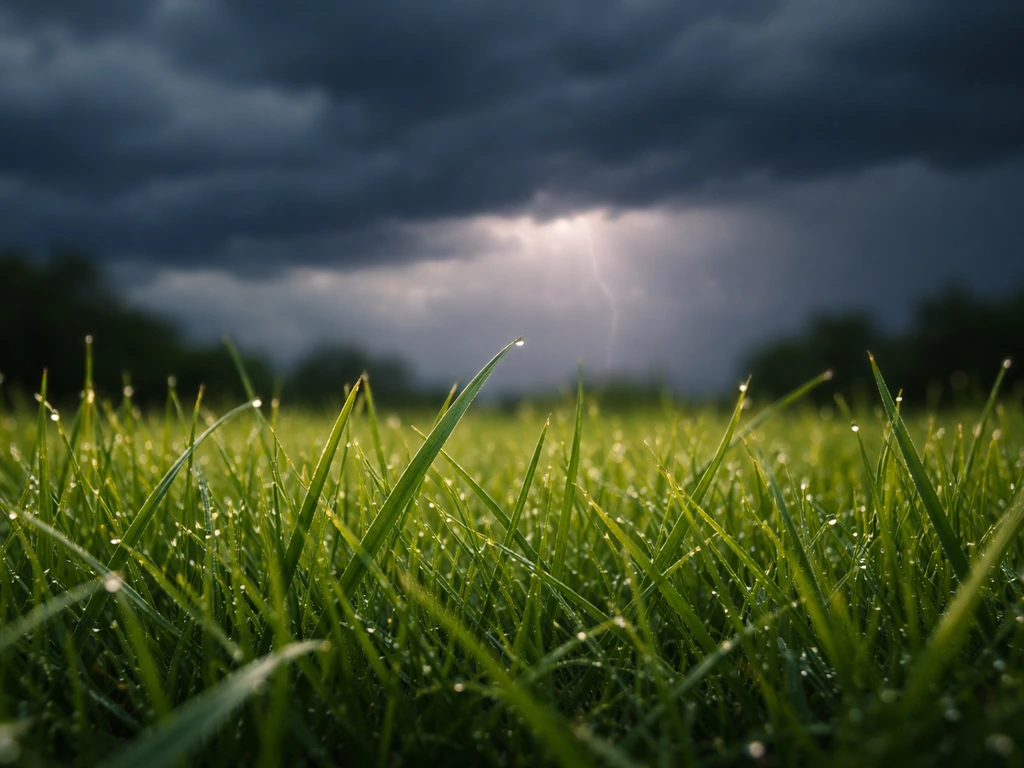
There is real science behind this one. Lightning converts atmospheric nitrogen (N2) into nitrogen oxides, which dissolve in rainwater and fall as weak nitric acid, providing a small dose of bioavailable nitrogen. Studies estimate lightning fixes roughly 5 to 8 million metric tons of nitrogen globally per year. At the scale of your lawn, a single storm's contribution is minimal, but over a season it is not zero. The greening effect people notice after a thunderstorm is real, though most of it comes from the rain itself, lower ET conditions, and the nitrogen boost together, not lightning alone. For more detail on lightning's role in fertilizing lawns, see does lightning help grass grow.
When to test, aerate, overseed, replace, or call a pro
Not every drought-stressed lawn needs the same response. Here is how I think through the decision.
Soil test first
If your lawn repeatedly struggles despite adequate watering, a soil test is the first thing I would do before spending any money on amendments. A basic test from your state's cooperative extension lab costs $15 to $25 and tells you pH, organic matter content, and major nutrient levels. It removes all the guesswork from lime and fertilizer decisions and can save hundreds of dollars in misapplied amendments.
Aeration timing
Core aerate in the active growing season for your grass type: late summer to early fall for cool-season grasses, late spring to early summer for warm-season. Aerating during heat or drought stress compounds the damage. Wait for moderate temperatures and do it when the lawn has some soil moisture so cores pull cleanly.
Overseeding vs. full replacement
If more than 50 percent of your lawn area is dead (failed the tug test), overseeding on top of dead material will give you a poor result. At that point, scalping, killing remaining vegetation, and starting with fresh seed or sod is faster and more cost-effective. If damage is patchy and under 50 percent, overseeding after aeration in the appropriate season will fill in without a full renovation.
When to call a pro
Call a certified turfgrass professional or your local extension service when: your soil test results are confusing; you are seeing recurring disease or pest symptoms that drought stress may be masking; you have drainage or grading problems that are causing both drought stress in high spots and waterlogging elsewhere; or you are considering converting to a drought-tolerant alternative that requires herbicide renovation. These are not DIY-first situations.
Quick reference: fast fixes vs. long-term fixes
| Action | Type | Timeline | Best For |
|---|---|---|---|
| Deep, early-morning irrigation | Quick fix | Immediate | Actively stressed or dormant turf |
| Raise mowing height | Quick fix | Immediate | All stressed lawns |
| Apply wetting agent | Quick fix | Days | Hydrophobic or heavily thatched soils |
| Pause nitrogen fertilizer | Quick fix | Immediate | Preventing further stress in drought |
| Limit foot traffic on stressed areas | Quick fix | Immediate | Reducing physical damage during drought |
| Core aeration | Medium-term | 1 to 2 weeks recovery | Compacted soils limiting infiltration |
| Dethatch | Medium-term | 1 to 2 weeks recovery | Thatch over 12 mm blocking water uptake |
| Compost top-dressing | Long-term | 2 to 3 seasons | Building AWC in sandy or depleted soils |
| Biochar amendment | Long-term | 1 to 2 seasons | Sandy soils with very low AWC |
| Overseed with drought-tolerant variety | Long-term | 1 growing season | Replacing poorly adapted species |
| Install drip or subsurface drip irrigation | Long-term | Permanent improvement | High-efficiency water delivery |
| Lime application (after soil test) | Long-term | 3 to 6 months to full effect | Acidic soils below pH 6.0 |
| Full lawn renovation and species change | Long-term | 1 full season | More than 50% dead turf or wrong species for climate |
Your next three steps
If you have read this far, you probably have a lawn that is struggling right now or one you want to make more drought-resilient before the next dry stretch. Here is the shortest useful path forward.
- Order a soil test through your state's cooperative extension service: it is cheap, fast, and tells you whether lime, organic matter, or specific nutrients are the underlying issue limiting your grass's drought recovery
- Plan your irrigation: decide whether your current setup (sprinklers, manual, soaker hoses) is matched to your lawn's water needs; if you are applying 1 to 1.5 inches per week and still seeing stress, infiltration (compaction or thatch) is the real problem, not the volume of water
- Choose the right seed for next overseeding season: if you are on a warm-climate warm-season lawn, look at bermudagrass or zoysia; if cool-season, tall fescue or a fine fescue blend will carry you through drought better than straight Kentucky bluegrass or ryegrass — make that switch during the next appropriate seeding window
Grass absolutely can grow without rain. The question is whether you are setting it up with the soil depth, root system, species choice, and water alternatives it needs to make that work. See does grass grow when it rains for a short Q&A on how rainfall timing affects turf growth. Get those pieces in place and a rainless stretch becomes a manageable inconvenience instead of a lawn crisis.
FAQ
Short answer — can grass grow without rain?
Yes. Grass can survive and continue limited growth without rainfall by using stored soil moisture, groundwater or capillary rise, and non‑precipitation inputs (dew, fog, high humidity). However, growth rate, color, and density decline as soil moisture is depleted; prolonged dry conditions can force reversible dormancy or cause permanent damage if roots and crowns dry out.
How do non‑rain water sources support grass?
Natural and artificial sources include: 1) Stored soil moisture — the main short‑term source; available water capacity (AWC) determines how long grass can draw on it. 2) Groundwater/capillary rise — finer soils transmit more capillary water upward than coarse sands. 3) Dew, fog and foliar water uptake — can contribute small but sometimes meaningful amounts (typical dewfall 0.1–0.7 mm per event in some dry regions). 4) Irrigation, greywater or reclaimed water — reliable artificial inputs subject to local regulations. 5) Subsurface moisture from irrigation systems (subsurface drip) that reduce evaporation losses.
What limits grass growth without rain?
Key limiting factors: 1) Soil texture and AWC — sandy soils hold less plant‑available water than loams/clays. 2) Rooting depth and species — deep‑rooting species (tall fescue, bermudagrass in warm climates) access deeper moisture. 3) Temperature and evapotranspiration — hot, windy, sunny conditions raise water loss; reference ET methods quantify this. 4) Evaporation from the soil surface and canopy interception losses. 5) Length of dry spell — longer droughts surpass stored water reserves. 6) Management practices (mowing height, fertilization) that influence root vigor.
Does rain speed grass growth?
Yes — rainfall supplies soil moisture that increases available water for uptake, so after rain grass often green‑up and faster leaf production occur. The growth response magnitude depends on antecedent soil moisture, species, temperature and season; small rains may only maintain turf but larger, deeper‑soaking events restore growth more substantially.
Do humidity and cloudy days help grass during dry spells?
High humidity and cloudy weather reduce evapotranspiration and can lower plant water stress, slowing moisture loss and preserving soil moisture. Dew and fog (more likely during humid or calm nights) can supply small volumes of water to leaves and soil surface and help rehydrate canopies, but they rarely replace the volume supplied by meaningful rainfall or irrigation.
Can lime, urine, or lightning make grass grow without water?
No, not in any practical sense. Lime adjusts soil pH slowly and can improve nutrient availability if pH is limiting, but it does not provide water. Urine supplies nitrogen and salts; small, diluted applications can fertilize but concentrated urine can burn turf and does not substitute for water. Lightning does not reliably provide usable water or growth stimulation. None of these replace the need for adequate soil moisture.
Next Articles
Does Grass Grow on Cloudy Days? Lawn Growth Tips
Yes, grass grows on cloudy days but slower. Learn how light, soil, water, mowing, and grass type affect growth.
Does Rain Help Grass Grow? Germination and Establishment Tips
How rain and irrigation affect grass seed germination and early growth, plus actionable timing and troubleshooting tips.
Does Lightning Help Grass Grow Faster? What to Do Instead
Does lightning boost grass growth? Mostly no, and not faster. Get today’s steps to fix soil, water, aeration, and seedin