The phrase 'blank" rel="noopener noreferrer">grass doesn't grow on a busy street' is an old proverb that means roughly the same thing whether you heard it from a grandparent or stumbled on it in a 1939 issue of Elks Magazine: constant activity, traffic, and commotion leave no room for growth or stillness. It's used figuratively to describe people, places, or situations too hectic to allow anything to take root and flourish. But if you landed here because you're staring at a bare, brown, compacted strip of lawn near a road and wondering why nothing will grow there, you're dealing with a very real, very fixable (or at least manageable) problem that goes well beyond metaphor.
Grass Doesn’t Grow on a Busy Street Meaning and Fixes
Marcus Volkmann
21 Jun 2026
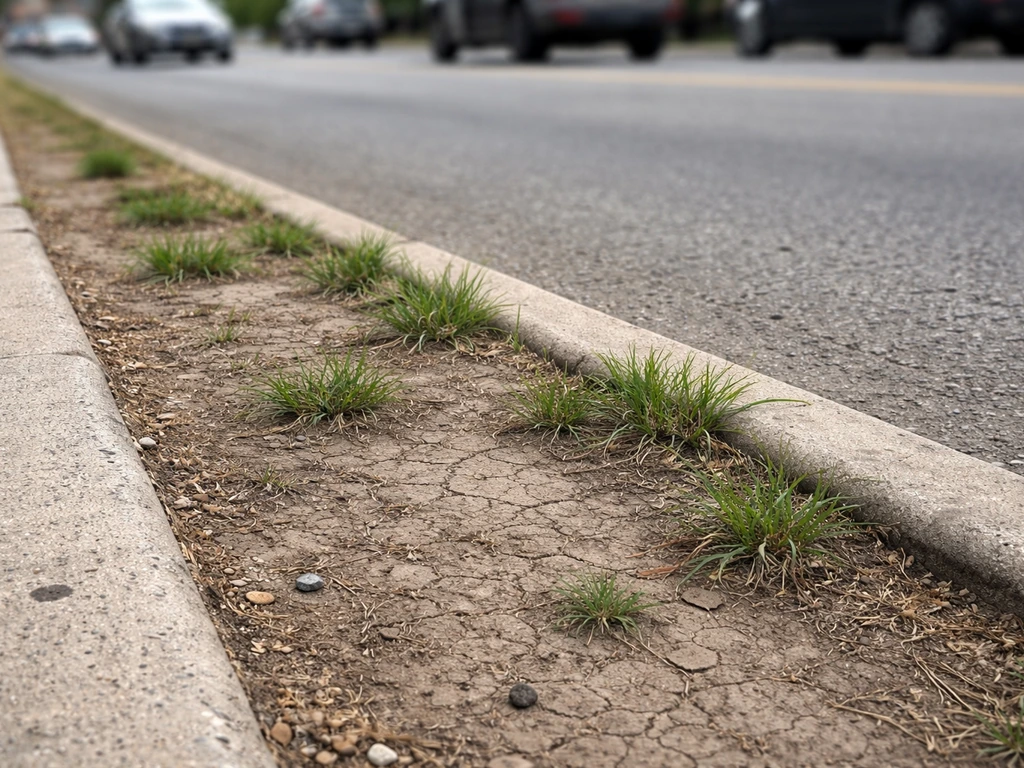
The idiom vs. the actual lawn problem
The proverb works because it's literally true. Heavy foot traffic and vehicle activity physically destroy grass. The saying has been used figuratively since at least the early 1900s to suggest that a busy, constantly churned-up place can't support quiet growth, whether that means a person who never slows down or a neighborhood too chaotic for community. GardenerBible frames it as a reminder that fulfillment sometimes requires stillness and space, not perpetual motion.
If you're here for the figurative meaning only, that's it: too much activity crowds out growth. But most people searching this phrase are frustrated homeowners who literally cannot get grass to establish along their street edge, driveway apron, or sidewalk strip. The rest of this guide is for you.
Why grass actually fails near busy streets
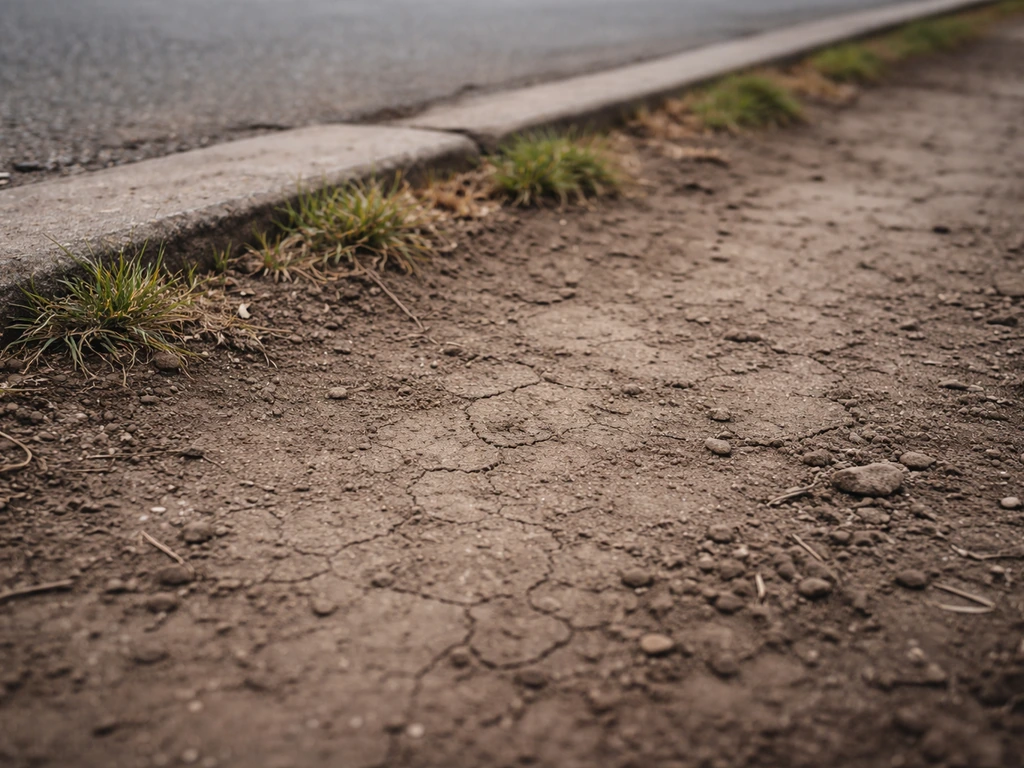
Street-edge grass fails for a cluster of reasons that almost always overlap. Understanding which ones are hitting your lawn is the key to not wasting money on seed or sod that will die in the same spot for the third time.
- Soil compaction: Vehicles parked on or driving across the verge, plus pedestrian foot traffic cutting corners, compress soil particles together until there's almost no pore space left. Grass roots need oxygen and water to move through the soil. When bulk density climbs above roughly 1.6 g/cm³ in loam soils, root penetration becomes nearly impossible.
- Salt and de-icing chemicals: Road salt (sodium chloride) and calcium/magnesium chloride blowback from the road surface and snowplow spray accumulates in the top few inches of soil. Even a moderate salt buildup raises soil osmotic pressure, essentially pulling water out of plant roots instead of letting them absorb it. This is called physiological drought, and it looks just like heat stress or under-watering.
- Exhaust and airborne pollutants: Heavy particulate matter, ozone, and nitrogen dioxide from vehicle exhaust create oxidative stress in turfgrass leaves. Over time, chronic exposure suppresses growth even when soil conditions are otherwise decent.
- Heat and pavement reflection: Asphalt and concrete radiate heat. Surface temperatures along curb strips can run 15 to 25°F hotter than open lawn areas during summer afternoons, desiccating young seedlings and stressing established turf.
- Thin or contaminated topsoil: During road construction or repaving, contractors often strip or bury the original topsoil. What's left at the surface can be compacted subsoil, gravel fill, or construction debris with almost no organic matter or microbial life.
- Mechanical damage: Mower scalping, string trimmer hits, parking overhang, and utility vehicle access all physically tear or shear grass repeatedly before it can knit together.
- Shade from structures and signs: Fencing, walls, utility poles, and overhead signage can create persistent shade on narrow street strips, cutting the light grass needs to recover from everything else on this list.
This is why the problem is so persistent. It's rarely just one thing. If your grass isn't growing in the backyard either, that's a separate issue with its own diagnosis. But the street edge is uniquely brutal because every single factor on that list tends to hit simultaneously.
Quick on-site diagnosis you can do right now
Before you spend anything, spend 20 minutes doing these checks. They'll tell you which problems are dominant and point you toward the right fixes.
- Screwdriver test for compaction: Push a standard flathead screwdriver into the soil by hand. If it won't penetrate more than 2 to 3 inches without real effort, you have severe compaction. Normal healthy lawn soil should allow 6 inches of easy penetration.
- Water infiltration check: Dig a small hole about 12 inches deep, fill it with water, and let it drain completely. Fill it again and time how long it takes to drain. More than 4 hours to drain the second fill means serious drainage or compaction problems.
- Soil smell and color: Pull back any dead thatch or debris and look at the top 2 inches of soil. Gray, white, or orange-streaked soil suggests either salt damage, poor drainage, or fill material. Healthy soil is dark brown and has an earthy smell. A sour or sulfur smell means anaerobic conditions from waterlogging.
- Salt residue: Look for white crusty deposits on the soil surface near the curb line, especially in late winter and early spring. That's sodium or calcium chloride crystallizing out of the soil as it dries. If you see it, salt is a primary problem.
- pH test: Grab an inexpensive soil test kit from any hardware store or send a sample to your local cooperative extension. Salt-affected and road-adjacent soils often run above pH 7.5 or below pH 5.5, both of which lock out nutrients grass needs.
- Traffic observation: Watch the area for one day. Where are people actually walking? Where do vehicles overhang or pull up? The bare paths will tell you exactly where compaction resets happen constantly.
Fixing the soil before you plant anything
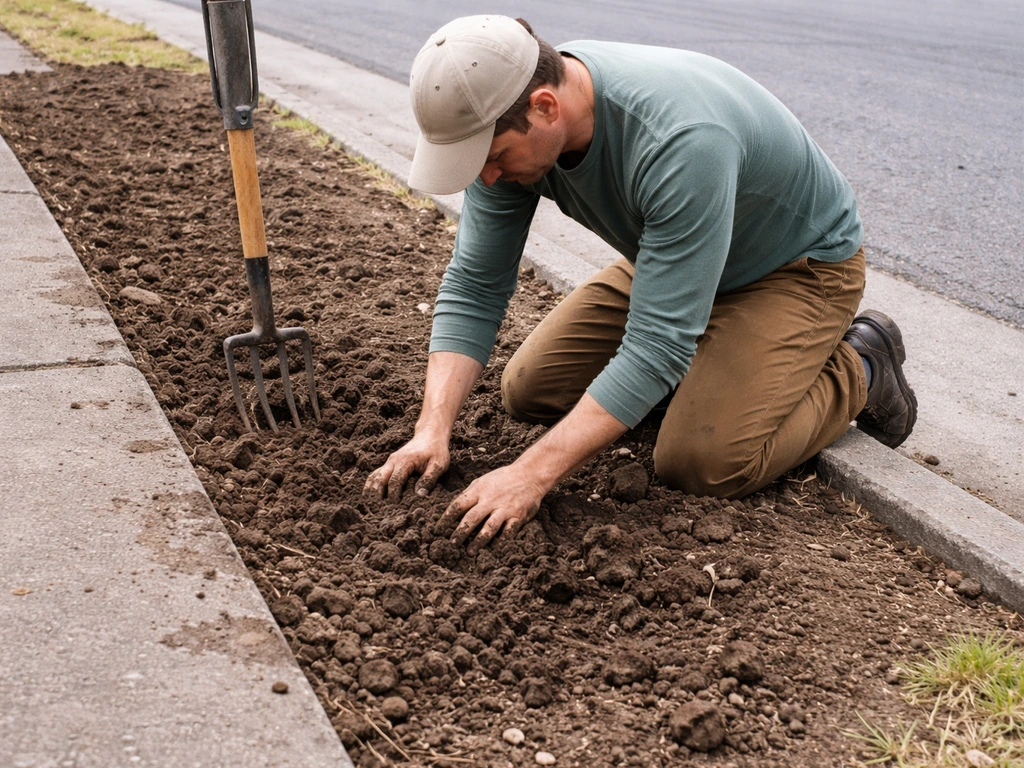
Planting into broken soil without fixing the underlying problems is the number one reason people keep repeating this failure. The fixes don't have to be expensive, but they do have to come first.
Decompaction and aeration
For mild to moderate compaction, a core aerator (available to rent for around $75 to $100 per half day) pulls 2 to 3 inch plugs of soil and leaves channels for air, water, and roots to penetrate. Run it in two perpendicular passes for maximum effect. For severely compacted or construction-fill soil, you may need to go further: rent a subsoiler or vertical tine aerator, or hire someone to deep-till the area to 8 to 10 inches and incorporate organic matter before re-grading. If the ground is too hard to even get a core aerator to penetrate, try watering the area deeply 24 hours before aerating.
Amendments for salt, pH, and poor organic matter
For salt-affected soil, the first step is flushing. Apply 2 inches of water across the zone, let it drain, and repeat two or three times over a week. This leaches sodium down below the root zone. Follow that with gypsum (calcium sulfate) at about 40 pounds per 1,000 square feet. Gypsum displaces sodium on soil particles and helps the salt leach without raising pH the way lime would. For pH that's too high (above 7.5), elemental sulfur brings it down; for pH below 5.5, pelletized lime brings it up. Target pH 6.0 to 7.0 for most turfgrasses. Regardless of what else you do, work in 2 to 3 inches of quality compost before planting. In stripped or fill-contaminated zones, you may need to bring in 4 to 6 inches of screened topsoil mixed with compost and till it into whatever's there. Don't skip this step: organic matter is what allows soil biology to function, and street-edge soils are almost always biologically dead.
Drainage improvements
If water pools in the area after rain, you either have a grading problem or a drainage restriction below the surface. For narrow curb strips, a simple crown grade (slightly higher in the middle than at the edges) helps shed water toward the curb rather than pooling. For persistent wet spots, a small French drain running parallel to the street edge can redirect water without major excavation.
The best grasses and alternatives for street-edge conditions
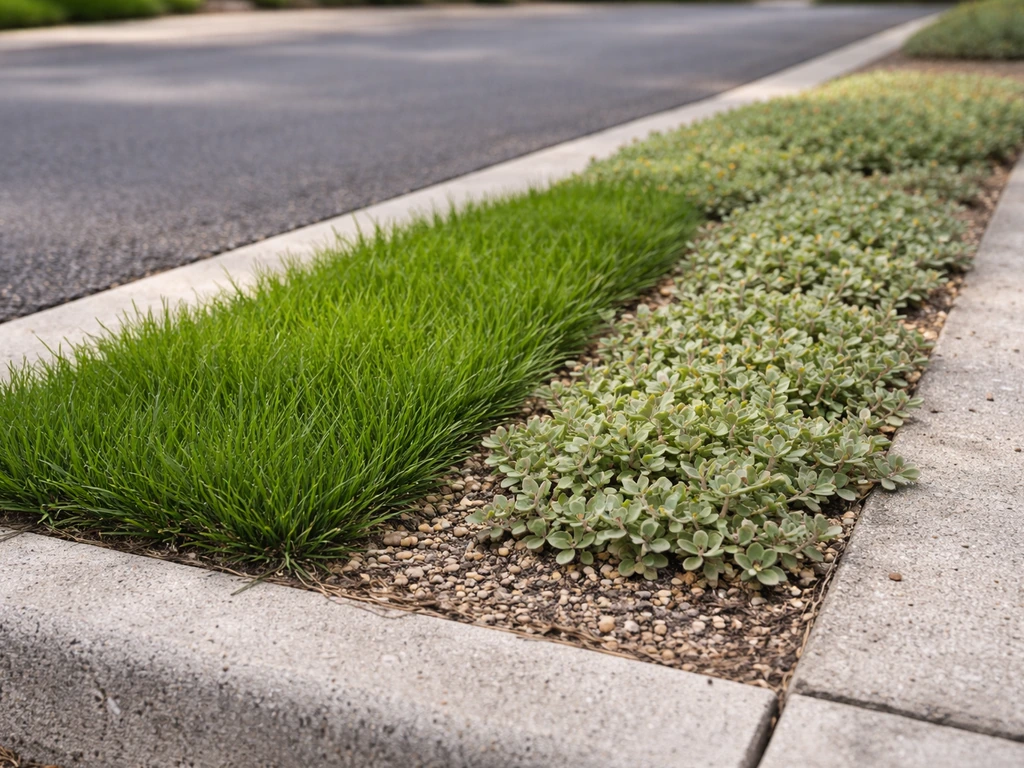
Not all grass species handle this abuse equally. Choosing the wrong species is another common reason street-edge grass fails repeatedly. Here's how the main options stack up.
| Species / Option | Traffic Tolerance | Salt Tolerance | Heat Tolerance | Best Climate Zone |
|---|---|---|---|---|
| Tall Fescue | High | Moderate | Moderate-High | Transitional/Cool-season |
| Bermudagrass | Very High | Moderate-High | Very High | Warm-season (Zones 7-10) |
| Zoysiagrass | High | High | High | Warm-season (Zones 6-10) |
| Perennial Ryegrass | Moderate-High | Low | Low-Moderate | Cool-season |
| Kentucky Bluegrass | Moderate | Low | Low-Moderate | Cool-season (Zones 3-6) |
| Buffalograss | Moderate | Low-Moderate | Very High | Warm/Semi-arid (Zones 4-8) |
| Creeping Red Fescue | Low-Moderate | Moderate | Low | Shade/Cool-season |
| Clover (white clover) | Moderate | High | Moderate | Most zones |
| Creeping thyme | Moderate | High | High | Zones 4-9 |
| Artificial turf | Unlimited | N/A | N/A (hot surface) | Any |
For most homeowners in transitional or cool-season climates, tall fescue is the go-to: it's the most forgiving grass for street-edge stress, with deep roots that handle both drought and moderate salt. In warm-season zones, zoysia is worth the extra cost because its density and lateral spread mean it outcompetes weeds and recovers from traffic damage faster than bermudagrass in typical residential use. If your strip is very narrow (under 18 inches), extremely exposed, or takes constant vehicle overhangs, consider bypassing grass entirely. Low-growing, salt-tolerant groundcovers like creeping thyme or white clover can handle conditions that kill any turfgrass, need far less maintenance, and still look intentional. White clover is particularly underrated: it fixes nitrogen, tolerates compaction and salt, stays green through summer drought, and handles light foot traffic without complaint.
Seed, sod, or groundcovers: which installation method works here
Seeding
Seeding is the cheapest option but the riskiest in high-stress street-edge zones. Seed needs 4 to 8 weeks of relatively undisturbed moisture and low traffic to germinate and establish. That's hard to guarantee near a busy street. If you seed, use a starter fertilizer (high phosphorus, around 10-20-10), cover with erosion-control blanket or straw, and water lightly twice daily for the first two to three weeks. The best windows are early fall (late August through mid-October for cool-season grasses) when temperatures are moderate and rain is more reliable, or spring once soil temperatures consistently hit 55°F for cool-season and 65°F for warm-season varieties.
Sod
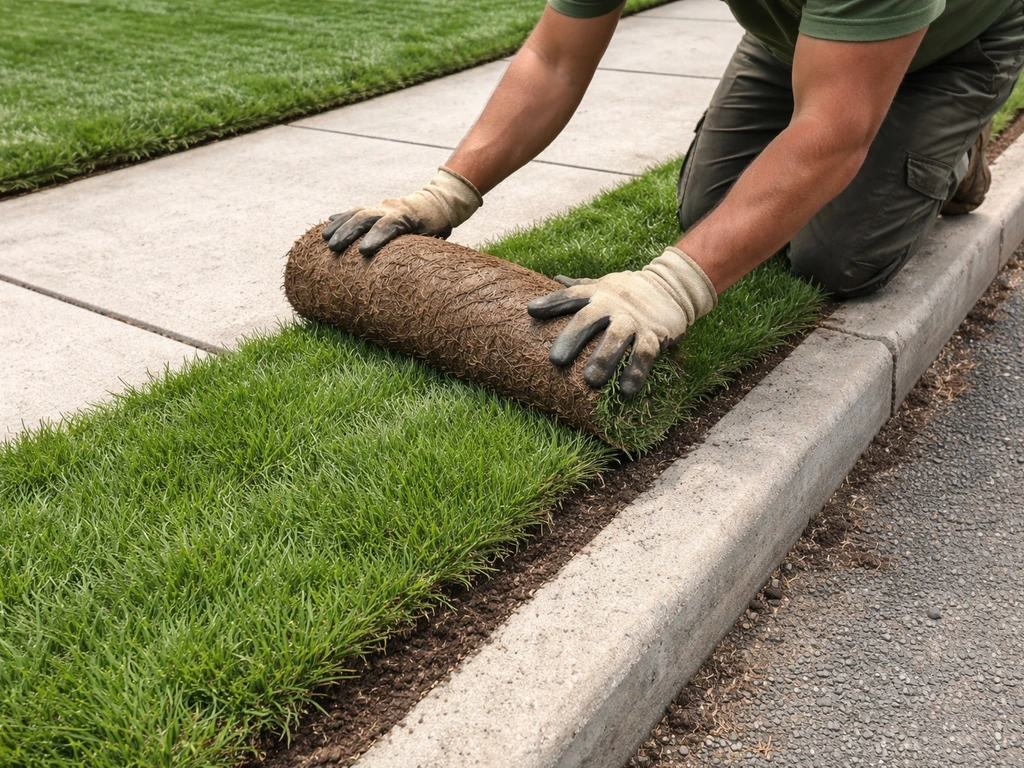
Sod is significantly more expensive (typically $0.35 to $0.85 per square foot plus installation) but gives you an established surface in two to three weeks instead of two to three months. For street-edge zones that can't be kept off-limits long enough for seed to establish, sod is often the smarter investment. Press it firmly against the soil, stagger the seams, and water it heavily every day for the first two weeks, then taper off. Don't let anyone walk on it for at least three weeks, and check the edges daily since they dry out fastest.
Groundcovers and alternative surfaces
If you've tried grass twice and it's failed both times, take that as the site telling you something. Groundcovers planted as plugs or flats (creeping thyme, sedum, clover, or ajuga) establish with far less coddling and cost less to maintain. Mulched beds with ornamental grasses or low shrubs can also work well for wider strips. In the most extreme cases, a permeable paver system or engineered gravel edge eliminates the problem entirely without the maintenance overhead. Artificial turf is an option for very narrow strips where appearance matters more than ecology, though it can generate surface heat even higher than asphalt on hot days.
Establishment care and long-term maintenance
The first 60 days
This is where most street-edge plantings fail: the homeowner does all the right prep work, then lets foot traffic resume too soon or forgets to water during a dry spell in week three. Use physical barriers during establishment. Simple wooden stakes with bright flagging tape, small wire fencing, or even a row of decorative edging blocks are enough to redirect pedestrian traffic. Put up a polite sign if needed. Water new seed or sod consistently: for seed, light and frequent (twice daily if no rain) until germination, then deep and less frequent once you see growth. For sod, deep daily watering for two weeks, then back off to encourage deep rooting. Hold off on fertilizing newly seeded areas until after the second mowing; too much nitrogen early on pushes top growth at the expense of roots.
Seasonal maintenance for street-edge turf
- Aerate every fall (cool-season) or late spring (warm-season) to counteract ongoing compaction from the street environment.
- Top-dress with a thin layer (0.25 inches) of compost annually to keep building organic matter in depleted soils.
- Overseed thin or bare spots each fall or spring before they become bare patches large enough for weeds to dominate.
- Apply gypsum each spring in regions with heavy winter road salt use, and flush the area with water as soon as the ground thaws.
- Mow high: keep grass at the top of its recommended height range (3 to 4 inches for tall fescue, 1.5 to 2 inches for zoysia). Taller grass shades its own roots, retains moisture better, and tolerates stress more effectively.
- Water deeply and infrequently once established: 1 to 1.5 inches per week total, applied in one or two deep sessions rather than daily shallow watering, to drive roots downward away from the compacted surface.
- Avoid high-nitrogen fertilizer during heat stress or drought: it pushes soft, vulnerable top growth. A balanced slow-release formula (like 16-4-8) applied in fall is better for street-edge turf than heavy spring feeding.
When grass keeps failing: realistic expectations
There are situations where grass is simply not a sustainable long-term solution. If your strip is narrower than 18 inches, receives daily vehicle overhang, sits directly adjacent to a road that's heavily salted every winter, or is compacted by foot traffic you genuinely cannot redirect, you're fighting the same battle the idiom describes. The ground is too busy for grass to grow. The key is recognizing when the site is too busy or stressful for grass to establish, and then choosing a better surface or groundcover The ground is too busy for grass to grow. That's not a failure of effort; it's an honest environmental assessment. In those cases, the practical advice is to switch to a groundcover, a mulched bed, or an engineered surface rather than repeating the same expensive cycle. Problems like can't grow grass in a zone at all, or ground being too hard and compacted for any establishment, are worth addressing at the system level rather than just trying harder with the same approach.
If you do want to keep trying with grass, document what's happening. Take photos of the same spot each month, note when you water and fertilize, and check for salt crust or new compaction events after heavy traffic periods. That record will tell you whether you're making progress or whether the site conditions are resetting faster than any grass can keep up with. Sometimes the honest answer is that the proverb got it right, and the solution isn't a better grass seed but a better surface.
FAQ
If the lawn looks green in other parts of my yard, why does the street-edge strip fail first?
The street edge often gets the worst combined stress, compaction from foot traffic, splash salt from vehicles, and faster drying from wind and sun exposure. Even if your backyard soils support grass, the curb strip can have a different soil fill mix, lower organic matter, and more hard-packed texture, so it fails earlier and shows symptoms sooner.
How can I tell whether the issue is salt, pH, or drainage before I buy anything?
Do two quick tests. First, check for salt crust or white residue after winter storms, especially in low spots. Second, watch where water goes after rain, if it pools for more than 30 to 60 minutes, drainage restriction is likely. For pH, a basic soil test is usually the only reliable shortcut, since pH problems can mimic nutrient issues that look similar to drought or poor germination.
Should I aerate and add compost right away, or after flushing salt and adjusting pH?
If salt is suspected, flush first so you are not simply trapping sodium into the new organic matter. After flushing and any pH adjustment, then aerate and incorporate compost so roots grow into healthier soil biology. Aerating before addressing salt can spread contaminated soil further into the root zone if the site is very salty.
Is gypsum really necessary if my soil test shows high sodium, or can I just keep watering?
Gypsum helps move sodium off soil particles by improving soil structure so water can leach it down. Simple watering can work, but it may be slower or less effective if the soil structure is already degraded by sodium. Also, you still need enough drainage to carry the sodium beyond the root zone, otherwise repeated watering just keeps salts cycling near the surface.
What’s a common mistake with watering new grass on the street edge?
Overwatering lightly, which keeps the top inch wet while roots stay shallow. For seed, you want consistent moisture during germination, then shift to deeper, less frequent watering once growth appears. If sod dries at the edges first, it usually means seams are not sealed tightly enough or the watering pattern is missing the margins.
How long should I keep people off newly seeded or sodded areas near a road?
For seed, plan on keeping traffic off for at least the first 4 to 6 weeks, since young seedlings are easily uprooted before they develop strong anchoring roots. For sod, the article’s minimum hold-off is about three weeks, and in street-edge conditions it can take longer if daily pedestrian traffic is unavoidable, use barriers during that entire establishment window.
Can I seed in spring or should I wait for fall every time?
Fall is usually the safer choice for cool-season grasses because it combines moderate temperatures with more reliable rainfall. Spring seeding can succeed when soil temperatures are consistently warm enough and you can provide controlled watering during dry spells, but it is more vulnerable to summer heat once seedlings are still thin.
When should I stop trying grass and switch to a groundcover or pavers?
Switch when the site repeatedly resets before roots can establish, for example, narrow strips under about 18 inches, daily vehicle overhang, heavy annual road salt exposure, or foot traffic you cannot realistically redirect. If two full planting cycles fail even after correcting compaction and drainage, the groundcover or engineered surface option is usually the more cost-effective long-term move.
My soil tests show both low fertility and compaction, what should I fix first?
Fix physical constraints first, compaction and drainage, then correct fertility. If you apply fertilizer into compacted or biologically dead soil, you may get temporary top growth with weak rooting, which makes the strip more vulnerable to traffic and drought. Once the soil structure is improved, nutrients actually support root development.
Do I need to fertilize right away when I install sod or seed?
Seed benefit depends on establishment timing, too much nitrogen early can push leaf growth before roots anchor, so hold off on heavy fertilization until after you have visible establishment and after the second mowing as a general rule. For sod, focus on consistent watering first, then fertilize later once roots knit into the soil, since stressed sod will not use nutrients efficiently.
How do I prevent weeds if I use groundcovers like clover or thyme instead of turfgrass?
Keep the soil covered and reduce bare spots during establishment. If you use clover, avoid aggressive mowing too early, since young clover needs time to form a dense canopy that outcompetes weeds. For thyme or similar groundcovers, ensure soil prep is done thoroughly first, then use edging to prevent soil disturbance that brings weed seeds back to the surface.
What records should I keep to identify the real cause over time?
Track three things in the same spot, weekly photos, watering schedule (including whether rainfall occurred and how much), and any evidence of salt or new compaction after busy days. If growth never progresses month to month or keeps thinning after certain weather or traffic events, it usually points to an unresolved drainage, salt, or access-control problem rather than a seed choice problem.
Next Articles
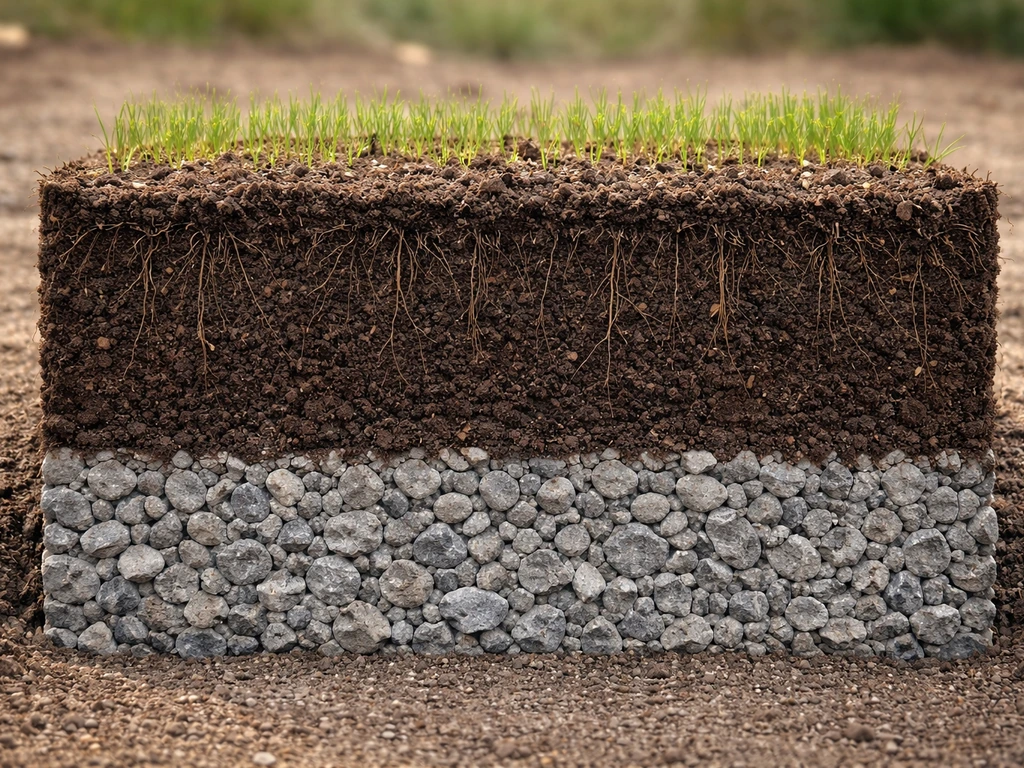
Can You Grow Grass Over Gravel? How to Do It Right
Learn when you can grow grass over gravel and follow a step-by-step method for soil depth, drainage, seeding or sod, and
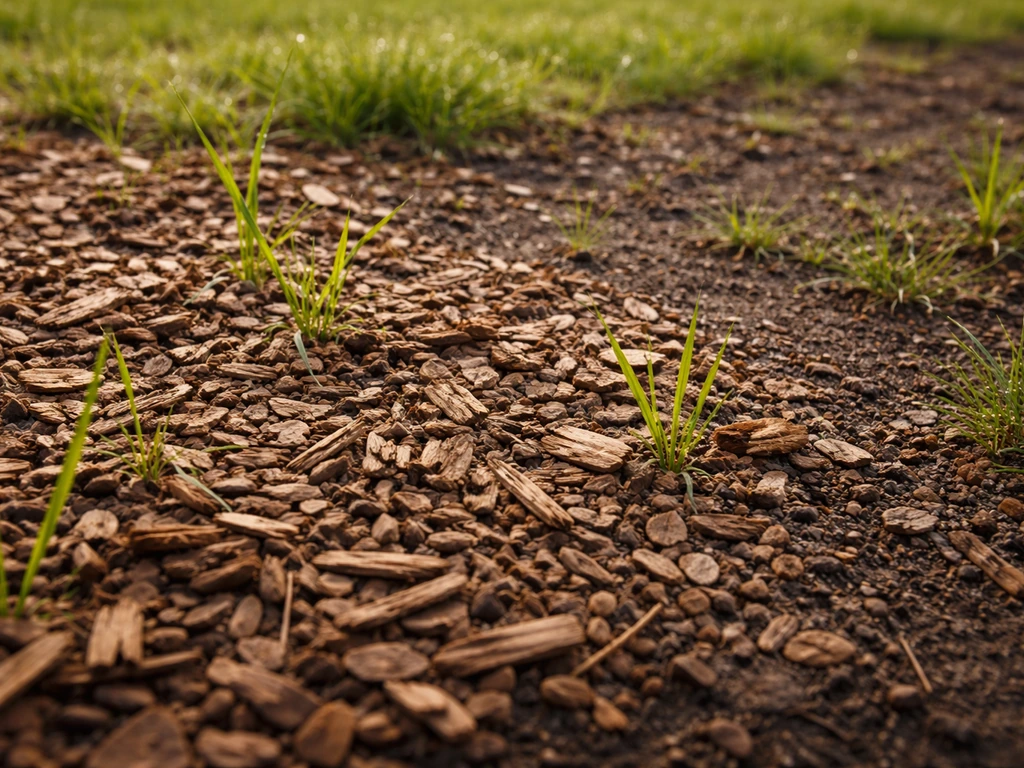
Do Wood Chips Help Grass Grow? When They Work and When Not
Learn when wood chips help grass grow, when they steal nitrogen, and step-by-step how much to apply and seed options.

Will Potting Soil Help Grass Grow? What Works and What Fails
When potting soil helps grass grow, when it fails, and how to prep, apply, seed, water, and troubleshoot bare spots.