Grass can grow under redwood trees, but only under specific conditions and with the right species. Fine fescues are your best bet, and even they require meaningful canopy thinning, pH correction, and patient soil prep before you'll see anything worth calling a lawn. If you're working under a mature, closed-canopy redwood with thick needle duff and dense surface roots, be honest with yourself early: there's a real chance a groundcover or mulch bed will serve you better. For partially shaded edges or younger trees with gaps in the canopy, a fine fescue planting can genuinely work.
Can Grass Grow Under Redwood Trees? Practical Guide for Homeowners & Gardeners
Marcus Volkmann
20 Jul 2026
Why grass struggles under redwoods
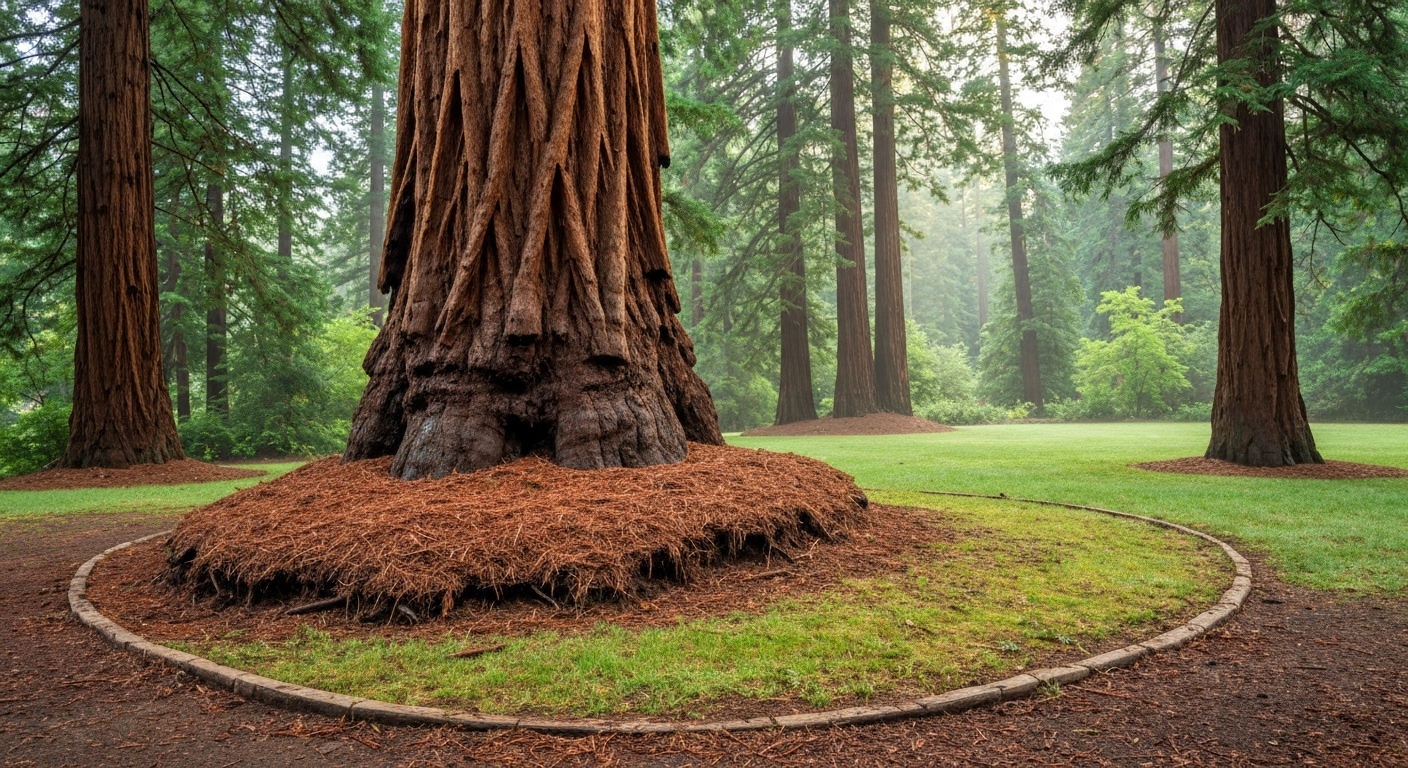
Every factor that makes redwoods magnificent as trees also makes the ground beneath them hostile to turf. It isn't just shade, though that's where most people start their diagnosis. The real problem is that redwoods stack multiple obstacles on top of each other, and turf has to fight all of them simultaneously.
Light: the primary killer
Coast redwoods (Sequoia sempervirens) produce some of the highest leaf area index values measured in any forest system, with reported projected LAI values exceeding 14 in mature stands. That translates to a canopy that blocks nearly all usable light. Field studies measuring photosynthetic photon flux density (PPFD) under closed-canopy redwood plots find values around 302 µmol·m⁻²·s⁻¹, compared to roughly 561 µmol·m⁻²·s⁻¹ in gap plots where thinning has opened the canopy. For turf, what matters is the daily light integral (DLI), the total amount of photosynthetically active light a plant receives over a full day. Most cool-season turfgrasses begin to struggle below about 4 mol·m⁻²·d⁻¹ DLI, and warm-season grasses like bermudagrass need significantly more than that. Under a mature, uncut redwood canopy, you're almost certainly below those thresholds for most of the year.
Shallow roots that steal water and nutrients
Redwoods don't have a deep taproot. Instead, they develop wide, shallow lateral roots concentrated in the top 12 inches (30 cm) of soil, spreading laterally for tens of meters and frequently interlocking with neighboring trees. That's exactly where turf roots live. The competition is direct: redwood roots are pulling water and nutrients from the same thin zone your grass depends on, and they win that competition every time because of sheer root mass and tree priority.
Needle duff and soil chemistry
Redwood litter, needles, and woody tissue are rich in lignin, tannins, and aromatic terpenoids. These compounds decompose slowly and have been shown in lab studies to suppress soil nitrogen mineralization and aspects of nitrification. Over time this builds a persistent duff layer that physically smothers turf seedlings and shifts soil pH downward. Most turfgrasses want soil pH in the 6.0–7.0 range. Under a redwood that has never been managed, you can easily find pH values below 5.5, sometimes well below. That level of acidity locks up phosphorus and creates aluminum and manganese toxicity issues that no grass variety can fully overcome without soil correction.
Compaction and moisture extremes
Redwood forest soils near mature trees are often compacted, especially if there has been any construction activity or foot traffic nearby. Research on California redwood soils found that mechanical disturbance measurably raises surface bulk density and reduces infiltration in the top 5 cm of soil. USDA Forest Service research 'Impacts on soils and residual trees from cut‑to‑length thinning operations in California's redwood forests (USDA Forest Service research)' documents that mechanical disturbance from logging and forwarder traffic raises surface bulk density and reduces infiltration in the 0–5 cm layer. At the same time, redwood canopies intercept substantial rainfall, which means the soil under the drip line can cycle between drought stress during dry periods and temporary saturation when rains penetrate. Turf establishment in that kind of variable moisture environment is genuinely difficult.
How redwood roots and canopy behavior punish competing plants
The canopy of a mature redwood isn't static. It intercepts fog drip and rainfall at the crown, then releases water unevenly across the understory. Directly under the trunk you may get almost no rain penetration; at the drip line edge you may get concentrated runoff. This uneven moisture distribution creates patchiness in turf even when you've done everything else right. Root competition makes this worse. Because redwood laterals spread so broadly and densely through the top foot of soil, any turf you establish in that zone is in constant resource competition. The tree's root system is also extremely sensitive to soil disturbance, particularly cuts or significant grade changes, which limits how aggressively you can amend soil without harming the tree itself. Deep tilling or roto-tilling within the drip line of a redwood is off the table. You're working with shallow amendments, aeration, and top-dressing, not a full soil renovation.
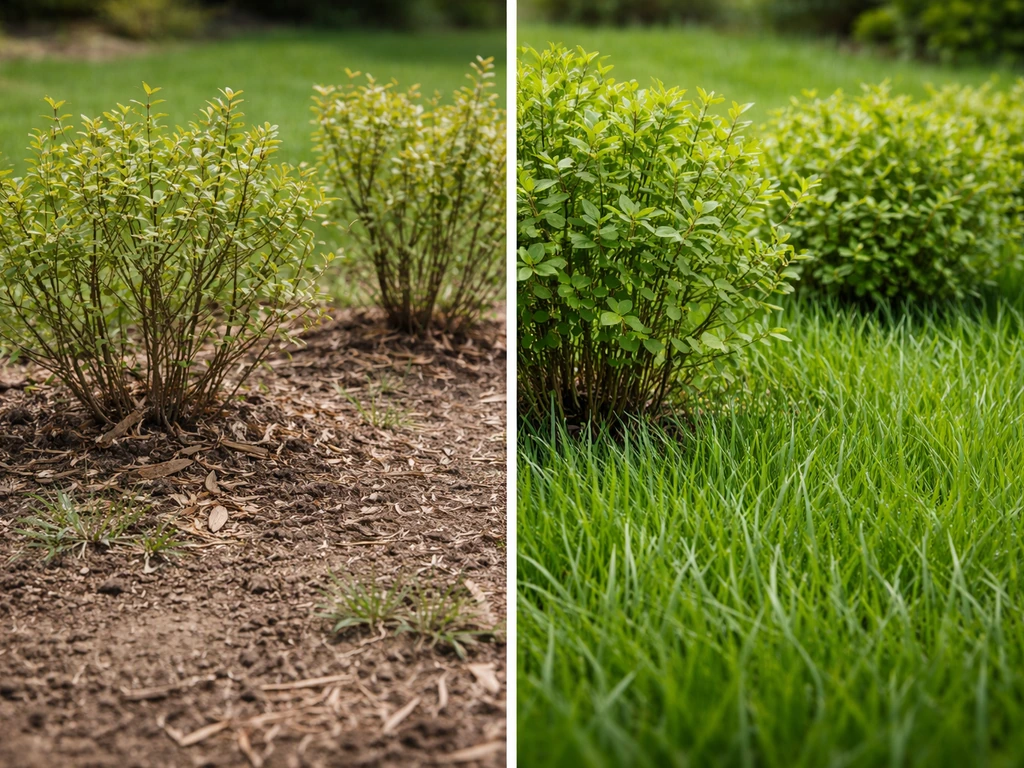
This also affects shrubs and other plantings, not just grass. The same light and root competition that stresses turf affects any plant you try to establish in that zone. If you've wondered why bushes and shrubs seem to struggle to get established before grass has a chance to fill in, the competition dynamic is essentially the same: the tree is the dominant competitor at every level, from canopy light to shallow soil resources. For a deeper explanation, see our guide on why can't bushes and shrubs grow before grass. The difference is that many shade-tolerant shrubs and groundcovers are better adapted to low-DLI conditions than any turfgrass variety is.
The best grass species to try under redwoods
The honest species shortlist for under-redwood planting is short. Fine fescues, specifically hard fescue, sheep fescue, creeping red fescue, and Chewings fescue, are the most shade-tolerant cool-season turfgrasses available. University extension research consistently ranks them at the top for low-light persistence. Turf-type tall fescue is the second-best option, tolerating moderate shade reasonably well, particularly at the sunnier edges of the drip zone. Perennial ryegrass and Kentucky bluegrass are poor choices under redwoods: they have fair to poor shade tolerance and will thin out and disappear within a season or two. For a mixed-shade situation where you get some filtered light through gaps, a tall fescue and fine fescue blend can give you better coverage across variable light conditions than either species alone.
Warm-season grasses like bermudagrass are not suitable for planting under redwoods. Bermudagrass has one of the highest minimum DLI requirements of any common turfgrass, needing levels well above what a redwood canopy provides. Even the most shade-tolerant bermudagrass cultivars will thin, discolor, and eventually die out under the chronic low-light conditions of a mature redwood. This holds true whether you're seeding or laying sod. If you're already growing bermuda elsewhere in your yard and thinking about extending it under a redwood tree, that's a project I'd steer you away from entirely. If you want more detail on whether bermudagrass will grow under trees, see will bermuda grass grow under trees for specific light and DLI requirements.
Species comparison: shade tolerance, root competition, and establishment
| Grass Species | Shade Tolerance | Root Competitiveness Under Tree | Establishment Difficulty | Recommended Use Under Redwoods |
|---|---|---|---|---|
| Fine fescue (creeping red, hard, Chewings, sheep) | Excellent | Moderate (shallow-rooted, but resilient) | Moderate | Best primary choice; 3–5 lb seed/1,000 sq ft |
| Turf-type tall fescue | Good | Moderate (deeper roots help somewhat) | Moderate | Good for partial shade edges; 5–7 lb seed/1,000 sq ft |
| Tall fescue / fine fescue blend | Good to Excellent | Moderate | Moderate | Best for variable-light zones with mixed shade |
| Perennial ryegrass | Fair | Low | Easy to establish, poor persistence | Not recommended; thins quickly in shade |
| Kentucky bluegrass | Poor | Low | Moderate to difficult | Not recommended under redwoods |
| Bermudagrass | Very Poor | Low | Will not persist in shade | Not suitable; avoid entirely |
| Zoysiagrass | Poor to Fair | Low | Slow establishment, poor under deep shade | Not recommended under mature redwoods |
Soil pH, nutrient targets, and how to amend under a redwood
Before you buy seed or sod, get a soil test. This is non-negotiable under redwoods because the needle duff almost certainly has pushed your pH below the 6.0–7.0 target range that most turfgrasses need. Take a composite of 10 to 15 soil cores from 3 to 6 inches deep across the planting area. Send them to a university extension lab or certified private lab and request pH, phosphorus, potassium, organic matter, and a buffer pH test so the lab can calculate lime rates. Do not apply lime without those lab-calculated rates. Blind liming is how people overshoot pH and create a new set of nutrient problems.
If your pH comes back below 6.0, which is common under redwoods, pelletized calcitic or dolomitic lime is the standard correction. Apply it at the lab-specified rate, typically expressed as pounds per 1,000 square feet, and incorporate it into the top 2 to 3 inches where you can do so without major root cutting. Surface application with gentle raking works for lighter rates. Phosphorus is often deficient in acidic, compacted under-tree soils, so if the lab flags a P deficiency, a starter fertilizer at seeding is appropriate. Nitrogen fertilization under fine fescues should be conservative: these grasses actually prefer lower fertility than typical lawn grasses, and pushing nitrogen in shade promotes disease and weak, spindly growth. Aim for about 1 to 2 pounds of nitrogen per 1,000 square feet per year for fine fescues under trees.
Step-by-step plan to grow grass under a redwood
Step 1: Honest site assessment
Stand under your redwood at midday in midsummer and look up. If the canopy is almost entirely closed with no visible gaps, and the area directly under the tree never gets more than an hour or two of filtered light, you're fighting an uphill battle. Mark where the lighter zones are, usually at the drip line edge or where neighboring trees leave gaps. These are your best planting candidates. If the entire area under the tree is deep, unbroken shade, consider alternatives before investing time and money in turf.
Step 2: Soil test and pH correction
Take your soil test as described above. Submit it in late summer so you have results in time for fall planting. Apply lime per lab recommendations at least four to six weeks before seeding to allow some pH movement before seeds go in the ground.
Step 3: Canopy thinning
Have a certified arborist remove dead lower branches and selectively thin the interior canopy to open gaps. Research shows that creating gaps in a redwood canopy can raise understory PPFD from roughly 300 to over 500 µmol·m⁻²·s⁻¹, roughly a 1.5 to 2 times increase. That's the difference between turf that barely survives and turf that actually looks decent. Don't attempt this yourself on a mature redwood. A bad pruning cut on a large redwood is expensive to fix and can harm the tree's long-term health.
Step 4: Surface preparation without major root disturbance
Rake off the needle duff and accumulated surface litter. Core aerate the area to relieve compaction, using a plug aerator that pulls 3-inch cores. Do not roto-till. Top-dress with a thin layer (about a quarter inch) of quality compost after aerating, then lightly rake the surface to achieve reasonably even contact for seed. If there are exposed surface roots forming ridges, work around them rather than cutting them.
Step 5: Seed or sod installation
For seeding, apply fine fescue seed at 3 to 5 pounds per 1,000 square feet, or turf-type tall fescue at 5 to 7 pounds per 1,000 square feet. Use a hand spreader or drop spreader for accuracy and lightly rake seed into the surface. Early fall (late August through mid-September in most of the western U.S.) is the ideal window for cool-season species: soil temperatures are right for germination, summer heat stress is dropping, and roots have time to develop before winter.
Step 6: Watering strategy
Water lightly two to three times daily during germination, keeping the surface moist but never saturated. Once germination is complete and seedlings reach about 2 inches, shift to deeper, less frequent watering. Under redwoods, the competition from tree roots means you'll need to water more frequently than you would in an open lawn, particularly during dry months. Drip or soaker irrigation works well here because it delivers water directly to the root zone without wetting the canopy or creating disease conditions on turf foliage in low-light environments.
Step 7: Mowing and ongoing maintenance
Mow fine fescues at 3 to 4 inches in shaded areas. Taller mowing height is one of the most important adjustments you can make for shade-stressed turf: it increases the leaf area available for photosynthesis at low light levels. Avoid mowing when turf is wet or stressed. Keep foot traffic on shaded turf minimal because shade-grown grass has less root mass and recovers more slowly from physical damage. Rake or blow needle fall promptly because accumulated needles will smother turf quickly.
Seeding vs sodding vs plugs under a redwood
Seeding is the preferred method for establishing fine fescues under redwoods. Fine fescue sod is difficult to source compared to bluegrass or tall fescue sod, and seed is far cheaper. More importantly, seeded turf develops roots directly in your native soil from the start, which matters when you're working in a challenging under-tree environment. Sod brings its own growing medium, which can create a layering problem: the sod's soil mix sits on top of your native soil with different texture and drainage characteristics, and under compacted tree-root competition, that sod often fails to root through and establish properly. Sod also tends to struggle with chronic shade more visibly because the plants were grown in full-sun nursery conditions before being cut and laid in low light.
Plugs are rarely the right approach for grass under trees. They leave too much bare soil exposed during establishment, which becomes a needle-duff trap and a weed opening. The exception is if you can only source a particular fine fescue cultivar as plugs and you're willing to overseed bare areas between them. If you do use plugs, plant them 6 inches on center and overseed the gaps simultaneously.
| Method | Best Species Group | Pros | Cons | Best Timing |
|---|---|---|---|---|
| Seeding | Fine fescues, tall fescue | Cheapest, roots integrate naturally, widest species availability | Takes 4–8 weeks to cover; needs consistent moisture | Late August to mid-September (fall) |
| Sodding | Tall fescue (if fine fescue sod unavailable) | Instant cover, erosion control on slopes | Expensive, often fails to root under tree competition, shade stress immediately | Early fall; avoid summer |
| Plugs | Fine fescues (limited use) | Useful for small patches or cultivar-specific needs | Slow coverage, large bare-soil gaps invite weeds and duff buildup | Spring or early fall |
Troubleshooting common problems
- Turf germinates but thins within 6 months: almost always a light problem. Revisit canopy thinning before reseeding.
- Patchy germination with bare spots: check for surface duff accumulation blocking seed-to-soil contact. Rake bare areas, re-scarify lightly, and overseed.
- Yellow, spindly seedlings: nitrogen deficiency worsened by low pH. Recheck pH and apply a light nitrogen application only after confirming pH is in range.
- Turf does well at drip line but fails under the crown: this is the expected pattern. Work with it rather than fighting it. Accept turf at the edges and use mulch or groundcover directly under the canopy.
- Needle fall smothers new seedlings: fine fescue seedlings are particularly vulnerable. Gently remove accumulated needles by hand during the first season rather than blowing or raking hard.
- Surface roots make mowing difficult and damage mower blades: raise mowing height and mow slowly; never scalp the lawn to expose roots more.
When to give up on grass and go with alternatives
If you've done a soil test, corrected pH, had the canopy thinned, seeded with fine fescues twice, and you still can't get consistent coverage under the main canopy, it's time to make a practical decision. The area directly under the trunk of a mature redwood, from the trunk out to roughly half the distance to the drip line, is often simply not suitable for turf regardless of what you do. That's not a failure of effort. It's the biology of the tree. In that zone, a 3 to 4 inch layer of arborist wood chip mulch is genuinely the best solution. It suppresses weeds, protects surface roots, conserves moisture, and looks intentional. Shade-tolerant groundcovers like Oxalis oregana (redwood sorrel), Pachysandra, or low-growing ferns are also good fits because they're ecologically adapted to exactly these conditions. For more practical ideas on what to put under trees where grass won't grow, see guidance on mulch options, shade-tolerant groundcovers, and low-maintenance understory plantings. For more troubleshooting and alternative options, see our guide on what to do when grass won't grow under trees.
If aesthetics demand a transition zone between the tree mulch bed and the open lawn, use that drip line edge for your fine fescue planting and accept a defined bed boundary under the canopy. This approach gives you a clean, maintainable landscape instead of a perpetually struggling patchy lawn. Questions about what to put in those spaces where grass simply won't grow, and how to get grass to grow under trees in general, are worth thinking through before you start, because the answer for a redwood is often more nuanced than for a lighter-canopied ornamental tree.
A quick maintenance timeline
- Late summer (August): Take soil test, schedule arborist canopy thinning, order seed.
- Early fall (late August to early September): Apply lime per lab rates, core aerate, remove duff, top-dress with compost.
- Mid-fall (September): Seed at recommended rates, irrigate for germination.
- Late fall (October to November): First mow at 3 to 4 inches once seedlings reach 3 inches. Gently remove needle fall by hand.
- Winter: Minimal management. Avoid foot traffic on dormant or semi-dormant turf.
- Spring (March to April): Overseed thin areas, apply light fertilizer only if pH is confirmed in range. Resume regular mowing.
- Summer: Monitor moisture closely due to root competition. Water deeply and less frequently. Rake needle fall promptly.
- Following fall: Reassess coverage. If significant bare zones remain under the main canopy, consider transitioning those areas to mulch or groundcover.
Does any of this apply to other trees?
The principles here are broadly transferable, though each tree species creates a somewhat different combination of obstacles. Crepe myrtles, for example, have a much lighter canopy than redwoods, less aggressive root competition in the top soil layer, and don't produce the acidic duff that redwoods do, so grass establishment under a crepe myrtle is considerably more forgiving. Other dense evergreen conifers like Douglas fir or spruce share some of redwoods' challenges: acidic litter, dense shade, and shallow roots. If you're troubleshooting grass under trees in general, the species-specific light and root behavior of the tree matters a lot, and the same fine fescue and site-prep fundamentals covered here will take you far regardless of the tree. See our guide Can grass grow under trees for broader advice on establishing turf beneath different tree species.
FAQ
Short answer: can grass grow under redwood trees?
Yes — but only under specific conditions. In dense, mature redwood canopy with high leaf area index and very low understory light, most turf will fail. Where light, soil, and root competition are improved (thinned canopy, raised light via pruning, amended topsoil, relieved compaction), shade‑tolerant cool‑season grasses (especially fine fescues and some turf‑type tall fescues) can establish and persist at an acceptable level. Warm‑season grasses such as bermudagrass typically fail in chronic shade.
Why does grass often fail under redwoods? (biological and environmental reasons)
Key reasons: 1) Low light — mature redwoods produce very low understory PPFD/DLI that limits turf photosynthesis. 2) Root competition — redwoods have shallow, wide lateral roots concentrated in the top ~30 cm that compete for water and nutrients. 3) Thick duff/needle mulch and slow litter decomposition — surface organic layers impede seed‑soil contact and can reduce mineral nitrogen. 4) Altered soil chemistry — acidic, high‑organic top layers and slow N mineralization can be unfavorable. 5) Soil compaction and poor infiltration — from foot traffic, construction, or heavy equipment. 6) Moisture stress patterns — intermittent drying at the surface while deeper tree roots extract water. These factors act together; fixing one alone often isn’t enough.
Which grass species work best under redwoods and which to avoid? (evidence‑based recommendations)
Work best (cool‑season, shade‑tolerant): - Fine fescues (creeping red, chewings, hard, sheep) — best overall in heavy shade. - Turf‑type tall fescue — better in mixed/patchy shade and under intermittent light. Use cultivar mixes recommended by local extension. Avoid or expect failure: - Warm‑season grasses (bermudagrass, zoysia) — require much higher light and rarely persist. - Kentucky bluegrass and perennial ryegrass — moderate to poor in deep shade compared with fine fescue. Seeding rates: follow extension guidance (e.g., fine fescue ~3–5 lb/1000 ft²; tall fescue ~5–7 lb/1000 ft²). Sod can provide instant cover but will still struggle to root through roots/compaction and needs the same site fixes.
Species comparison table (simple, practical)
Species | Shade tolerance | Rooting habit | Best use under redwood Fine fescue | Excellent | Fine fibrous, shallow | Primary choice for deep shade Turf‑type tall fescue | Good | Deeper fibrous clump | Mix or where intermittent light occurs Kentucky bluegrass | Fair–poor | Rhizomes, needs more light | Not preferred in dense shade Perennial ryegrass | Fair | Shallow fibrous | Temporary or overseed only Bermudagrass (warm) | Poor | Deep/active stolons | Avoid under chronic shade Notes: choose quality cultivars from extension lists and mix fine fescue with tall fescue where occasional sun occurs.
Soil pH and nutrient targets and amendment guidance
Targets: - pH: aim for ~6.0–7.0 (many turf species perform best near 6.0–6.8). - Macronutrients: follow soil test lab recommendations for P and K; maintain adequate but conservative N in shade. - Organic matter: moderate (excessive duff should be removed). Amendment guidance: 1) Get a lab soil test from 0–6 in (0–15 cm) composite cores. 2) Apply lime only if the buffer/pH test recommends it; calculate lbs/1000 ft² per lab. 3) Add phosphorus and potassium per lab rates; avoid over‑liming or over‑fertilizing. 4) Incorporate 1–2 in (2.5–5 cm) topsoil/compost into the top 3–6 in to improve texture and starter fertility, avoiding deep excavation that severs roots. 5) Use starter fertilizer with lower N and some P when overseeding; in long‑term shade, reduce N rates (fine fescues prefer less fertility).
Step‑by‑step establishment plan (concise timeline and actions)
Assessment (week 0): measure light (qualitatively: hours of bright indirect light; quantitatively if possible: PPFD/DLI), map large roots, take soil test. Prep (weeks 1–4): remove surface duff/leaves by raking (avoid damaging major roots), core aerate to relieve compaction, topdress with 1–2 in of screened compost/topsoil and lightly incorporate into top 2–3 in, prune lower branches to increase light if allowed, avoid trenching through major roots. Amend (as per soil test, week 2–4): apply lime or P/K per lab instructions and lightly work in. Establish (best timing — cool‑season seed: early fall): seed at recommended rates (fine fescue 3–5 lb/1000 ft²; tall fescue 5–7 lb/1000 ft²), lightly rake to assure seed‑soil contact, or install thin sod only if root zone amended. Early care (first 4–8 weeks): keep surface consistently moist (frequent light waterings) until seedlings root; avoid overwatering that favors fungal issues. Ongoing maintenance (seasonal): mow higher for shade (fine fescue 2.5–3.5 in), reduce N frequency/rate, core aerate yearly, manage leaf/needle fall promptly.
Next Articles
Why Can’t Bushes and Shrubs Grow Before Grass
Learn why shrubs lag behind grass, then fix light, soil, spacing, and timing for lasting shrub growth.
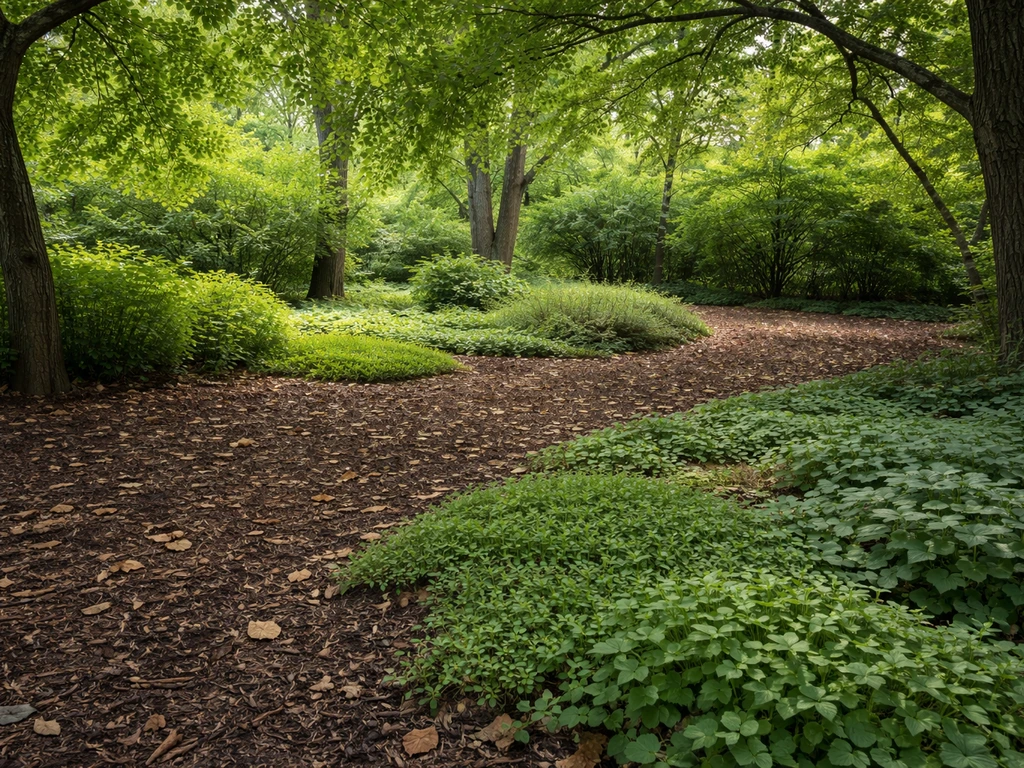
What to Put Under Trees Where Grass Won’t Grow
Step-by-step ideas for what to put under trees so grass fails less, with shade and moisture tolerant groundcovers.
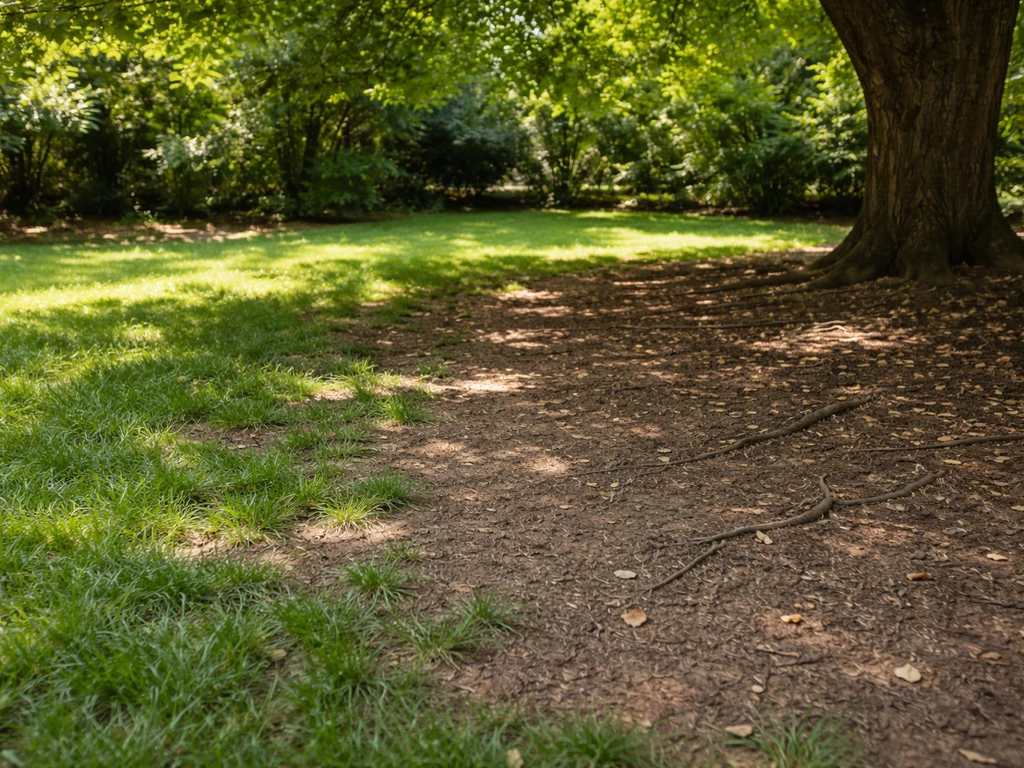
Can Grass Grow Under Trees? Fix Shade and Soil Fast
Yes, but shade, roots, and soil block it. Fix pH, topdress, plant shade grass, and overseed for success.