
Title: Why Do Some Patches of Grass Grow Faster? (Causes and Fixes) Meta description: Some lawn patches grow faster due to soil fertility gaps, irrigation unevenness, species mixes, shade, or compaction. Here's how to diagnose and fix it. For a concise diagnostic guide on why does my grass grow uneven, consult this article.
Why Do Some Patches of Grass Grow Faster? Causes & Fixes
Marcus Volkmann
5 Aug 2026
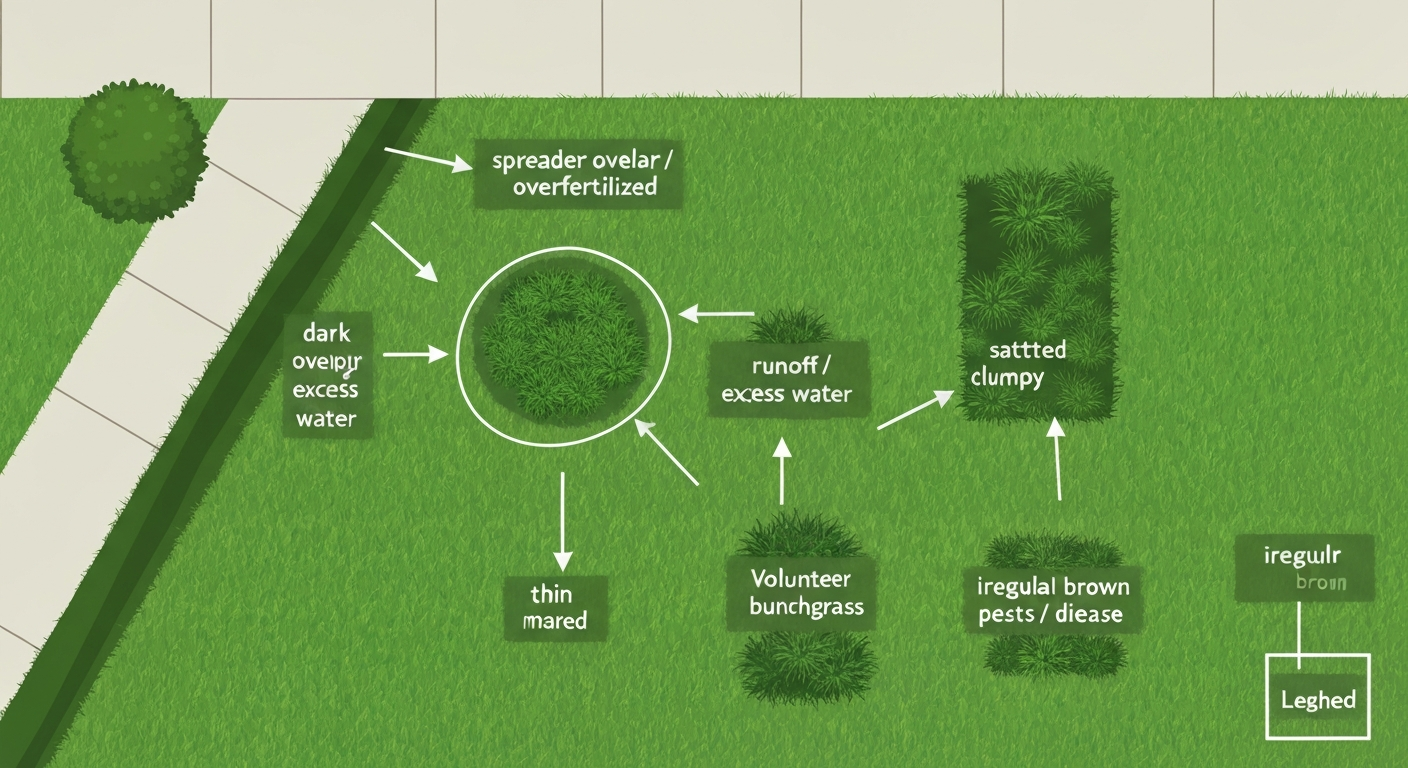
Some patches of grass grow faster than others because they are getting more of something: more nitrogen, more water, more sunlight, or better soil. The fast-growing strip near the sidewalk, the lush circle around the downspout, the clumpy dark-green tufts after you fertilized, each one has a specific, fixable cause. Once you identify which resource is unequal across your lawn, the fix is usually straightforward. If you see especially lush growth under a trampoline, read about why does grass grow better under trampoline for that specific, common scenario.
All the likely causes at a glance
Uneven growth almost always comes down to one or more of these nine factors. I'll go deeper on each one below, but here's your initial list to scan:
- Species and seed mix: cool-season and warm-season grasses have completely different active-growth windows, so a lawn that contains both (or patches of volunteer species) will look uneven for most of the year.
- Soil fertility and pH: high-nitrogen pockets from uneven spreader passes, old compost piles, dog waste, or leaching fertilizer bags produce visibly darker, faster-growing zones.
- Moisture and irrigation: a distribution uniformity (DU) below 0.6 on a sprinkler system creates reliably wet and dry strips that directly cause uneven growth rates.
- Sunlight and shade: most turf species need at least 4 to 6 hours of direct sun per day; patches receiving less than that grow slowly, thin out, or get replaced by shade-tolerant weeds.
- Microclimates: pavement-reflected heat, south-facing slopes, low spots that collect runoff, and urban heat-island effects all change soil temperature and moisture enough to alter growth timing.
- Compaction: penetrometer readings above roughly 200 to 300 psi indicate root-restrictive soil layers; grass over compacted ground grows slowly and thins because roots cannot reach water and nutrients.
- Mowing and fertility practices: scalping low spots, skipping high spots with the mower deck, or fertilizing unevenly with a hand-held spreader creates lasting growth-rate differences.
- Pests and diseases: white grubs (at roughly 6 to 10 per square foot), chinch bugs, sod webworms, and billbugs cause irregular dead or slow-growing patches that are easy to confuse with drought or fertility problems.
- Buried debris and utilities: old construction fill, buried concrete chunks, tree stumps, and utility corridors alter drainage, soil chemistry, and root depth zone by zone.
Visual clues: what uneven growth usually looks like and what it means
Before pulling out any tools, a slow walk across the lawn at eye level gives you a lot of information. The pattern of faster or slower growth is almost always a clue to the cause.
| What you see | Most likely cause | Secondary possibility |
|---|---|---|
| Dark-green stripe following a straight line | Overfertilized strip from spreader overlap | Buried irrigation leak or drain line |
| Circular lush patch, often near a downspout or tree | Concentrated water or decomposing organic matter | Dog urine (if brown center present) |
| Fast-growing clumps scattered randomly | Tall fescue or other bunch-grass volunteer species | High-nitrogen pocket from old pet waste |
| Slow or thin strip along pavement edge | Heat stress and reflected light, or soil compaction from foot traffic | Irrigation head not reaching edge |
| Patchy fast growth after rain, slow otherwise | Low irrigation DU — some zones not reaching field capacity | Shallow root zone from compaction |
| Consistently fast in one corner of yard | Microclimate — south-facing slope, heat-reflective wall, or runoff collection | Different soil fill from original grading |
| Irregular dead or sparse patches with no clear pattern | White grub or chinch bug feeding below surface | Fungal disease or buried debris |
One thing I see all the time on client lawns: people assume the fast-growing clumps are a nutrition problem and fertilize the whole lawn. That fixes nothing if the clumps are a different grass species entirely. For a focused explanation of why grass forms clumps and practical fixes, see why does my grass grow in clumps. The growth-pattern shape is your first and most important clue.
Diagnostic checklist for homeowners and landscapers
Work through this in order. Each step narrows the cause before you spend money on amendments or equipment.
- Walk the lawn and photograph the pattern. Note whether fast or slow patches follow straight lines (irrigation, spreader passes), circles (water pooling, tree roots), or random shapes (pests, diseases, buried debris).
- Check what grass species are present. Pull a sample from a fast-growing clump and compare leaf width, texture, and color to your dominant grass. Bunch-type volunteer grasses (tall fescue in a bluegrass lawn, for example) will always outgrow fine-leaved turf in certain seasons.
- Check your irrigation system zone by zone. Run each zone separately and watch for dry arcs, overly wet strips, and heads that are blocked, tilted, or missing. Note which zones overlap the fast- and slow-growing areas.
- Check mowing height at the slow patches. If the deck is scalping low spots or the turf is repeatedly cut below one-third of blade height, root growth is suppressed and the area will stay thin.
- Inspect the soil surface. Push a screwdriver into the soil in both fast and slow zones. If it goes in easily in the fast zone and stops within 2 to 3 inches in the slow zone, compaction is a likely culprit.
- Look under the surface at slow patches. Cut a 6-inch deep plug with a knife or spade and look at root depth and color. Healthy roots should be white and extend at least 3 to 4 inches; shallow, brown, or missing roots point to compaction, disease, or buried debris.
- Check for pest activity. At sparse or slow patches, pull back a section of turf and count grubs; more than 6 to 10 per square foot is a treatment-threshold level. Look for chinch bug activity at the border between fast and slow zones in sunny areas.
- Submit a soil test from each distinct zone (sun versus shade, fast versus slow). Collect 10 to 15 cores at 4 to 6 inches depth per zone, combine them, and submit about 1 to 2 cups to a university or cooperative extension lab. Record which zone each sample came from.
Simple field tests you can do yourself
These five tests require minimal equipment and give you hard data to act on, not guesses.
Soil test
Collect a stratified, composite sample: 10 to 15 cores per zone, 4 to 6 inches deep, mixed together. Spread the mix on a clean surface, let it air-dry, and send roughly 1 to 2 cups to a university extension lab. A standard report will cover pH, organic matter percentage, and extractable phosphorus, potassium, calcium, and magnesium. It will also give a lime requirement and specific fertilizer recommendations. Record which area of the lawn each sample came from because spatial variability is the whole point.
Compaction rod or screwdriver test
Push a standard screwdriver handle-first (or use a cone penetrometer if you have one) straight down into the soil with steady hand pressure. In healthy lawn soil, it should slide to 4 to 6 inches without much resistance. If you hit resistance at 2 inches or less, write down the location. A penetrometer reading above roughly 200 to 300 psi is root-restrictive; map those spots because they correlate almost perfectly with slow-growth zones. Record depth-of-penetration for each spot and compare fast versus slow patches side by side.
Root-depth pull test
Use a soil knife or hand trowel to cut a 6-inch-deep plug in both a fast-growing patch and a slow-growing patch. Lay them side by side. Measure how deep the white roots extend in each, and note root color (white and branching is healthy; brown and sparse is stressed). Record the depth in inches. A difference of 2 or more inches between zones is a red flag for compaction, buried hardpan, or drainage problems beneath the slow zone.
Shade map
Photograph your lawn from an upstairs window or elevated angle at 9 a.m., 12 p.m., and 3 p.m. on a clear day. Mark shaded zones in each photo. If a problem area receives less than 4 hours of direct sun across all three photos combined, shade is very likely a driver of slow growth. Most turf species need 4 to 6 hours of direct sun; fine fescues and certain zoysia cultivars are the most tolerant at the lower end. Record actual hours of shade per zone.
Moisture probe or catch-can audit
For irrigation uniformity, place equal-sized straight-sided cans (tuna cans work perfectly) across a zone in a grid pattern and run the irrigation for a set time. Measure the water depth in each can. If the highest and lowest readings differ by more than about 30 to 40 percent, your distribution uniformity is low enough to cause patchy growth. For soil moisture without an irrigation system, push a simple volumetric water content (VWC) probe into the root zone of fast and slow patches after a dry spell. Record VWC percentages; a slow-growing patch reading below field capacity consistently tells you it is moisture-stressed, not nutrient-deficient.
Interpreting what your tests tell you
Here are the thresholds and decision points that matter most:
| Test | Result that flags a problem | Recommended action |
|---|---|---|
| Soil pH | Below 5.5 or above 7.5 for most turf | Apply agricultural limestone to raise pH or elemental sulfur to lower it, based on lab lime-requirement value — not a general rate |
| Soil nitrogen (N) | Low organic matter (<2%) + no recent fertilizer = likely N deficiency | Follow lab fertilizer recommendation; cool-season turf generally needs 2 to 4 lb N/1,000 ft² per year, timed to active growth |
| Compaction (screwdriver) | Stops at 2 inches or less in problem zone | Core aeration in fall or spring (cool-season) or late spring (warm-season); repeat annually for chronic zones |
| Root depth pull | Roots less than 2 inches in slow zone vs. 4+ inches in fast zone | Aerate, topdress with screened compost, and investigate for buried debris or hardpan |
| Shade map | Less than 4 hours direct sun per day | Reseed with fine fescue (cool-season) or shade-tolerant zoysia (warm-season), or consider ground cover alternatives |
| Catch-can audit | Variation >30–40% across a zone | Adjust or replace sprinkler heads; add a zone if dry arcs persist; consider soil-moisture sensor control |
| Grub count | 6 to 10 or more grubs per square foot | Apply an appropriate insecticide based on local extension guidance; confirm species before treating |
| Species identification | Bunch-type grass (e.g., tall fescue in bluegrass lawn) | Spot-treat volunteer clumps with a non-selective herbicide, then overseed with matching species |
One honest note on pH adjustment: elemental sulfur works slowly and the rate you need depends heavily on both starting pH and soil texture. Extension tables (like Cornell's) give specific rates in pounds per 1,000 square feet by pH band and soil type. Do not apply a generic rate you found online. The same is true for lime: only apply it when a soil test shows a need, and use agricultural limestone rather than hydrated or burnt lime.
Why does my lawn grow faster than my neighbor's?
This is one of the most common questions I get, and the answer almost always comes down to a few specific, fixable differences. If your whole lawn grows noticeably faster or greener than the one next door, start with these comparisons.
The most likely causes of lawn-to-lawn differences
- Fertilization timing and rate: if you or a previous owner applied more nitrogen than your neighbor — or applied it on the right schedule for your grass species — your lawn simply has more fuel. Cool-season grasses fertilized in fall and spring will outgrow a neighbor's lawn that was fertilized in midsummer when the grass was heat-stressed.
- Grass species: a lawn with bermudagrass or tall fescue will grow aggressively in late spring through summer while a neighbor's Kentucky bluegrass lawn slows down. In fall, the roles reverse. If the species are different, the growth-rate comparison is essentially meaningless.
- Irrigation access: a lawn on a dedicated irrigation system calibrated to species needs will consistently out-compete a lawn relying on rainfall alone, especially during dry spells. ET-based and sensor-based irrigation controllers maintain turf quality with significantly less water waste than calendar scheduling.
- Soil organic matter and history: a lawn on ground that was previously a garden bed, had regular compost topdressings, or was never scraped and compacted by construction will have better water retention, nutrient availability, and microbial activity than a lawn on builder-grade fill.
- Microclimate differences: south-facing properties warm up faster in spring, giving warm-season grasses a head start. Properties near large paved surfaces benefit from reflected heat. These are not controllable, but knowing about them explains the difference.
- Mowing discipline: a lawn mowed at 3 to 3.5 inches for tall fescue or Kentucky bluegrass will have deeper roots and better drought tolerance than one scalped at 1.5 inches. Deeper roots mean more consistent growth even between rain events.
Quick comparison: fixable vs. structural differences
| Cause | Fixable? | What to do |
|---|---|---|
| Fertilizer timing or rate mismatch | Yes | Match nitrogen application to species growth window and stay within 2 to 4 lb N/1,000 ft²/yr for cool-season grass |
| Wrong grass species for season | Partially | Overseed bare areas with the correct species; full renovation if the mismatch is severe |
| No irrigation system | Yes (with investment) | Install a zone-based drip or spray system; soil-moisture sensors reduce water use significantly |
| Poor soil from construction grading | Yes (long-term) | Annual core aeration plus compost topdressing improves soil biology over 2 to 3 seasons |
| South-facing microclimate advantage | No | Use it: fertilize and seed slightly earlier in spring to take advantage of the warmth |
| Neighbor's lawn is a different species | No | Different growth windows are normal; compare lawns in the same season for the same species only |
Step-by-step fixes once you've identified the cause
Soil amendments and fertility
Always work from lab results. If the test shows low pH, apply the lab's lime requirement in agricultural limestone form. If it shows low phosphorus or potassium, apply a starter fertilizer product matching those specific deficiencies. For nitrogen, time applications to active growth: spring and fall for cool-season species, late spring through summer for warm-season species. Never fertilize warm-season grasses heading into winter dormancy. Compost topdressing at roughly a quarter-inch depth after aeration improves organic matter, soil aggregation, and (per peer-reviewed turfgrass research) can suppress some soil-borne diseases like dollar spot when applied correctly.
Overseeding and species correction
If the fast-growing clumps are a different species (a common scenario with tall fescue invading a Kentucky bluegrass or fine fescue lawn), spot-treat with a non-selective herbicide, wait the label-specified interval, then overseed with your matching species. Timing matters: overseed cool-season lawns in early fall when soil temperatures are between 50 and 65°F; overseed warm-season lawns in late spring. If you are dealing with new grass that germinated patchily and then died, that is a separate but related problem worth investigating further before reseeding. If you need more help diagnosing why does my grass seed grow and then die, read our detailed guide on that topic. For guidance on whether patchy new grass is normal and how to address it, see is it normal for new grass to grow in patches.
Irrigation fixes
If your catch-can audit revealed a DU below 0.6, adjust or replace individual heads before doing anything else. A single tilted or clogged head creates a permanently dry arc that fertilizer and aeration will not fix. Once heads are calibrated, consider switching to ET-based or soil-moisture-sensor scheduling. Field research shows sensor-based controllers maintain turf quality with substantially less applied water than calendar-based systems, and they prevent the over-irrigation that creates wet, fast-growing strips next to dry slow ones.
Aeration for compaction
Core (mechanical) aeration is the right tool for compaction relief. It improves root penetration, water infiltration, and nutrient uptake. Schedule it during active growth: spring or fall for cool-season grasses, late spring to early summer for warm-season grasses. For chronically compacted areas (near paths, gates, play equipment), plan on annual aeration for at least two to three seasons. Follow immediately with compost topdressing to fill the cores and build organic matter.
Mowing discipline
Raise your mowing height to the upper end of the recommended range for your species. Never remove more than one-third of the blade height in a single cut. If your lawn has low spots that get scalped, either topdress those areas to level them or manually raise the deck before passing over them. Consistent mowing height is one of the simplest ways to reduce growth-rate variation across a lawn.
Seasonal timeline for interventions
| Season | Cool-season turf actions | Warm-season turf actions |
|---|---|---|
| Early spring (soil temp 45–55°F) | Soil test, compaction check, light fertilizer application, overseed bare patches | Hold fertilizer; assess winter damage; prepare for aeration |
| Late spring (soil temp 55–65°F) | Main fertilizer application, aeration if needed, irrigation system startup and DU check | Begin fertilization, aerate and topdress, run catch-can audit |
| Summer | Reduce mowing frequency, irrigate based on ET or soil sensor, scout for pests | Main fertilization window, monitor for chinch bugs and grubs, adjust irrigation |
| Early fall (soil temp 50–65°F) | Best time to overseed, aerate, topdress with compost, main fertilizer application | Final fertilizer before dormancy (no late-season N), overseed warm-season bare spots |
| Late fall / winter | Apply lime if soil test indicates, no nitrogen fertilizer | Dormant period: no fertilizer, minimal irrigation, assess for buried debris or grading issues |
Prevention and ongoing maintenance
Most uneven-growth problems are preventable with a consistent annual routine. Soil test every two to three years and treat only what the results show a need for. Run an irrigation DU check every spring before the growing season. Mow at the correct height for your species and sharpen blades at least twice per season. Aerate any high-traffic zones annually. These are not complicated tasks, but skipping them for even one season can create fertility or compaction differences that take two to three years to fully correct.
If you have persistent patchy growth that does not follow the patterns described above (random sparse zones, no clear irrigation or shade explanation, odd shapes that shift over time), take a closer look at the soil profile. Construction debris, old tree stumps rotting underground, and utility corridors create root obstacles that no amount of fertilizer or aeration will fix from the surface. In those cases, you may need to excavate, remove the obstruction, backfill with quality topsoil, and re-establish turf from scratch in that zone.
When to call a professional
Most homeowners can handle soil testing, basic aeration, and irrigation adjustments on their own. But there are situations where a licensed professional adds real value and saves you money in the long run. Call a turfgrass professional or certified lawn care specialist if: your soil test results show extreme pH values (below 5. Pests that create patchy turf include white grubs (scarab larvae), chinch bugs, sod webworms and billbugs, and extension guidance (see White Grubs in Home Lawns, Penn State Extension) recommends confirming pest pressure with digging inspections and using thresholds of roughly 6–10 grubs per square foot before treating White Grubs in Home Lawns — Penn State Extension. 0 or above 8.0) that require multiple amendment cycles to correct; grub counts or pest damage are widespread across the entire lawn rather than isolated patches; you suspect a fungal disease and cannot identify it visually (misidentifying disease leads to wasted fungicide applications); buried debris or hardpan is confirmed at depth and physical excavation is needed; or you are planning a full lawn renovation with grading changes, new irrigation, and species conversion, where incorrect execution will cost more to fix than doing it right the first time.
FAQ
SEO title and meta description for this article
Title: Why Some Patches of Grass Grow Faster — Diagnose & Fix Uneven Lawns Meta description: Learn evidence‑based causes, step‑by‑step diagnostics (soil test, compaction, moisture, shade), fixes (aeration, amendments, irrigation tuning, overseeding/sodding), seasonal timelines, and when to call a pro to correct patchy, uneven lawn growth.
Core question: why do some patches of grass grow faster than others?
Patches grow unevenly because of differences in species/seed mix, soil fertility and pH, moisture distribution (irrigation or drainage), sunlight/shade and microclimate, soil compaction and depth, mowing and fertility history, pests or disease, and buried debris/utilities. Any one or combination of these factors can create visible faster or slower growth.
Diagnostic checklist (quick walkaround)
1) Map problem patches and note sun hours, nearby surfaces, and slope. 2) Compare grass type in fast vs slow areas (blades, color, growth habit). 3) Do a simple tug/root check: dig a 3–4 in plug to inspect root depth and color. 4) Perform a moisture check with a shovel or probe after irrigation/watering. 5) Do a compaction test (push rod or screwdriver; use penetrometer if available). 6) Take separate soil samples from representative zones (sunny, shady, wet, dry). 7) Check for insects/damage (look for grubs, chinch bug signs, frass). 8) Inspect for buried debris, fill, or utilities that restrict rooting.
Simple field tests you can do now (no lab)
1) Root‑depth test: lift a 2–3 in turf plug—healthy roots should extend several inches; shallow, pale roots indicate compaction or poor soil. 2) Moisture probe: push a screwdriver or metal rod into the soil; difficulty indicates dry or compacted soil. 3) Shade map: note direct sun hours across the yard on a single sunny day. 4) Catch‑can irrigation audit: place cans across a sprinkler zone and run 10–15 minutes to check uniformity. 5) Visual pest check: lift turf edges, examine soil for grubs or tunneling insects.
How and why to do a soil test (lab)
Collect 10–15 cores from a single management zone (sun/shade/wet/dry), 4–6 in deep, mix and submit 1–2 cups to a university extension lab. The report gives pH, extractable P and K, and lime or fertilizer recommendations. Act on lab guidance—apply lime or sulfur only when lab indicates need; follow recommended N‑P‑K rates and timing.
Common causes paired with quick fixes (comparison)
- Species mismatch (cool vs warm season): fix by overseeding or re‑sodding to match dominant species or accept seasonal patches. - Low fertility/pH issues: correct per soil test (lime or sulfur, balanced fertilizer) and follow species‑specific N rates. - Uneven irrigation/Du <0.6: run a catch‑can audit, adjust/repair heads, redesign zones, use soil‑moisture sensors. - Compaction/poor rooting: core aerate when turf is actively growing and topdress if needed. - Shade and microclimate: trim trees, choose shade‑tolerant varieties, or accept lower performance and install shade groundcover. - Pests/diseases: confirm with inspection, follow extension thresholds and targeted treatments. - Buried debris/filled soil: excavate and replace rootzone or sod over corrected area.
Next Articles
Is It Normal for New Grass to Grow in Patches?
Reasons new grass grows in patches plus quick checks and next steps to fix uneven seeding, watering, light, and soil.
Why Does My Grass Grow Unevenly? Fixes That Work Fast
Learn why grass grows in patches and get quick fixes for watering, soil, shade, drainage, and reseeding to even it out.
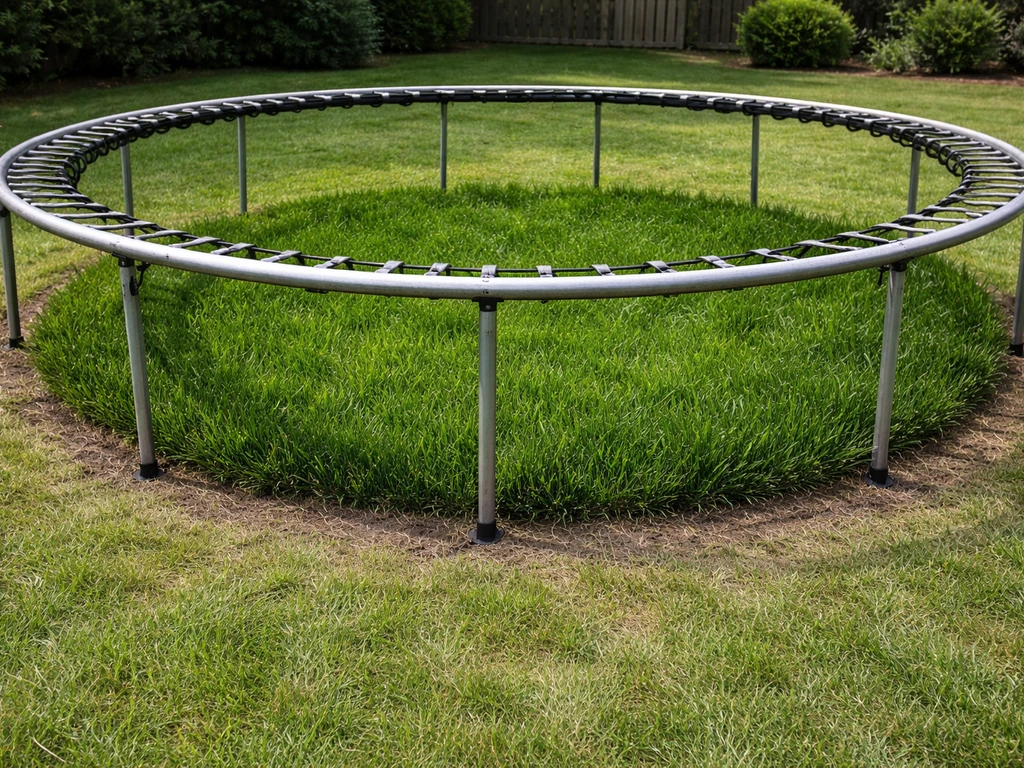
Why Does Grass Grow Better Under a Trampoline and How to Help
Learn why grass under a trampoline grows better and get step-by-step tips to prep, seed, water, and repair turf.