
The side of the house is one of those spots where grass just refuses to cooperate, and the fix isn't to keep reseeding it. The real move is to replace it with something that actually belongs there: gravel, groundcover, pavers, mulch, or artificial turf, depending on your specific conditions. But before you install anything, you need to know why grass is failing there, because that reason determines which solution will actually last.
Ideas for Side of House Where Grass Won’t Grow
Marcus Volkmann
15 May 2026
Why grass fails on the side of the house
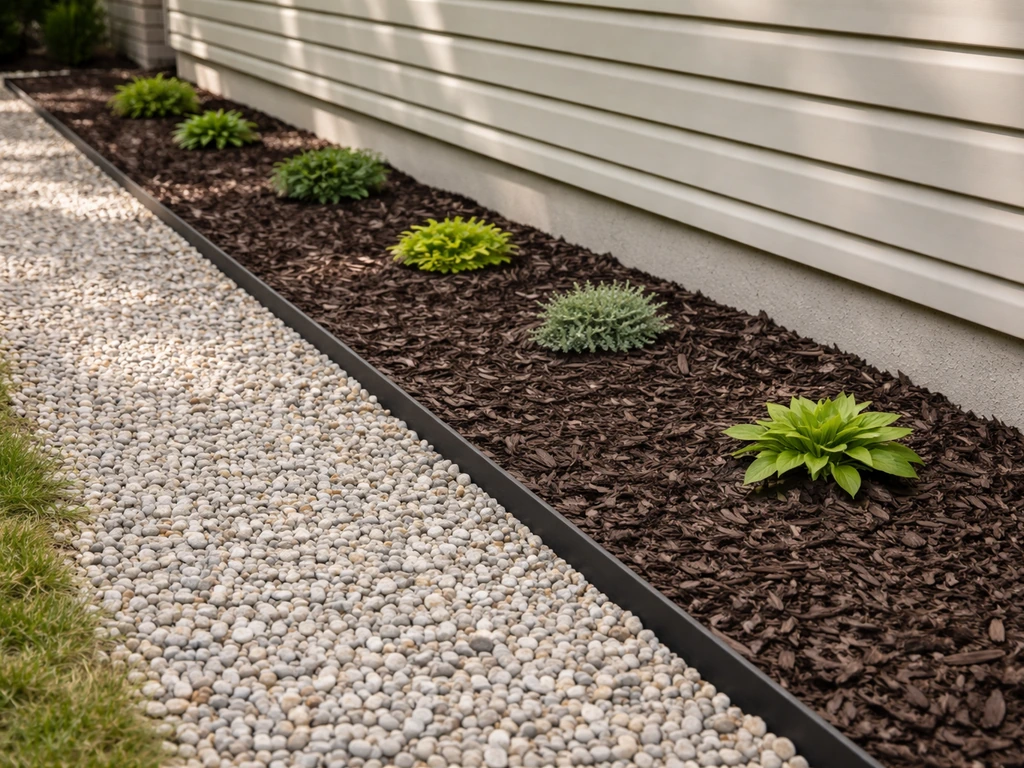
Sideyard strips are tough microclimates. Most of them fail grass for one or more of these reasons, and it's rarely just one thing working against you.
- Shade from the eaves, the house wall, and neighboring trees blocks the minimum 4 to 6 hours of sunlight most turf grasses need to stay dense and healthy. Penn State Extension confirms that shade competition shortens roots and reduces turf vigor, meaning even grass that germinates will thin out fast.
- Soil compaction along foundation edges is nearly universal. Years of foot traffic, backfill from original construction, and zero aeration leave a root zone that grass can't penetrate well enough to establish.
- Poor drainage or the opposite, overly dry soil under a wide roof overhang, creates feast-or-famine moisture. Water either pools near the foundation after rain or the area stays bone dry because eaves shed water away from the strip.
- Root competition from nearby trees or large shrubs pulls available water and nutrients away from any turf trying to get started.
- Soil that's sandy, heavily clay-based, or nutrient-depleted from construction backfill gives grass nothing to work with.
- Narrow strips get heavy foot traffic from people walking between the house and fence, compacting soil faster than the grass can recover.
If you've been overseeding this spot every spring and it still looks patchy or bare by midsummer, that's your signal: the site itself is the problem, not the grass seed. The honest answer is to stop fighting the conditions and choose a solution built for them.
Pick the right approach before you buy anything
There are three broad categories of sideyard solutions: hardscape (gravel, pavers, concrete), groundcover plants, and low-maintenance turf alternatives like artificial grass. Each one suits a different set of conditions, budgets, and goals. Here's how to think through the choice quickly.
| Option | Best For | Rough Cost (DIY) | Maintenance Level | Grass Regrowth Risk |
|---|---|---|---|---|
| Gravel/rock strip | Drainage access, dry climate, utility areas | Low ($1–$3/sq ft) | Low-medium (occasional weed removal) | Medium (weeds blow in on top) |
| Mulch + groundcover | Shady spots, near foundations, aesthetic value | Low ($1–$4/sq ft) | Medium (annual mulch refresh) | Low-medium (edging needed) |
| Pavers/stepping stones | High-traffic paths, access routes, clean look | Medium ($5–$15/sq ft) | Low (joint maintenance) | Low (with proper edging) |
| Concrete strip | Permanent solution, zero maintenance goal | Medium-high ($6–$12/sq ft) | Very low | Very low |
| Artificial turf | Narrow strips, pets, aesthetic priority without mowing | High ($8–$20/sq ft) | Low (rinse, debris removal) | Very low |
If your side of the house is primarily a pass-through path, pavers or a concrete strip are the most durable permanent fix. If it's more of a dead zone that just needs to look presentable and handle shade, mulch with groundcover or gravel is your best value. Artificial turf makes the most sense for narrow strips where pets need access and you want the look of green without mowing. Think about what's closest to a downspout or foundation before you commit, because drainage has to go somewhere and your solution needs to work with it, not against it.
Soil prep and drainage: do this first, no matter what you install
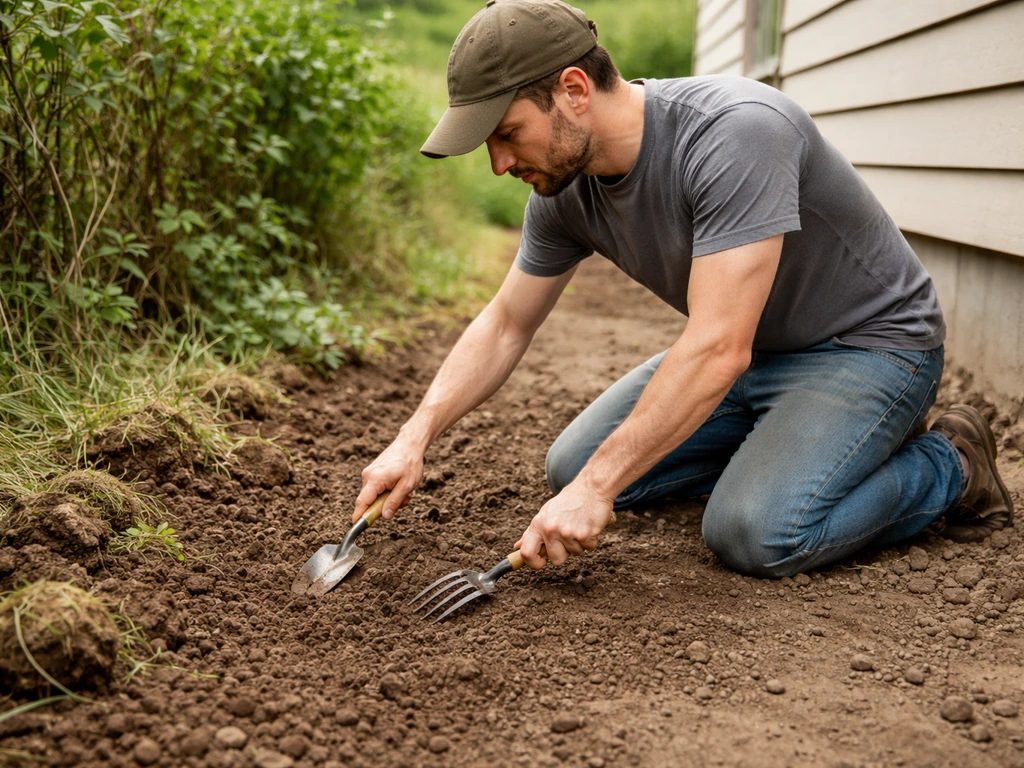
This is the step most homeowners skip, and it's why their gravel strip fills with weeds in two years or their pavers sink and shift. Proper prep isn't glamorous but it makes everything else work.
- Clear the area completely. Remove all existing grass and weeds, including roots. A flat spade or sod cutter works for turf. For persistent weeds, a non-selective herbicide applied two weeks before you start gives you a cleaner slate.
- Grade for drainage away from the foundation. You want positive slope moving away from the house, roughly 1/8 to 1/4 inch drop per linear foot. This keeps water moving out rather than pooling against the foundation, which protects both the structure and whatever you're installing.
- Check your downspout locations. If a downspout discharges into the strip, install a splash block or underground extension to carry water at least 4 to 6 feet away before your finished surface begins. Running water under gravel or pavers will undermine them over time.
- Assess the soil. If you're installing hardscape, you need a firm, compacted base. If you're planting groundcover, loosen compacted soil 6 to 8 inches deep and amend with compost. Soil that's been compacted by construction backfill benefits from a full cubic foot of compost per 10 square feet worked in before planting.
- Install your edge restraints before anything else. Physical edging (metal or plastic bender board buried 3 to 4 inches deep along the lawn side) is what stops grass from creeping back in laterally. The K-State Extension recommends cut-edge or trench edging as one of the most effective physical methods for keeping grass out of adjacent beds. Without it, grass runners will re-enter within one growing season.
Gravel and rock strips: what actually works and where it goes wrong
Gravel is one of the most popular sideyard solutions because it's cheap, handles drainage well, and looks clean. Done right, it lasts. Done wrong, it becomes a weed garden with rocks on top within two seasons.
Setup that holds up
- After clearing and grading, install your edge restraints on the lawn side and along any border.
- If you choose to use landscape fabric, use a woven geotextile rated for ground contact, not the thin black plastic sheeting sold at discount stores. Overlap seams by at least 6 inches and secure with staples every 12 inches.
- Apply a minimum of 2 to 3 inches of gravel. Pea gravel, decomposed granite, and river rock all work. Larger rock (1.5 to 2 inch) stays cleaner longer because soil doesn't work its way between the pieces as quickly.
- Keep gravel a few inches away from wood siding and at least an inch from foundation vents to allow airflow.
The landscape fabric problem you need to know about
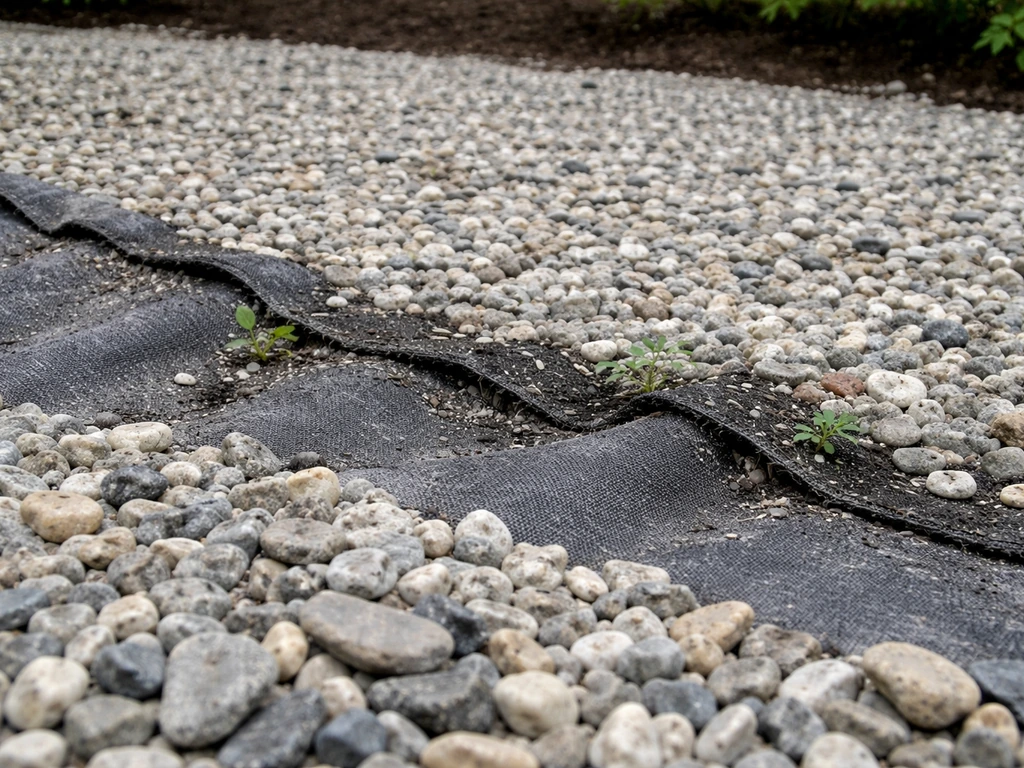
Here's what the bag doesn't tell you: landscape fabric under gravel works reasonably well for the first two to four years, then it becomes a problem. Over time, soil particles and decomposing organic debris sift down between the rocks and sit on top of the fabric. Weed seeds blown in by wind germinate in that surface layer, and when they root through the fabric, they're nearly impossible to pull out cleanly. UF/IFAS Extension, UNH Extension, and Penn State all flag this same issue: fabric that's been in the ground a few years with mulch or soil accumulating on it becomes harder to manage than no fabric at all. Colorado State University Extension goes further and recommends against woven plastic weed barriers under mulch in landscape beds entirely.
The better approach in most shady, organic-matter-accumulating sideyards is to skip the fabric and rely on gravel depth (3 inches minimum) plus consistent edging and annual touchups. In a pure gravel utility strip with minimal foot traffic and low organic debris, fabric can extend your weed-free window, but go in with realistic expectations. It is not a permanent solution.
Mulch beds and groundcover for shady, poor-soil strips
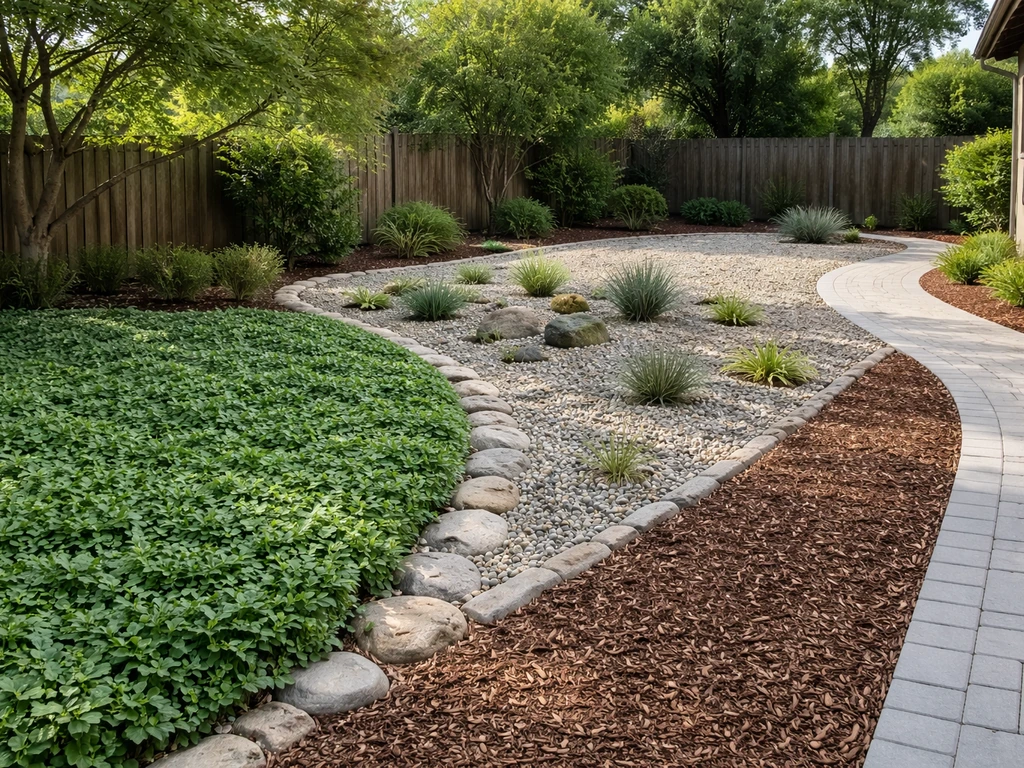
If your sideyard is heavily shaded and you want something living in it, mulch plus shade-tolerant groundcover is your best long-term play. It's the approach that works with the conditions instead of fighting them, and it improves the soil over time rather than degrading it.
Mulch depth matters more than the fabric underneath it
Cornell and CSU Extension both recommend 2 to 4 inches of mulch for weed suppression, with CSU going to 4 inches for organic wood chip mulch. That depth alone, without any fabric, suppresses most weed germination by blocking light to the soil surface. Wood chip mulch also moderates soil temperature, retains moisture, and breaks down to feed soil biology over time, which inorganic mulches like gravel simply don't do. Plan to refresh organic mulch every one to two years as it breaks down.
Groundcover plants that thrive where grass gives up
Once your mulch bed is established and edged, you can add groundcover plants that will eventually fill in and out-compete weeds on their own. Good options for shade and poor soil on the side of the house include:
- Liriope (lily turf): tough, evergreen in mild climates, handles dry shade and compacted soil well. Spreads slowly but stays where you put it.
- Pachysandra: classic deep-shade groundcover, spreads steadily, and fully suppresses weeds once established. Needs consistent moisture to get started.
- Creeping Jenny or creeping thyme: lower-growing options that work in partial shade and handle foot traffic reasonably well.
- Hostas: not a spreading groundcover but excellent for filling in large shady spots with minimal care, and their broad leaves suppress weeds effectively.
- Ferns (native or ornamental): thrive in moist shade near downspout areas and look intentional rather than planted-by-default.
- Ajuga (bugleweed): spreads aggressively in shade, handles poor soil, and has attractive foliage. Use it where you want quick coverage.
The key with any of these is getting the edging right first. A steel or aluminum edge buried 3 to 4 inches deep along the lawn-facing border is what keeps lawn grass from reclaiming the bed from the outside while your groundcover fills in from the inside. This is worth repeating: edging is not optional if you want this to stay clean.
Pavers, stepping stones, and concrete strips for permanent paths
If the sideyard is primarily a path, or if you just want a zero-maintenance permanent fix, a hardscape surface is the most reliable long-term answer. Pavers, flagstone, or a simple concrete strip all fully suppress grass growth by eliminating the soil surface it would need to germinate in. The difference is cost, look, and how involved the base prep is.
Paver strip installation basics
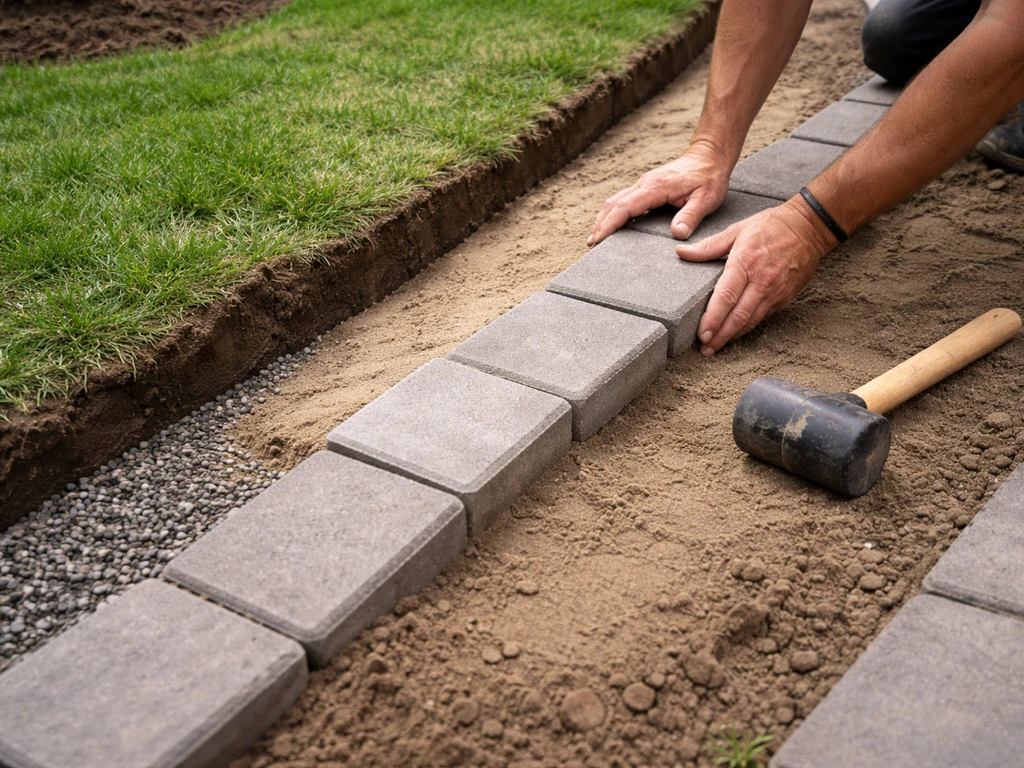
- Excavate 6 to 8 inches below the finished surface grade, depending on your soil type. Clay soils may need deeper excavation and a thicker base, or a layer of geotextile fabric between the subgrade and base material to prevent clay migration up into the base.
- Compact the subgrade, then add 4 to 6 inches of compacted crushed stone base (Class II base rock or road base).
- Add a 1 to 1.5 inch layer of bedding sand over the compacted base, screeded flat.
- Set pavers, maintaining consistent slope for drainage (1/8 to 1/4 inch drop per foot away from the foundation, per RCP Block and Brick guidance).
- Install edge restraints on all exposed sides before sweeping joint sand. Without restraints, pavers migrate outward and joints open up over time.
- Sweep polymeric jointing sand into joints and compact, then wet to activate the polymer binder. Polymeric sand (products like those from Quikrete or Basalite) resists washout and significantly reduces weed germination in the joints compared to regular sand.
Stepping stones set in mulch or gravel are a lower-cost version of this, good for a light-traffic pathway where you don't need a fully paved surface. Set them on a thin sand bed and keep them level with the surrounding surface so they don't become trip hazards. The gaps between stones can be filled with groundcover plants or just maintained with mulch.
When a concrete strip makes sense
A poured concrete strip is the most permanent and lowest-maintenance option of all. It's also the most expensive and the least reversible. It works well for utility sideyards where you need clean access to hose bibs, meters, or gates, and where aesthetics are secondary to function. Make sure any concrete strip is sloped away from the foundation and includes a gap (expansion joint) where it meets the house to prevent cracking and water infiltration.
Artificial turf for narrow strips and pet zones
Artificial turf has gotten genuinely good in the last five years, and for a narrow sideyard strip, it's one of the more practical options when you want the look of green grass without any of the growing conditions required to support real turf. Penn State Extension identifies turfgrass failure in shade as driven by competition for light, water, and nutrients, and notes that shade can shorten roots while reducing turf vigor and wear tolerance real grass cannot survive the shade and soil conditions. It makes the most sense when the strip is 3 to 6 feet wide, gets heavy use or pet traffic, and real grass simply cannot survive the shade and soil conditions. If you are trying to figure out how to grow grass in shade with dogs, it helps to compare real-turf options with pet-safe alternatives like artificial turf and shade-tolerant groundcover pet traffic.
Installation basics
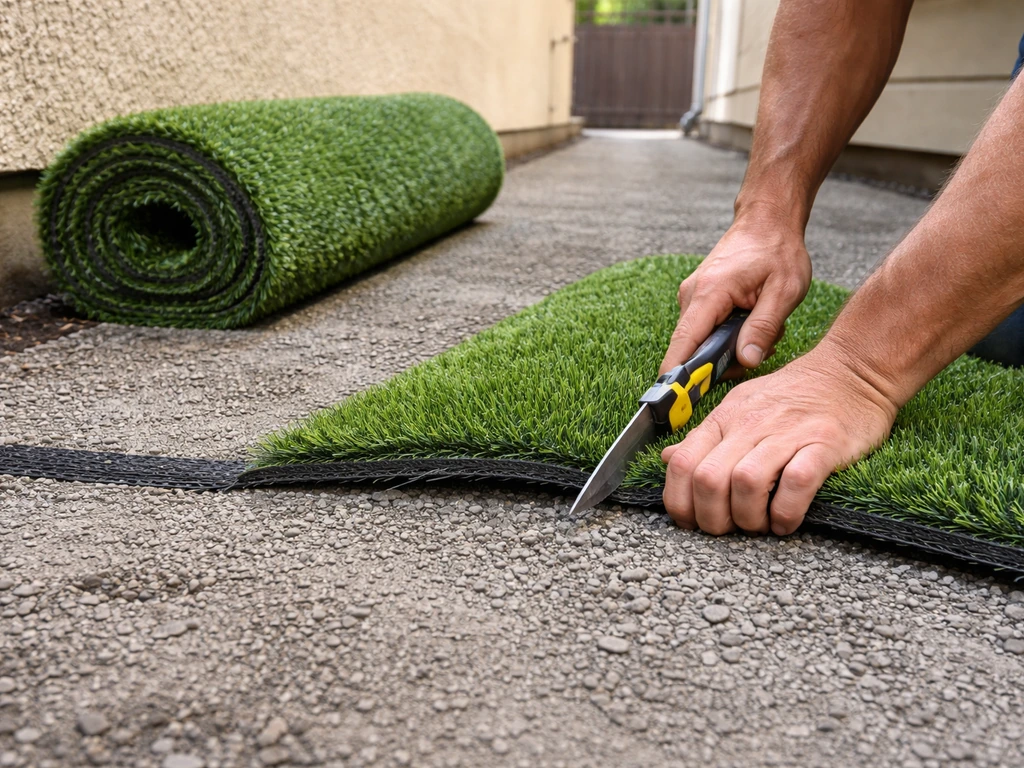
- Excavate 3 to 4 inches and compact a crushed aggregate base (3/4 minus decomposed granite works well). Grade for drainage away from the house.
- Roll out the turf and cut to fit, leaving a few inches of overlap at edges to trim precisely. Blade direction should run consistent throughout the strip (all blades pointing the same direction).
- Secure edges with galvanized nails or staples every 3 to 4 inches along perimeters and seams.
- Use seaming tape and turf adhesive at any seam points, per the manufacturer's instructions. Mismatched seams are the most common installation mistake that makes artificial turf look artificial.
- Apply infill (silica sand, crumb rubber, or a pet-specific infill) per manufacturer recommendations, typically 1 to 2 lbs per square foot, and brush fibers upright with a stiff broom.
Pet use considerations
If pets use the sideyard strip, drainage is the single most important factor. If you want real grass where dogs pee, you can still improve success with dog-safe lawn practices like adjusting irrigation, choosing resilient grass types, and spot-treating or renovating urine-damaged areas drainage is the single most important factor. A free-draining aggregate base and a permeable backing on the turf are non-negotiable. Pet-specific infill products designed with odor control (antimicrobial or zeolite-based infills) significantly outperform generic sand-only infill for hygiene and smell management. A simple rinse with a hose after pet use keeps things fresh. For example, Realturf describes its PetClean as a pet-focused enhancement that helps surfaces drain faster and stay fresher, paired with a free-draining base and a simple rinse routine for blank" rel="noopener noreferrer">odor control. For dog-specific areas, this overlaps with ideas covered for grass areas where dogs urinate, but with artificial turf the drainage system does the heavy lifting. If grass won’t grow where dogs urinate, it’s usually because pet urine and salt can damage the soil surface and stress new seedlings.
Honest trade-offs
Artificial turf greatly reduces weeds but doesn't eliminate them entirely. Weeds can germinate around the edges or in debris that accumulates on the surface. Hand-pulling edge weeds every few weeks and using a turf-safe spot treatment handles this easily. Surface temperatures on artificial turf can run 20 to 50 degrees hotter than real grass on sunny days, so in a south or west-facing sideyard exposed to afternoon sun, factor that into your decision, especially if children or pets will use the space barefoot.
Keeping it looking clean long-term
Whatever you install, ongoing maintenance is what keeps it from reverting to a weedy mess within a few years. The good news is that all of these alternatives require dramatically less work than trying to keep struggling grass alive. Here's what each approach actually demands of you on an ongoing basis.
| Solution | Annual Tasks | Refresh Cycle | Watch For |
|---|---|---|---|
| Gravel/rock | Pull or spot-spray edge weeds, rake debris | Add 1 inch of fresh gravel every 3–5 years as needed | Soil accumulation on surface feeding weed seeds |
| Mulch + groundcover | Refresh mulch to 3–4 inch depth, edge lawn side | Top up mulch annually or every 2 years | Grass runners breaching the edge from the lawn side |
| Pavers | Sweep joints, spot-treat weeds in joints, re-sand if joints erode | Re-polymeric sand every 5–7 years | Edge restraint failure causing paver migration |
| Concrete strip | Rinse debris, check expansion joints for cracking or soil intrusion | Reseal every 3–5 years if desired | Cracks along foundation edge from settling |
| Artificial turf | Rinse, remove debris, brush fibers upright | Infill top-up every 2–3 years | Edge weed germination, seam lifting |
The single maintenance task that matters most across every option is maintaining the edge along the lawn side. Grass is persistent. Runners and rhizomes will find their way under or through any edge barrier that's degraded, shallow, or has gaps. Walk the edge of your sideyard solution every spring and again in early fall, check for intrusion, and cut or trim it back before it re-establishes. Five minutes twice a year beats a full reinstall.
If you're dealing with a shady back or side area and want to think through plant-based alternatives more broadly, the same principles that apply here connect to the larger question of what to grow instead of grass across your entire property. If you’re looking for ideas for areas where grass won't grow across the whole property, focus on matching plants or hardscape to shade, soil, and drainage instead of trying to force turf. The sideyard is just the spot where those alternatives become non-optional the fastest.
FAQ
Should I remove the existing dead grass and topsoil before adding gravel or pavers on the side of the house?
Yes, in most cases. Clear old sod and about 2 to 4 inches of topsoil so you do not bury a weed seed bank under your new material. If you skip this, weeds can still emerge from remaining organic matter, especially where debris collects near a downspout or foundation.
Will landscape fabric work better if I use it under mulch instead of under gravel?
It can suppress for a short time, but it still tends to fail in sideyards where leaf litter and compost-like debris build up. When fabric gets covered with soil and decomposing material, weed roots can penetrate and become difficult to remove cleanly. For long-term beds, the more predictable approach is correct mulch depth plus edging, not fabric.
How deep should edging be for a groundcover strip next to the lawn?
Bury edging about 3 to 4 inches deep along the lawn-facing edge. This depth matters because lawn runners and rhizomes can travel horizontally under shallow barriers. Also keep the top edge slightly firm and consistent, so the border does not open up and create gaps.
What’s the best material if my sideyard is both shady and gets wet from a downspout or grading issues?
Choose based on drainage first, then shade tolerance. A sloped gravel or paver strip that drains away from the foundation is usually more reliable than mulch-only areas that stay soggy. If water is actively coming from a downspout, consider redirecting it to a proper discharge point or dry well before installing the surface.
If I choose mulch plus groundcover, how often should I refresh the mulch?
Plan on refreshing every 1 to 2 years for most organic mulches as they break down. Re-top up sooner if you see weed gaps near the edge or if the mulch thins below roughly 2 inches. Keeping a consistent thickness is what maintains the light-blocking effect.
How can I prevent weeds at the edges, even when I use artificial turf or gravel?
Edges are where seeds blow in and where roots find a path. Maintain a tight border with solid edging, remove new growth early (small edge weeds are easiest), and keep the adjacent lawn barrier intact. If debris accumulates (leaves, grit, mulch fragments), clear it periodically so it does not become a germination layer.
Can artificial turf get too hot on the side of the house?
Yes, especially on south- or west-facing strips. Surface temperatures can climb far above real grass, so if children or pets will be barefoot frequently, consider shade exposure, a narrower strip, or switching to shade-tolerant groundcover where possible.
What should I do if pavers sink or shift after installation?
Most failures come from base prep and lack of compaction. Ensure you install on the correct crushed stone base, compact in lifts, and keep the leveling consistent. Also verify that runoff drains away from the foundation so water does not wash fine material out underneath over time.
Is stepping-stone spacing appropriate for a utility side path, or will weeds fill the gaps too fast?
It depends on the traffic level and how well you maintain the gaps. If you want fewer weeds, widen the stones so maintenance time is lower, or use groundcover in the gaps rather than leaving bare soil. If the area gets a lot of leaf litter, expect more sprouting and plan for seasonal gap touchups.
Can I still grow real grass in a narrow, heavily shaded strip alongside the house with pets?
Sometimes, but you will likely need to treat it as a drainage and soil-management problem, not a seed problem. For dog use, keep the turf system free-draining, manage irrigation so it does not stay saturated, and consider upgrading the area to pet-safe shade-tolerant groundcover or artificial turf if urine damage keeps resetting the lawn.
How do I stop lawn grass from reclaiming the sideyard bed over time?
Do the two annual edge checks described in the article, but also look specifically for creeping grass at the lawn-facing border after mowing. If you see intrusion, trim it back immediately and fix any gaps in edging right away, because once runners establish, they regrow quickly even if the rest of the bed stays clean.
Next Articles
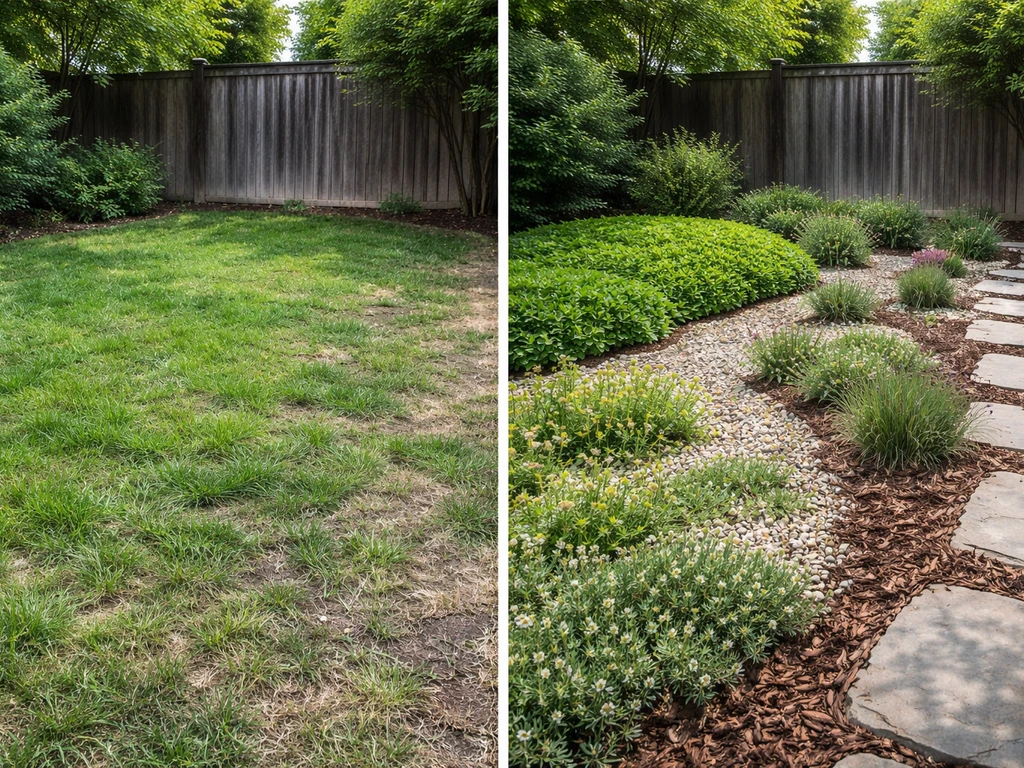
What to Grow Instead of Grass: Plant Options by Yard Conditions
Find the best plants to replace grass by your yard conditions, with groundcover picks, setup steps, and care plans.
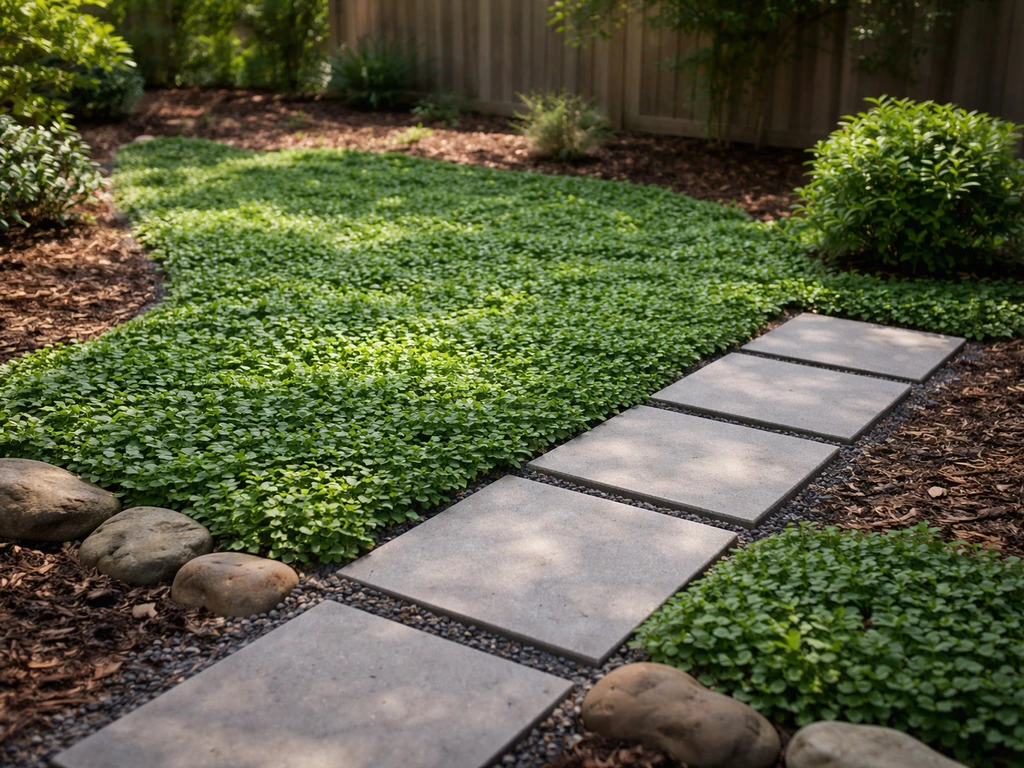
Backyard Ideas Where Grass Won’t Grow: Fix and Replace Lawn
Fix patchy or dead lawn with shade, soil, and drainage solutions plus ground covers, hardscape, and weed control steps.
Ideas for Areas Where Grass Won’t Grow: Practical Options
Replace dead grass with shade, drought, and drainage-friendly landscaping: groundcovers, mulch, gravel, turf, and hardsc