
Water grass grows because your soil is holding more moisture than your lawn grass can tolerate, and moisture-loving species rush in to fill the gap. Whether you are dealing with barnyardgrass colonizing a low spot after rain, nutsedge popping up along a downspout drain line, or true aquatic sedges taking over a poorly graded side yard, the root cause is almost always the same: standing water, poor drainage, compacted soil, or some combination of all three. Fix the water problem and the water grass loses its competitive edge. Ignore it, and no amount of herbicide will keep the problem away permanently.
What Causes Water Grass to Grow: Diagnosis & Long-Term Fixes
Marcus Volkmann
13 Jul 2026
What exactly is 'water grass'? It depends who you ask
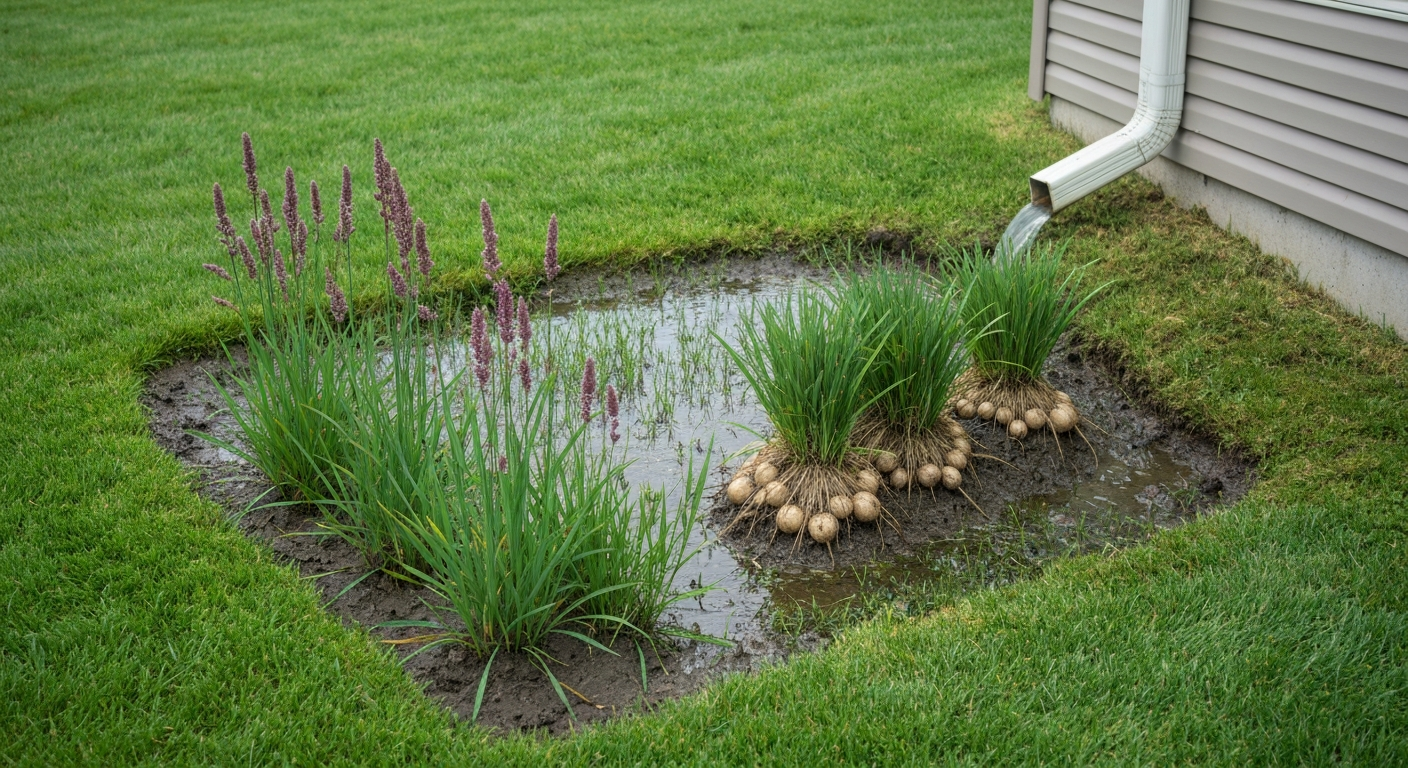
'Water grass' is a folk term, not a botanical one, and that ambiguity causes a lot of misdiagnosis. In practice it gets applied to at least four different plant groups, and each one has a distinct biology, spread mechanism, and management approach. Getting the ID right before you buy a herbicide or rent a sod cutter saves a lot of wasted effort.
- Barnyardgrass (Echinochloa crus-galli and related species): Probably the most common plant called 'watergrass' in North American lawns and disturbed sites. It is a fast-growing annual grass with broad, flat leaves, an open leaf sheath (no ligule), and a distinctive branching panicle seedhead. It loves moist, disturbed, fertile soil and can produce anywhere from 590 to over 2,400 seeds per plant in field conditions, rapidly building a seedbank that carries through winter.
- Aquatic and emergent grasses: True water-edge grasses like reed canarygrass (Phalaris arundinacea) and common reed (Phragmites australis) colonize pond margins, drainage ditches, and chronically flooded sites. These are perennial, often rhizomatous, and much harder to remove than barnyardgrass.
- True sedges (Carex spp.): With roughly 2,000 species worldwide, Carex sedges occupy a huge range of wet habitats. Their defining ID feature is a triangular stem ('sedges have edges') and distinctive perigynia enclosing the female florets. Many species look convincingly like lawn grass until you check the stem cross-section.
- Nutsedges (Cyperus rotundus — purple nutsedge; C. esculentus — yellow nutsedge): Often lumped in with 'water grass' complaints, though technically sedges rather than grasses. Triangular stems, a characteristic umbrella-like (umbel) seedhead, and nutlike underground tubers distinguish them. Tubers, not seeds, drive their spread, which is why hand-pulling almost never works long-term.
If you are also fighting a fungal problem in the same wet patch, it is worth knowing that excess moisture encourages diseases like leaf spot and other turf pathogens alongside weed pressure. See whether crimson fungus can grow on grass for a deeper look at how that specific pathogen behaves in wet turf conditions can crimson fungus grow on grass. The connection between wet conditions, weeds, and fungal outbreaks is real and practical to address together rather than separately.
Who ends up dealing with water grass
In my experience the problem falls into a few predictable patterns depending on who you are and what you are managing.
- Homeowners with low-lying yards or clay soils: The most common scenario. A corner of the lawn stays soggy for days after rain, the turf thins out, and opportunistic moisture-lovers fill in. Often worsened by downspouts discharging close to the foundation, poor lot grading, or clogged gutters backing up near the house.
- Landscapers managing multiple client properties: Water grass tends to concentrate around irrigation heads, drainage swales, and low transitions between hardscape and turf. Identifying and fixing the source drainage issue saves repeat visits.
- Vegetable and ornamental gardeners: Barnyardgrass is a serious competitor in garden beds, especially after wet springs. Its massive seedbank means it returns every year if soil moisture and disturbance remain high.
- Turf managers near water features: Pond margins, creek banks, and retention areas almost guarantee a mix of emergent grasses, sedges, and nutsedge pressure along the transition zone.
The environmental drivers behind water grass growth
Understanding why water grass thrives in your specific spot is the most useful diagnostic step you can take. These are the conditions that reliably favor moisture-tolerant, weedy species over standard turf.
Standing water and poor drainage
Prolonged standing water after rain is the most direct trigger. Most turf grasses (Kentucky bluegrass, tall fescue, bermudagrass) start to lose root function within days of waterlogged conditions. Barnyardgrass and sedges are adapted to low-oxygen soils and move in as turf thins. Common structural causes include insufficient slope around structures (poor grading), hardscape runoff concentrating in one area, and downspouts that discharge directly onto lawn surfaces.
Compacted and anaerobic soils
Compacted clay soils have low infiltration rates, meaning water sits on the surface or perches in the upper few inches rather than draining through. Compaction also reduces oxygen diffusion into the root zone, creating anaerobic (low-oxygen) conditions that kill off turf roots but are tolerable for many sedges and wet-adapted grasses. High penetrometer resistance values and bulk density above roughly 1.4 to 1.6 g/cm3 (clay soils) are associated with severely restricted root growth in most turf species.
Soil pH and nutrient imbalances
Chronically wet soils often develop altered chemistry: reduced pH, manganese and iron becoming more soluble, and nitrogen cycling changing under anaerobic conditions. This can suppress turf growth while leaving opportunistic weeds relatively unaffected. A basic soil test before treating is never wasted effort.
Shade and tree competition
Dense shade reduces evapotranspiration, which keeps surface soils wetter for longer between rain events. Turf thins in the shade, opens up bare soil, and water-tolerant species take hold. The shade-moisture combination is particularly common under trees with surface roots that also compact the soil.
Seasonal timing and temperature
Barnyardgrass germinates in warm soil (typically above 50 to 60 degrees F) and peaks in late spring through summer, aligning exactly with the wet, warm windows when turf is either recovering from winter dormancy or stressed by heat. Nutsedges are warm-season plants that flush aggressively in late spring and early summer once soil warms. Both become much harder to control once established, so early identification matters.
How excess moisture sets off a chain reaction: fungal disease, nutsedge, and feedbacks
Wet soils do not just invite water grass. They create the environment for a reinforcing cycle of turf decline. Extended leaf wetness and high humidity promote foliar fungal diseases, including the leaf-spot pathogens that thin turf in high-moisture conditions. Thin turf exposes bare soil, which barnyardgrass and nutsedge colonize rapidly. Once nutsedge establishes its tuber network underground, even killing the above-ground growth does not remove the stored carbohydrate reserves that drive re-sprouting season after season.
Nutsedge in particular thrives at the intersection of wet conditions and disturbed soil. Purple nutsedge (Cyperus rotundus) forms chains of rhizomes bearing multiple tubers, and a single plant can generate a surprisingly large tuber network in one season under favorable conditions. Those tubers remain viable for multiple seasons, which explains why a patch of nutsedge that seemed to disappear over winter is back in full force by June. The relationship between moisture, fungal disease, and nutsedge is a genuine management challenge worth understanding as a connected problem, not three separate ones.
General grass-growth factors that overlap with wet-site problems
Many of the same factors that drive healthy grass growth generally also interact with wet-site problems in ways that are worth understanding. Fertility, irrigation habits, mowing, and soil structure all matter here, not just drainage.
- Fertility: Excess nitrogen in wet, poorly drained soils encourages lush, soft turf growth that is more susceptible to fungal pathogens and to competition from fast-growing weeds like barnyardgrass. Balanced fertility with adequate potassium improves stress tolerance.
- Irrigation: Frequent shallow irrigation keeps surface soils consistently moist, exactly the conditions barnyardgrass and nutsedge prefer. Shifting to infrequent, deep watering cycles (where drainage allows) dries the surface between cycles and reduces germination opportunities for water-grass seeds.
- Mowing height: Scalping turf with a low mower increases solar radiation reaching the soil surface, raises soil temperature, and promotes weed seed germination. Maintaining recommended mowing heights for your turf species creates a canopy that shades out seedlings.
- Soil structure: Organic matter content directly affects drainage, aeration, and water-holding balance. In clay soils, building organic matter through repeated light topdressings improves both aeration and drainage over multiple seasons.
How to identify what you actually have
Correct ID is the step most people skip. It matters because a herbicide that works beautifully on barnyardgrass may do almost nothing against nutsedge, and vice versa. Here are the key traits to check.
| Plant | Stem shape | Ligule | Leaf sheath | Seedhead | Underground structure |
|---|---|---|---|---|---|
| Barnyardgrass (Echinochloa crus-galli) | Round, hollow | Absent (no ligule) | Open, no hairs | Branching panicle, often purplish, bristly spikelets | Fibrous roots only, annual |
| Yellow nutsedge (Cyperus esculentus) | Triangular ('edges') | Absent | Closed | Umbrella-like (umbel) of straw-colored spikelets | Rhizomes with pale tan tubers/nutlets |
| Purple nutsedge (Cyperus rotundus) | Triangular | Absent | Closed | Umbel of reddish-brown to purple spikelets | Chain of rhizomes with dark brown tubers |
| True sedge (Carex spp.) | Triangular | Present (membranous or hairy) | Closed | Spikes with perigynia enclosing female floret | Varies; many form clumps or short rhizomes |
| Reed canarygrass (Phalaris arundinacea) | Round, hollow | Membranous ligule | Open | Dense, branched panicle, pale to purplish | Stout rhizomes, perennial |
Photo and figure suggestions for accurate field ID
If you are photographing a suspect plant for diagnosis or comparison to online resources like USDA PLANTS or iNaturalist, these are the shots that actually tell you something useful.
- Leaf close-up at the collar: Photograph the junction of leaf blade and stem at 3 to 5 inches from the base. This is where you see (or do not see) the ligule and whether the sheath is open or closed.
- Stem cross-section: Cut the stem cleanly with scissors and photograph the cut end. Round equals grass family; triangular equals sedge family. This single photo often settles the ID.
- Seedhead: A clear shot of the full seedhead shows panicle structure vs. umbel vs. spike arrangement. Include scale (a coin or ruler) if possible.
- Whole plant with surrounding context: A wider shot showing plant height, growth habit (clumping vs. spreading), and the surrounding site (wet low spot, irrigation head, pond margin) helps confirm habitat.
- Dig up and photograph the roots: For nutsedge suspects, pulling up a clump and photographing the underground structures is definitive. Dark chains of tubers equals purple nutsedge; pale tan rounded nutlets equals yellow nutsedge; fibrous roots with no tubers pushes toward barnyardgrass or a true grass.
Diagnostic checklist and simple field tests
Before spending money on herbicides or drainage work, run through these basic field assessments. They take less than an hour and tell you whether you have a drainage engineering problem, a compaction problem, a chemistry problem, or all three.
- Surface grading check: Stand at the problem area during or just after rain and watch where water flows. Does it sheet toward the wet patch from a higher area, downspout, or hardscape edge? Use a simple line level or a smartphone level app to check slope direction. Soil around foundations ideally slopes away at 6 inches per 10 feet.
- Percolation / infiltration test: Dig a hole 6 to 12 inches deep and 6 inches wide. Fill it with water and let it drain completely, then fill again and time how long the second fill takes to drain. Well-drained soil drains 1 to 6 inches per hour. Drainage below 0.5 inches per hour indicates serious infiltration problems that will not be solved by herbicide alone.
- Soil texture test: Take a moist handful of soil and squeeze it. Sand feels gritty and does not hold a ribbon when worked between thumb and forefinger. Silt feels silky and forms a short ribbon. Clay feels sticky, holds a long ribbon (over 2 inches), and holds its shape when released. High clay content explains both compaction and slow drainage.
- Compaction test: Push a standard screwdriver or a pencil into the soil with hand pressure. If you cannot get 6 inches without significant resistance, compaction is restricting root growth and water movement. A penetrometer gives more consistent readings if you have access to one.
- pH test: Inexpensive pH test kits from garden centers or a basic lab soil test (typically under $20 through cooperative extension) tells you if pH corrections are needed. Most turf grasses perform best between pH 6.0 and 7.0. Chronically wet, anaerobic soils can acidify over time.
- Moisture mapping: After a significant rain event, walk the property at 12 and 24 and 48 hours and mark or photograph spots still visibly wet or soggy. This map tells you both the extent of the problem and where drainage intervention is most needed.
Short-term fixes: what you can do now
| Fix | Purpose | Speed of result | Pros | Cons / limits | Best use case |
|---|---|---|---|---|---|
| Surface regrading (minor) | Redirect surface runoff away from wet patches | Days to weeks (after work) | Relatively inexpensive DIY; addresses root cause | Only works for surface drainage; does not fix soil compaction or high water table | Low spots receiving runoff from higher ground or hardscape |
| Redirecting downspouts | Eliminate point-source water input to soggy area | Immediate | Fast, free or very low cost; directly removes a water source | Does not help if cause is rising water table or clay soil | Wet spots directly adjacent to foundation or downspout discharge points |
| Core aeration | Relieve compaction, improve water infiltration and air exchange | 1 to 2 seasons for measurable improvement | Addresses compaction directly; improves turf root depth | Must be repeated annually on heavy clay; no immediate drainage fix | Compacted turf with poor percolation test results |
| Temporary sump pump or surface drain | Remove standing water during and after heavy rain events | Immediate during operation | Buys time; protects turf during recovery | Operating cost; does not fix drainage permanently; requires outlet | Low-lying areas with no practical grading solution short term |
| Spot herbicide application | Suppress existing water-grass growth in affected area | Days to 2 weeks for visible effect | Targeted; minimizes collateral damage to surrounding turf | Does not prevent regrowth if drainage is not addressed; label compliance required | Established barnyardgrass or nutsedge patch with a clear ID |
| Targeted hand removal | Remove small infestations before seed set | Immediate (above-ground) | No chemicals; prevents seed addition to seedbank | Labor-intensive; ineffective for nutsedge unless tubers removed; promotes disturbance | Small annual grass patches caught early, before seedhead development |
| Adjust mowing height and frequency | Reduce soil temperature and light at surface; reduce stress on turf | Ongoing | Low cost; improves competitive advantage of turf | Does not fix water problem; benefit is incremental | Any wet site where turf is thinning due to combined moisture and mowing stress |
Long-term fixes: solving the underlying problem
| Fix | Estimated cost (residential scale) | Permanence | Timeline to effect | Tradeoffs |
|---|---|---|---|---|
| Subsurface French drain installation | $500 to $3,000+ depending on length and complexity | High (10+ years with maintenance) | Drainage improvement within 1 to 2 rain cycles after installation; full turf recovery 1 season | Requires planning, a clear legal outlet, and proper slope (~0.5 to 1%); can clog if geotextile fails; may require permits |
| Soil amendment program (compost topdressing + aeration) | $100 to $400/year DIY; more if contracted | Moderate; improves over 3 to 5 seasons with repetition | Noticeable infiltration improvement after 2 to 3 seasons of repeated applications | Slow; requires commitment to annual program; light application rates (roughly 0.5 cubic feet per 1,000 sq ft) are key — one heavy dump does not work |
| Converting to wet-tolerant turf varieties | $200 to $800+ for seed or plugs depending on area | High once established | Full cover in 1 to 2 growing seasons | Species selection is critical; some wet-tolerant grasses have lower wear tolerance or different aesthetics |
| Rain garden or bioswale conversion | $300 to $2,000+ depending on design and plants | High; structural solution | Drainage function immediate; plant establishment 1 to 2 seasons | Eliminates lawn in affected area; requires appropriate plant selection; may need permit in some municipalities |
| Converting to alternative groundcover or hardscape | $500 to $5,000+ depending on material and area | High | Immediate drainage benefit if permeable materials used | Eliminates turf; significant aesthetic and use change; permeable pavers cost more upfront but provide drainage benefit |
| pH and fertility correction | $30 to $100 for materials (lime, sulfur, fertilizer) | Moderate; re-test every 2 to 3 years | 1 growing season for measurable pH shift | Does not fix drainage; must be combined with drainage work to have lasting effect on water-grass pressure |
Herbicide and cultural control: what to know before you spray
Chemical control works best as a complement to cultural fixes, not as a replacement for them. If the drainage problem is not addressed, water grass will return the next season regardless of how effective the herbicide application was. That said, targeted herbicide use is a legitimate part of an integrated plan. See the blank" rel="noopener noreferrer">SedgeHammer (halosulfuron‑methyl) EPA product label for label-specific use rates, application instructions, and registered claims for nutsedge control.
- Always confirm the ID before buying a product: Herbicides labeled for grassy weeds (pre-emergent or post-emergent grass controls) will not effectively suppress nutsedges, which require selective sedge herbicides. Getting this wrong costs time and money.
- For nutsedges specifically: Products containing halosulfuron-methyl (SedgeHammer and generic equivalents) are the most widely recommended for homeowner and professional use. Sulfentrazone-based products are another option. Both require repeat applications per label instructions because tubers surviving in the soil will re-sprout. Apply when nutsedge is young and actively growing, not drought-stressed or mature.
- Spot treatment vs. broadcast: Where water grass patches are clearly defined, spot treatment protects surrounding turf and non-target plants. Reserve broadcast applications for situations where infestation covers more than 30 to 50 percent of the lawn area.
- Read and follow the label: Label compliance is not optional. Pay attention to temperature and wind restrictions, re-entry intervals, buffer requirements near water features, and whether the product is labeled for use near ditches or pond margins.
- Cultural first approach: Improving drainage, aerating, topdressing, and adjusting irrigation often reduces water-grass pressure significantly without any herbicide. In my experience, managing the site conditions first and using targeted chemical control for what remains gives better multi-season results than a chemical-only approach.
Control vs. adapt vs. replace: how to decide
Not every wet, weedy spot is worth fighting for as turf. Honest assessment of a few criteria saves a lot of money and frustration.
| Scenario | Recommended approach |
|---|---|
| Small patch (under 100 sq ft), clear identifiable cause (one downspout, minor low spot), first occurrence | Control: redirect the water source, spot-treat the weed, overseed. High likelihood of success with straightforward fix. |
| Recurring infestation same spot every season despite treatment, moderate area (100 to 500 sq ft) | Adapt: investigate deeper drainage issue. Combine aeration and soil amendment program with chemical control. May take 2 to 3 seasons. |
| Large area (over 500 sq ft), perennially wet from high water table or site topography, significant nutsedge or reed canarygrass pressure | Replace: consider converting the area to a rain garden, native wet-tolerant planting, or permeable surface. Maintaining standard turf in a site that is structurally unsuited to it is an ongoing cost with diminishing return. |
| Wet area near water feature, drainage ditch, or creek margin — plants appear native or semi-natural | Assess before acting: some emergent grasses and sedges provide erosion control and habitat value at water margins. Check local regulations before removing plants in jurisdictions that protect riparian vegetation. |
| Recurrence after repeated herbicide applications with no drainage work done | Stop and diagnose: repeated chemical applications without addressing root-cause drainage issues rarely produce lasting results and add unnecessary product to the soil and water system. |
When to call a professional
There is a clear line between what a motivated homeowner can handle and what genuinely needs specialized help. Here is where that line usually falls.
- Drainage engineers or civil engineers: If your wet spot is caused by a high water table, seasonal flooding from an adjacent water body, or inadequate lot grading that requires significant earthwork, you need a professional grade assessment before investing in drainage infrastructure. French drain installation is relatively simple when the outlet exists and the slope is obvious. When it is not obvious, engineered solutions prevent costly mistakes.
- Turf and landscape specialists: If you have large-scale nutsedge or invasive grass problems, a licensed professional applicator can use commercial-rate products and application equipment that homeowners do not have access to. They can also do a soil health assessment that goes beyond a basic pH test.
- Licensed pesticide applicators: Some situations near water bodies, wetlands, or protected vegetation zones require applicators with aquatic pesticide endorsements. Applying the wrong product near a drainage ditch or retention pond can violate state and federal regulations.
- Signs you need professional help: Your wet spot is getting larger over multiple seasons despite DIY intervention; water is ponding within 24 hours of light rain events; the problem involves a shared property line or municipal drainage infrastructure; you suspect a broken underground irrigation or utility line is contributing to the moisture.
Step-by-step homeowner action plan
- Diagnose first: Run the percolation test, compaction check, surface grading observation, and moisture mapping as described above. Photograph the problem plants using the ID shots listed in the identification section. Confirm whether you are dealing with barnyardgrass, nutsedge, or a true sedge before purchasing any product.
- Address immediate water sources: Before any planting, seeding, or chemical work, redirect obvious water inputs. Move downspout extensions, clear clogged gutters, and if necessary install a temporary pop-up drain emitter to move water away from the problem area.
- Apply targeted control if needed: Once ID is confirmed and the immediate water source is managed, apply appropriate spot herbicide per label if infestation is established. For barnyardgrass, post-emergent grass selective herbicides work at the young seedling stage. For nutsedge, halosulfuron-methyl-based products applied to young actively growing plants give the best results with expected need for repeat applications.
- Address the underlying soil problem: Schedule core aeration during the appropriate active growing period for your turf species. Apply a light topdressing of screened compost (approximately 0.5 cubic feet per 1,000 square feet) while cores are open. For serious compaction or drainage issues, plan longer-term drainage installation.
- Overseed or replant: Once drainage is improved and water-grass competition is reduced, overseed thinned areas with appropriate turf varieties. Choose species with some wet-tolerance if the site will remain moderately moist (for example, tall fescue for cool-season lawns, or bahiagrass/St. Augustinegrass for warm-season areas with seasonal wetness).
- Follow up at 30, 60, and 90 days: Check whether nutsedge or barnyardgrass is re-sprouting. A second herbicide application per label timing is often necessary for nutsedge. Document what you find at each check.
Maintenance checklist to prevent recurrence
Once you have the problem under control, keeping it that way is mostly about consistent habits, not heroic interventions.
- Monitor monthly during warm season: Walk the affected area once a month from April through September. Catching barnyardgrass seedlings at 2 to 3 leaves or nutsedge at emergence is far easier and cheaper to manage than a mature infestation.
- Irrigation scheduling: Switch to deep, infrequent irrigation cycles. Most established turf grasses benefit from 1 to 1.5 inches per week total (rain plus irrigation) delivered in one or two applications rather than daily light watering. Consistently moist surface soil is the environment water grass prefers.
- Annual aeration: On clay or compacted soils, schedule core aeration once per year minimum. High-traffic areas or heavily compacted sites may benefit from twice-yearly aeration. Follow with a light compost topdress.
- Mowing discipline: Maintain the recommended mowing height for your turf species. Never remove more than one-third of the blade in a single mowing. Taller turf shades the soil surface, suppresses weed seed germination, and maintains a deeper root system better able to handle moisture stress.
- Annual soil test: Every two to three years is adequate for most established lawns, but annually if you are managing a wet-site recovery. Adjust pH and fertility based on results, not assumptions.
- Post-rain inspection after major storms: After any rain event that leaves standing water for more than 24 hours, walk the site and note problem areas. Early-season standing water is your clearest indicator of where next year's water-grass pressure will be concentrated.
Related topics worth reading alongside this one
Water grass rarely shows up in isolation. If you are dealing with a wet, problem lawn you will likely run into the following connected issues. Understanding what causes fungus to grow in grass helps you recognize why the same soggy spots that harbor water grass also produce leaf-spot and other turf diseases. Since nutsedge is one of the most common plants called water grass, a deeper look at what causes nut grass to grow is directly relevant, especially for understanding the tuber biology that makes it so persistent. And for the bigger picture of what is happening in your soil and environment, understanding the general causes of grass growth helps connect fertility, soil structure, and moisture management into a coherent approach for your whole lawn. For a concise overview of the environmental and biological factors behind turf development, see our article on what causes grass to grow.
Quick summary and next steps
Water grass grows because moisture-tolerant, opportunistic species outcompete standard turf under wet, compacted, or poorly drained conditions. The fix always starts with diagnosing the water source and soil condition, not with a herbicide purchase. For most homeowners, the winning sequence is: confirm the species, remove or redirect the water input, run the diagnostic tests, apply targeted control if needed, address the soil with aeration and amendment, and build monitoring habits to catch any comeback early. For detailed practical parameters, Carolina Athletic Fields (NC State Extension) recommends routine aeration and light, repeated topdressing (for example, about 0.5–0.7 cubic feet per 1,000 ft² or roughly ¼ inch per application) and applying topdressing while cores are open North Carolina Extension recommends routine aeration and light, repeated topdressing (for example, about 0.5–0.7 cubic feet per 1,000 ft² or roughly ¼ inch per application) and applying topdressing while cores are open.. If the site is structurally wet by nature, converting to a rain garden or wet-tolerant alternative is often the most honest and cost-effective long-term answer. When in doubt about drainage engineering, chemical application near water, or large-scale infestations, bring in a professional. The sites that stay clean year after year are the ones where the drainage problem was actually solved, not just the weeds that were sprayed.
FAQ
What does people mean by “water grass” and which species are commonly called that?
“Water grass” is a non‑technical umbrella term for several grasslike plants that colonize wet spots. Common candidates: barnyardgrass/wild millet (Echinochloa spp., annual, branching panicle seedheads), true sedges (Carex spp., triangular stems and perigynia), and nutsedges (Cyperus spp., triangular stems with underground tubers). It can also refer broadly to emergent aquatic grasses in ponds or ditches.
What environmental conditions cause water grass to appear?
Main drivers: standing water or a high water table, poor drainage or low landscape grade, compacted/anaerobic soils that limit oxygen diffusion, heavy clay soil texture, repeated shallow irrigation, nutrient‑rich (high N/P) wet soils, dense shade that reduces turf vigor, and seasonality (warm, wet periods favor many opportunistic grasses). These conditions favor species tolerant of low oxygen and disturbance.
How do I distinguish grasses (Poaceae) from sedges (Cyperaceae) and nutsedges (Cyperus) in the field?
Key ID checks: stem cross‑section (grasses round/hollow; sedges and nutsedges often triangular), ligule and sheath behavior (grasses have characteristic ligules; sedges lack typical grass ligules), inflorescence shape (grasses: panicles/spikelets; Carex: perigynia‑bearing spikes; Cyperus: clustered umbels/spikelets), and belowground parts (nutsedges produce chains of tubers). Close photographs of stem cross‑section, ligule/sheath, and seedhead are diagnostic.
What simple diagnostic tests can homeowners or landscapers run on site?
Practical tests: 1) Soil texture by feel (sand/silt/clay estimate). 2) Infiltration/percolation test: dig a 6–12" hole, fill with water, time how long to drain (slow = poor infiltration or high water table). 3) Compaction check: probe soil with a screwdriver or simple penetrometer; strong resistance suggests compaction. 4) Observe surface runoff and flow paths during rain and check gutters/downspouts. 5) pH test kit and basic soil nutrient test from extension lab if needed.
How do I decide whether to control water grass, adapt (tolerate), or replace the planting?
Decision points: - Control if the species is invasive, reduces desired turf/ornamental performance, or poses safety/aesthetic issues. - Adapt if wet conditions are chronic and species are stable, by converting to wet‑tolerant turf or moisture‑loving ornamental planting (e.g., native sedges, rushes). - Replace when wetness is chronic and corrective drainage is impractical or cost‑prohibitive. Consider effort/cost, site use, and recurrence potential (e.g., nutsedge tuber banks make eradication difficult). If in doubt, consult local extension or a landscape professional.
What short‑term fixes work quickly to reduce wet patches and limit spread?
Short‑term measures: surface grading to redirect flow, temporary sump pump or well‑placed outlet for standing water, fixing downspouts and gutter discharge, spot herbicide applications (see safe herbicide notes below), hand‑digging small patches (remove entire nutlets for nutsedge), and timely mowing to prevent seed set for annual watergrasses. These reduce immediate symptoms but may not solve underlying causes.
Next Articles
Can You Grow Grass Over Gravel? How to Do It Right
Learn when you can grow grass over gravel and follow a step-by-step method for soil depth, drainage, seeding or sod, and
Do Wood Chips Help Grass Grow? When They Work and When Not
Learn when wood chips help grass grow, when they steal nitrogen, and step-by-step how much to apply and seed options.

Will Potting Soil Help Grass Grow? What Works and What Fails
When potting soil helps grass grow, when it fails, and how to prep, apply, seed, water, and troubleshoot bare spots.