
Yes, you can let clover grow in your lawn, and for many homeowners it's the right call. Clover fixes nitrogen from the air, tolerates drought better than most cool-season grasses once established, and feeds pollinators all summer. If you’re asking “is clover easier to grow than grass,” clover often establishes more readily in poor, low‑nitrogen soils and tolerates some drought, though it behaves and looks very different from a traditional turf lawn. But it also flowers prolifically, spreads aggressively, and looks nothing like a traditional turf lawn. Whether you should keep it depends on why it showed up, what your soil is doing, and what you actually want your lawn to look like. This guide gives you the evidence to make that call, plus step-by-step paths for all three realistic options: accept it, manage it alongside grass, or remove it.
Should I Let Clover Grow in My Lawn: Decide with Checklist
Should I let clover grow in my lawn? The quick verdict
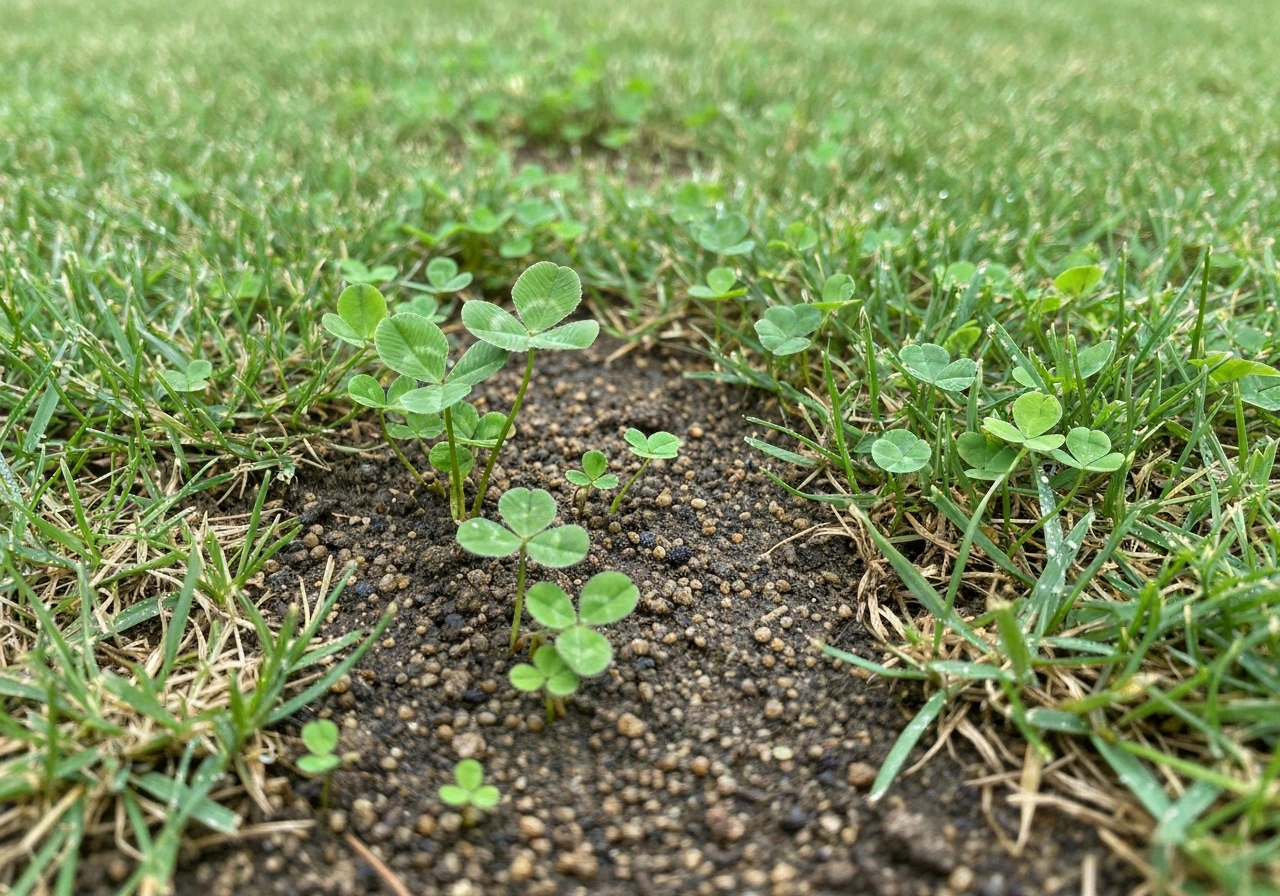
Clover in your lawn is almost always a symptom before it's a problem. It shows up because your soil is low in nitrogen, compacted, thin, or poorly drained, conditions where grass struggles and clover thrives. If those conditions are temporary and fixable, removing the clover and improving the soil makes sense. If your soil is genuinely poor or you're tired of the fertilizer treadmill, leaning into clover (or converting to a clover-grass mix) is a legitimate, practical alternative with real ecological upside. What this guide won't do is pretend there's one right answer. Use the decision checklist in section 6 to find which path fits your situation, then follow the relevant option below.
What clover actually does for your lawn
Nitrogen fixation, the real numbers
White clover (Trifolium repens) fixes atmospheric nitrogen through its root-zone rhizobia, and this is the benefit most homeowners have heard about. The honest numbers are more complicated than the marketing suggests. In mixed grass-clover swards, published field studies using 15N tracing report fixation rates of roughly 25 to 250 kg of nitrogen per hectare per year, depending on clover abundance, climate, and how much mineral fertilizer you're applying. The nitrogen that actually transfers to your grass in the early years is a smaller fraction, typically around 10 to 40 kg N per hectare per year in most experiments, which is meaningful but not a complete fertilizer replacement. Critically, applying mineral nitrogen fertilizer suppresses clover populations over time, so the more you fertilize, the less clover you'll have, and the less fixation occurs. If you want the nitrogen benefit, you have to ease off the synthetic N.
Drought tolerance, useful but not unlimited
University extension guides from Maine, Minnesota, and Florida note that established white clover and microclover varieties can persist with less irrigation than many cool-season grasses, staying green during dry spells that turn fescue and bluegrass lawns brown. That said, the research is genuinely mixed. A 2024 review, Global research trends and hotspots in white clover responses to drought stress (review), MDPI (2024), summarizes conflicting findings on white clover drought tolerance, noting cultivar, physiological traits, and management practices strongly influence whether clover is water‑efficient or drought‑sensitive Global research trends and hotspots in white clover responses to drought stress (review) — MDPI (2024). Physiological studies show white clover is sensitive to water deficit, and drought response varies significantly by cultivar and climate. In practice, what I've seen is that clover stays greener than grass during moderate summer stress, then suffers just as hard as anything else in a genuine, extended drought. Think of it as drought-resistant rather than drought-proof.
Pollinator value, this one is well documented
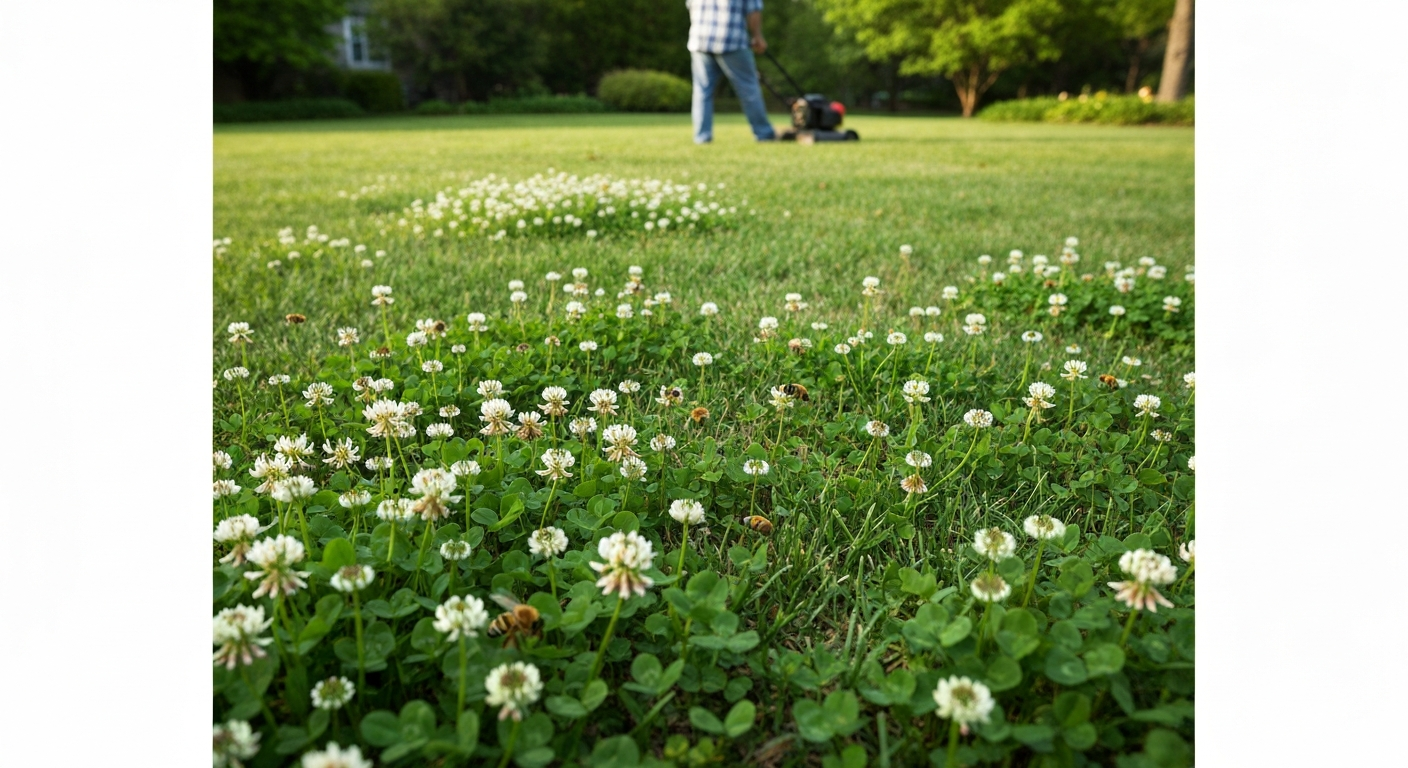
This is where the science is clearest. Multiple peer-reviewed studies, including urban lawn sampling work from the University of Kentucky, confirm that white clover in lawns is a major nectar source for honey bees, bumble bees, and native solitary bees during bloom periods. Research on No-Mow and bee lawn approaches shows measurably higher pollinator richness and abundance in lawns where flowering plants like clover are allowed to bloom. If you have even a small patch of clover flowering from spring through late summer, you're running a meaningful pollinator resource. Clover blooms from roughly April through September in most temperate regions, with multiple flowering flushes, that's a long season of forage. White clover, SARE / UC Davis cover crop info (flowering and seeding behavior) documents that white clover typically initiates flowering in spring with multiple flushes from about April–September in temperate regions, and seed maturation can follow each flush White clover — SARE / UC Davis cover crop info (flowering and seeding behavior).
Ground cover and soil benefits
Clover fills bare patches quickly, which matters in thin lawns. It has a relatively shallow but dense root structure that helps reduce soil erosion and bare-soil exposure, bare soil being the exact condition that invites more weeds. In my experience working with clients on thin, low-fertility lawns, a clover-inclusive sward holds the ground through difficult conditions far better than a struggling pure-grass stand waiting for conditions to improve.
The real drawbacks, don't ignore these
- Flowering: White clover blooms repeatedly from spring through summer. Flowers attract bees, which creates a barefoot-walking hazard and a genuine sting risk in high-traffic yards, especially for children or anyone with bee allergies.
- Texture and aesthetics: Clover has a distinctly different leaf texture, growth habit, and color than turf grasses. A mixed lawn will look patchy and uneven to most people, not lush and uniform. If appearance matters to you or your HOA, that's a real issue.
- Seed spread: White clover sets seed after each flowering flush from spring through late summer. Seeds spread by wind, foot traffic, and equipment, meaning clover can colonize neighboring beds, garden rows, and your neighbor's lawn.
- Allergy concerns: Some people are allergic to clover pollen. If anyone in your household has grass or pollen allergies, adding a prolific flowering plant to the lawn is worth discussing with them first.
- Mowing management: Clover grows at a different rate and height than turf grasses. If you're maintaining a mixed lawn, timing mowing to interrupt seed set while not scalping the grass requires more attention than a pure turf mowing schedule.
- Herbicide incompatibility: Standard broadleaf herbicides used for lawn weed control will kill clover. If you want to keep clover, most routine weed-and-feed products are off the table.
Why clover, dandelions, daisies, and bulbs like daffodils keep showing up
Clover, dandelions, daisies, and other broadleaf plants don't invade healthy, dense turf easily. They fill gaps. When your soil is low in nitrogen, compacted, or has a pH problem, grass thins out and broadleaf plants rush in because they tolerate those conditions better than turf grasses do. Dandelions and daisies are doing the same basic thing clover does: exploiting a stressed or thin lawn. For related guidance on intentionally establishing dandelions in a managed or 'grounded' area, see can you grow dandelions in grounded. Even bulbs like daffodils, while planted intentionally, persist and naturalize best where turf is sparse enough to give them light and space. The common thread is that a dense, well-fed, correctly mowed lawn is its own best defense. When you see clover and other broadleaf plants spreading, the lawn is trying to tell you something about your soil or your management. Understanding why these plants appear together is the starting point for any solution. For more detail on the specific ecology and management of daisies in lawns, see our guide on why do daisies grow in grass. For more on the ecology and reasons dandelions appear in turf, see our brief explainer on why do dandelions grow in grass. See the related piece 'Why does clover grow in grass' for a focused explanation of the soil and management reasons clover appears in lawns.
Soil and site causes you should actually test for
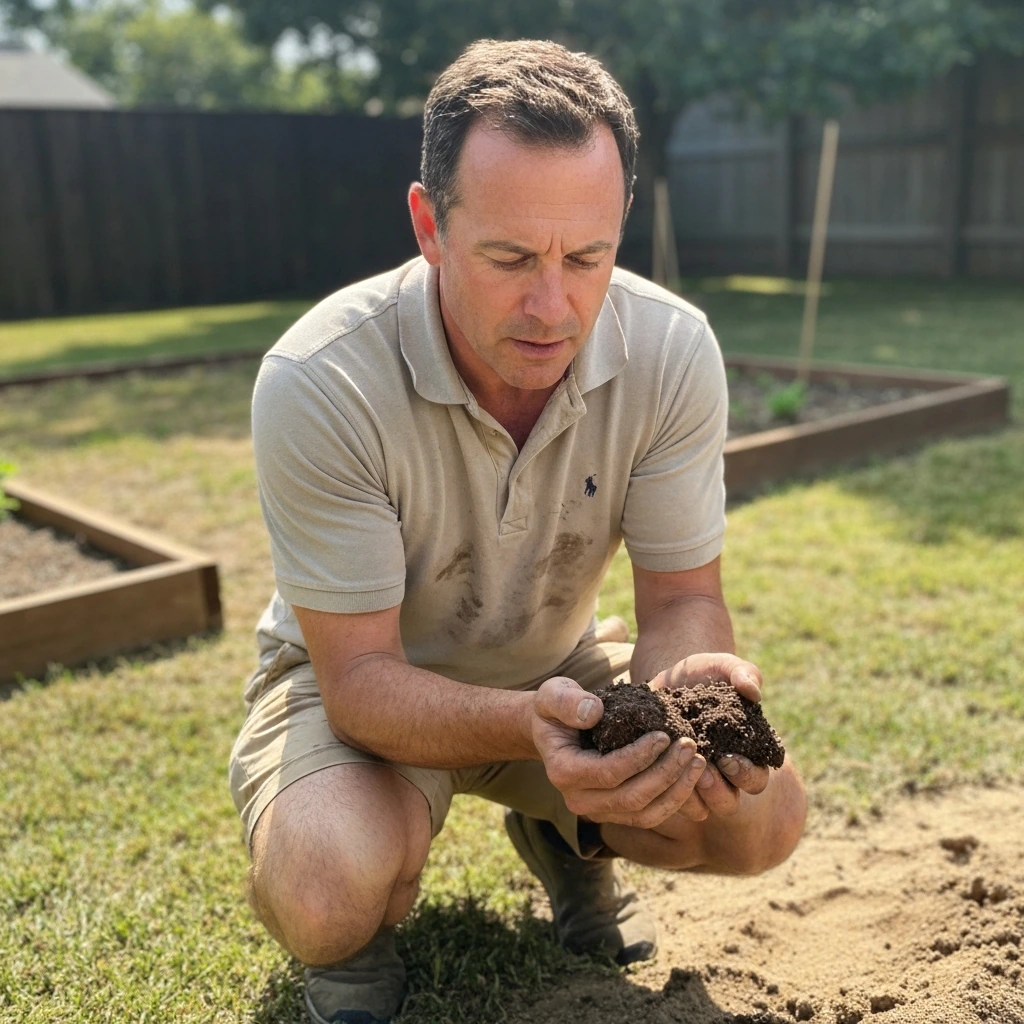
Before you spray anything or overseed, run a soil test. Most state university extension labs charge $15 to $25 and give you pH, phosphorus, potassium, and organic matter, the foundational numbers you need. Here's what each result means for your clover situation:
| Soil factor | What to test | How it favors clover | What to do |
|---|---|---|---|
| Nitrogen availability | Management history, clipping tests (routine soil tests don't reliably capture mineral N) | Low N weakens turf, creating gaps clover fills | Apply species-appropriate N per extension guidelines; cool-season lawns typically ~2–4 lb N/1,000 ft²/yr |
| Soil pH | Standard soil test (target 6.0–7.0 for most turf and clover) | Clover tolerates a wide pH range; very acidic soils weaken grass more than clover | Lime to raise pH or sulfur to lower it, based on lab recommendation |
| Compaction | Penetrometer (cone index) or bulk density core sample | Compacted soil restricts grass roots more than clover's shallower system | Core aerate; address underlying causes (heavy traffic, clay soil) |
| Phosphorus and potassium | Standard soil test | Low P/K weakens turf density and root development | Apply per lab recommendation; avoid over-application |
| Drainage and shade | Visual observation, shade mapping, drainage probe | Poor drainage and shade stress turf, leaving clover to fill in | Improve drainage where possible; consider shade-tolerant grass species or ground covers |
One thing I want to flag: routine soil tests from university labs are excellent for pH, P, K, and organic matter, but they don't reliably predict available nitrogen because N is biologically dynamic. Use your lawn's appearance, clipping growth rate, and fertilization history to gauge whether nitrogen is your limiting factor. If you've never fertilized and clover is everywhere, that's your answer.
10-question checklist: accept, manage, or remove?
Answer yes or no to each question. Tally your responses in the categories at the end.
- Do you have children or pets who regularly go barefoot in the lawn? (Yes = lean remove/manage; bare feet and bee-attracting clover flowers are a real hazard.)
- Does anyone in your household have a bee sting allergy? (Yes = strong lean toward remove.)
- Does your lawn have HOA restrictions or neighborhood appearance standards that require uniform turf? (Yes = manage or remove.)
- Is your soil low in nitrogen based on fertilization history or visible turf thinning? (Yes = clover is filling a genuine fertility gap; accept or manage is viable.)
- Is your soil compacted or poorly drained? (Yes = address the root cause first before deciding; clover is the symptom.)
- Are you trying to reduce fertilizer inputs and lawn maintenance time? (Yes = accept or convert to a clover mix makes sense.)
- Do you actively want to support pollinators in your yard? (Yes = keeping flowering clover is a real benefit.)
- Is the clover covering more than 30–40% of your lawn area already? (Yes = removal requires more work; acceptance or conversion may be more practical.)
- Are you willing to mow on a schedule that limits seed set if you keep clover? (No = clover will spread aggressively into beds and neighboring areas.)
- Is your lawn area heavily used for sports, play, or formal entertaining where surface uniformity matters? (Yes = manage or remove.)
Scoring: Mostly yes on questions 1, 2, 3, and 10 points toward removal or strict management. Mostly yes on 4, 5, 6, 7, and 8 points toward acceptance or conversion. If you're split, Option B (managed coexistence) is your starting point.
Option A: Accept it and convert to a clover or microclover lawn
If you've decided to lean into clover rather than fight it, you have two main paths: let existing clover naturalize with some management, or actively convert to a microclover-grass mix. The microclover route gives you the most control over the final result.
Microclover vs. standard white clover
Microclover (typically Trifolium repens var. Pirouette or similar dwarf selections) has smaller leaves, a lower growth habit, and flowers less prolifically than standard white clover, making it far better suited to mixing with turf grasses. Research from the International Turfgrass Society (Bigelow et al., 2022) shows that microclover mixed into cool-season lawn seed produces moderate turf appearance and dry matter without supplemental nitrogen. Adding around 98 kg N/ha/year improved overall turf quality but reduced clover populations over time. The practical takeaway: microclover works best in a low- to moderate-nitrogen management regime. If you fertilize heavily, you'll lose your clover over a few seasons.
How to convert or establish a clover-grass mix
- Test your soil first. Correct pH to 6.0–7.0, address major P/K deficiencies, and aerate if compaction is an issue. Clover needs good seed-to-soil contact to establish.
- Choose your mix. Microclover is typically seeded at 5–10% by weight of a grass-clover mix. A common pairing is microclover with fine fescues or perennial ryegrass for cool-season lawns.
- Timing: Seed in early fall (late August to mid-September in most northern regions) for cool-season grass dominance, or in spring after soil temps reach 50°F for clover-forward establishment. Fall is generally better for grass competition against weeds.
- Seed preparation: Scarify the area lightly (power rake, slit-seeder, or hand raking) to expose soil. Broadcast seed and rake in to 1/4 inch depth or use a slit-seeder for better contact.
- Seeding rate: For a microclover-grass mix, use grass at its standard recommended rate and add microclover seed at roughly 0.5–1 lb per 1,000 sq ft. Pure clover stands use 1–2 lb/1,000 sq ft.
- Irrigation: Keep seedbed consistently moist for 2–3 weeks post-seeding. Once established, reduce irrigation — this is where the drought-tolerance benefit begins to show.
- Fertilization: Withhold or minimize synthetic N after establishment. This is non-negotiable if you want clover to persist in the mix.
- Mowing: Set mower height to 3–4 inches. Higher mowing favors both grass density and microclover. Mow before flowers reach full bloom to reduce seed set and bee-sting risk.
Benefits and honest tradeoffs of a clover lawn
| Factor | Clover/Microclover Mix | Traditional Turf Grass |
|---|---|---|
| Nitrogen input needed | Low to none once established | 2–4 lb N/1,000 ft²/yr for cool-season grasses |
| Pollinator value | High during bloom season | Minimal |
| Appearance uniformity | Patchy, mixed texture, less formal | Uniform, formal |
| Drought performance | Moderate to good; stays greener in mild dry spells | Varies by species; most go dormant in drought |
| Foot traffic tolerance | Moderate; standard white clover wears poorly in heavy traffic | Generally higher with proper turf species |
| Weed control options | Limited; most broadleaf herbicides will kill clover too | Full range of selective herbicides available |
| Mowing frequency | Lower overall but timing-sensitive for seed management | Regular schedule, less timing-sensitive |
| Barefoot safety | Reduced — bee activity on flowers is a real concern | Higher when free of flowering weeds |
Option B: Manage coexistence and keep clover in check
This is where most homeowners realistically land: you don't want a clover lawn, but you also don't want to do a full renovation right now. The goal here is using cultural controls to favor grass over clover without herbicides, gradually reducing clover's share of your lawn over one to two growing seasons.
Fertilize strategically
This is the single most effective cultural lever you have. Because clover is favored by low-nitrogen conditions, raising your soil nitrogen level directly suppresses clover while boosting grass vigor. For most cool-season lawns, that means applying 2 to 4 lb N per 1,000 sq ft per year split across the season, with the largest applications in fall (late summer through mid-fall is the most critical window for cool-season grasses). Fine fescue-dominant lawns operate fine at the lower end, around 0.5 to 2 lb N/1,000 ft²/yr. Use slow-release nitrogen sources in summer to avoid burning. Within two to three seasons of consistent, species-appropriate fertilization, clover populations typically decline significantly in previously thin, low-fertility lawns. I've seen this work on multiple client sites where herbicide was not an option.
Mow at the right height and timing
Mowing height has two jobs here. First, taller grass (3 to 4 inches for most cool-season species) shades out lower-growing clover and reduces its competitive advantage. Second, mowing before clover flowers fully open prevents seed set, which directly slows the spread of clover across your lawn and into your garden beds. White clover flowers appear from spring through September in most regions, so you need to stay on a consistent mowing schedule throughout summer rather than letting the lawn go between cuts. Extension guidance from the University of Minnesota specifically recommends mowing before bloom to limit clover seeding and lateral spread.
Aerate and overseed thin areas
Clover colonizes thin, bare, and compacted areas first. Core aeration in early fall (for cool-season lawns) breaks up compaction, improves root growth, and prepares the surface for overseeding. Immediately after aeration, overseed with a species-appropriate mix at recommended rates, thin grass is your biggest vulnerability, and dense turf is the best long-term clover suppression tool you have. For most cool-season lawns in the northern US, the window for overseeding is late August through mid-September. Don't skip this step if your lawn has visible bare patches or thin areas.
Irrigation management
Deep, infrequent irrigation (watering to a depth of 6 inches once or twice a week rather than light daily watering) encourages deep grass root development and improves drought resilience of turf. Shallow, frequent irrigation keeps the surface moist in ways that benefit clover germination and establishment. If you're overseeding bare areas, you'll need to keep the seedbed consistently moist for 2 to 3 weeks, then transition to a deeper irrigation schedule once grass is established.
Traffic and compaction management
High-traffic areas, paths across the yard, play zones, parking areas near the grass edge, are almost always the first places clover establishes because compaction thins turf quickly. Installing stepping stones, redirecting foot traffic, or designating clear paths through the lawn reduces compaction in vulnerable areas. In zones of unavoidable heavy traffic, consider hardscaping or a more traffic-tolerant ground cover rather than trying to maintain turf grass under those conditions.
When cultural controls aren't enough: targeted herbicide use
If clover is well established across a large portion of your lawn and cultural controls alone aren't making a dent, postemergent broadleaf herbicides are the next step. Products containing triclopyr, MCPP, or clopyralid (check your local label) are effective on white clover when applied in fall or spring while the plant is actively growing. Timing matters: fall application (when daytime temps are consistently between 50 and 80°F) is often more effective than summer application. After herbicide treatment, most extensions recommend waiting at least 2 to 6 weeks before reseeding, depending on the specific product label, always check the label for the required interval. Do not use broadleaf herbicides if you want any clover to remain in the lawn.
FAQ
Should I let clover grow in my lawn?
It depends on your goals. Clover (usually white clover, Trifolium repens) offers real ecological and management benefits — nitrogen fixation, nectar for pollinators, and often improved green cover in thin turf — but it also flowers, seeds, changes lawn texture, and can be unwanted in formal lawns. Choose one of three evidence‑based strategies: accept (including microclover mixes), manage coexistence, or remove/replace. Your choice should be driven by desired appearance, tolerance for blooms/seed, and willingness to change maintenance (mowing, fertilizing, reseeding).
What are the main benefits of allowing clover in a lawn?
Key benefits: (1) Biological nitrogen fixation — mixed grass–clover swards commonly fix roughly 25–250 kg N·ha⁻¹·yr⁻¹ (rates vary widely with clover abundance and fertilization) and can transfer a modest fraction of that N to grasses (often ~10–40 kg N·ha⁻¹·yr⁻¹ in many studies), reducing fertilizer needs. (2) Pollinator forage — clover flowers provide nectar/pollen used by honey bees, bumble bees and native bees. (3) Improved groundcover — clover fills gaps and can maintain green cover in low‑fertility or thin areas. (4) Potential for reduced fertilizer inputs if you accept lower turfgrass quality or use microclover mixes.
What are the drawbacks of clover in a lawn?
Drawbacks include visible white flower heads during bloom (may be undesirable), seed production and spread, a different texture and color compared with turfgrass, potential sensitivity to heat/drought depending on cultivar, and inconsistent nitrogen delivery to grass. In high‑quality ornamental lawns clover can reduce uniformity and is often removed for aesthetics.
What is ‘microclover’ and is it a good compromise?
Microclover are low‑growing, smaller‑leaf cultivars of white clover bred to blend better with turf. They flower less conspicuously, reduce patchiness, and can contribute N while maintaining more turf‑like appearance. In trials, microclover mixed with cool‑season grass performed well, but populations decline with regular mineral N fertilization. Microclover is a good compromise when you want pollinator benefits and some N contribution without the full look of wild clover.
Why does clover (and other broadleaf weeds such as dandelions) appear in my lawn?
Cultural and soil conditions favor clover where grasses are weak: low available soil nitrogen, thin or patchy turf, soil compaction, low fertility (P/K/OM), poor drainage, and shaded sites. Clover exploits gaps and lower competition. Environmental stress like drought or mowing practices that weaken grass can also open niches for clover and other broadleaf species.
What soil tests or diagnostics should I run if clover is increasing?
Order a standard soil test for pH, phosphorus (P), potassium (K), organic matter (OM) and texture through your local extension lab. Note that routine tests don’t reliably estimate short‑term mineral N supply; manage N based on turf species and history. For compaction, use a penetrometer or bulk‑density/core test. These diagnostics identify common causes (low fertility, compaction, unsuitable pH) so you can choose cultural fixes.
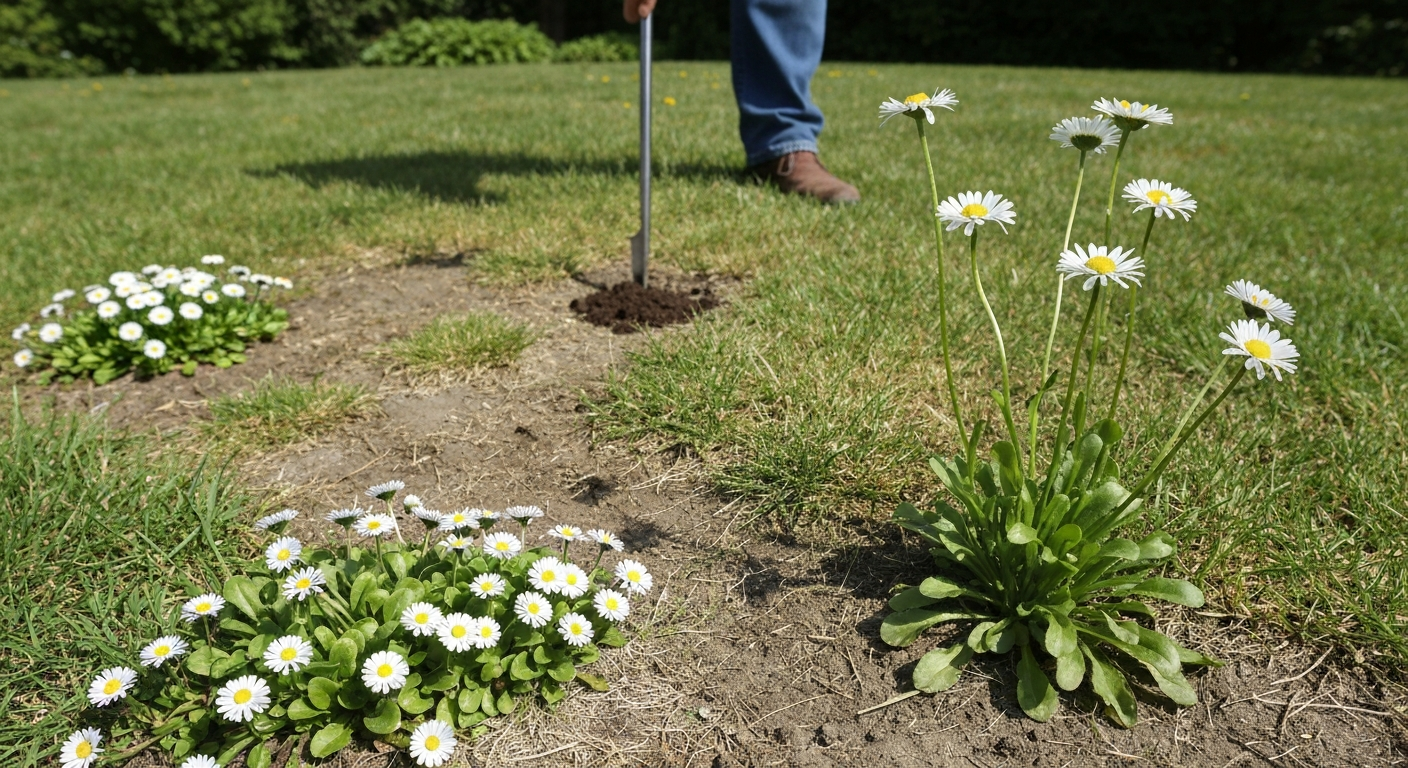
Why daisies grow in grass: identify species, diagnose causes, and follow step-by-step evidence-based fixes.
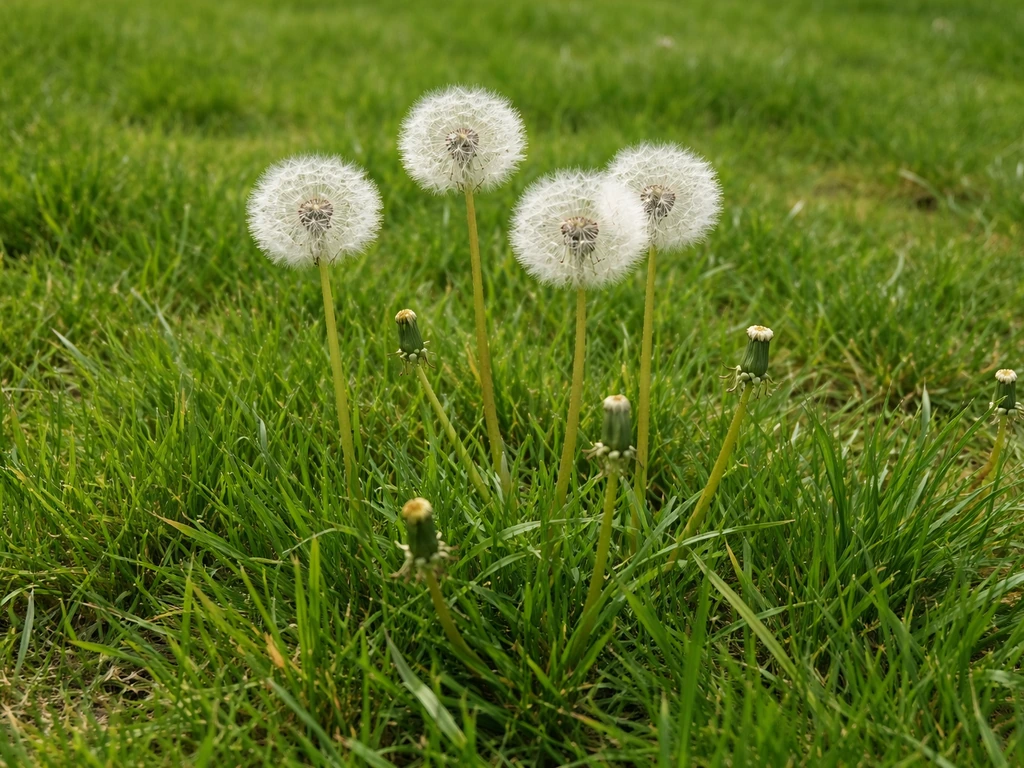
Learn why dandelions thrive in grass and get step by step fixes for soil, watering, mowing, and control.
Understand why clover appears in grass and how to diagnose soil, light, compaction, and mowing issues to stop it.