
Growing grass under spruce trees is hard, but it's not always impossible. The honest answer is: if your spruce casts dense shade for most of the day, grass is probably the wrong plant for that spot. But if you're getting at least 3 to 4 hours of direct sun, fine fescues are your best shot, and with the right soil prep, seeding method, and a low-nitrogen maintenance routine, you can get a reasonable stand established. The key is fixing the actual problems first: needle buildup, root competition, compacted soil, and dry surface conditions. Skip that work and nothing you plant will stick.
How to Grow Grass Under Spruce Trees: Step-by-Step
Marcus Volkmann
9 Jul 2026
Why grass fails under spruce trees
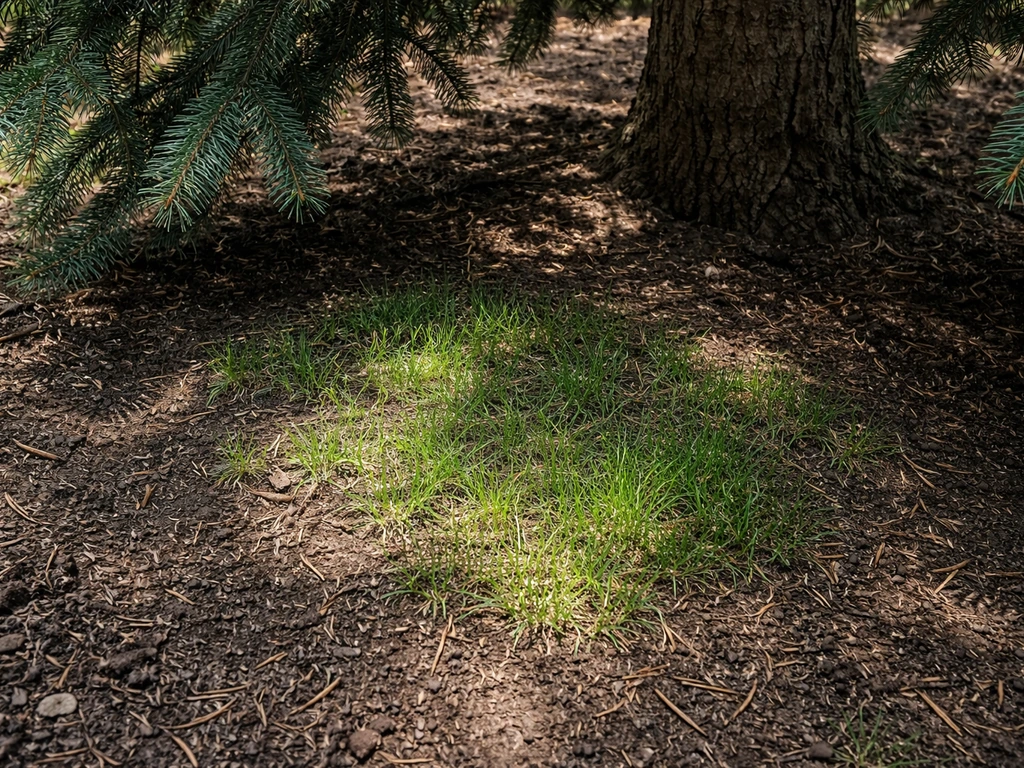
Spruce creates one of the toughest environments for turfgrass. It's not just one problem, it's four stacked on top of each other, and they reinforce each other in ways that make failure almost guaranteed if you don't address them deliberately.
Deep, persistent shade
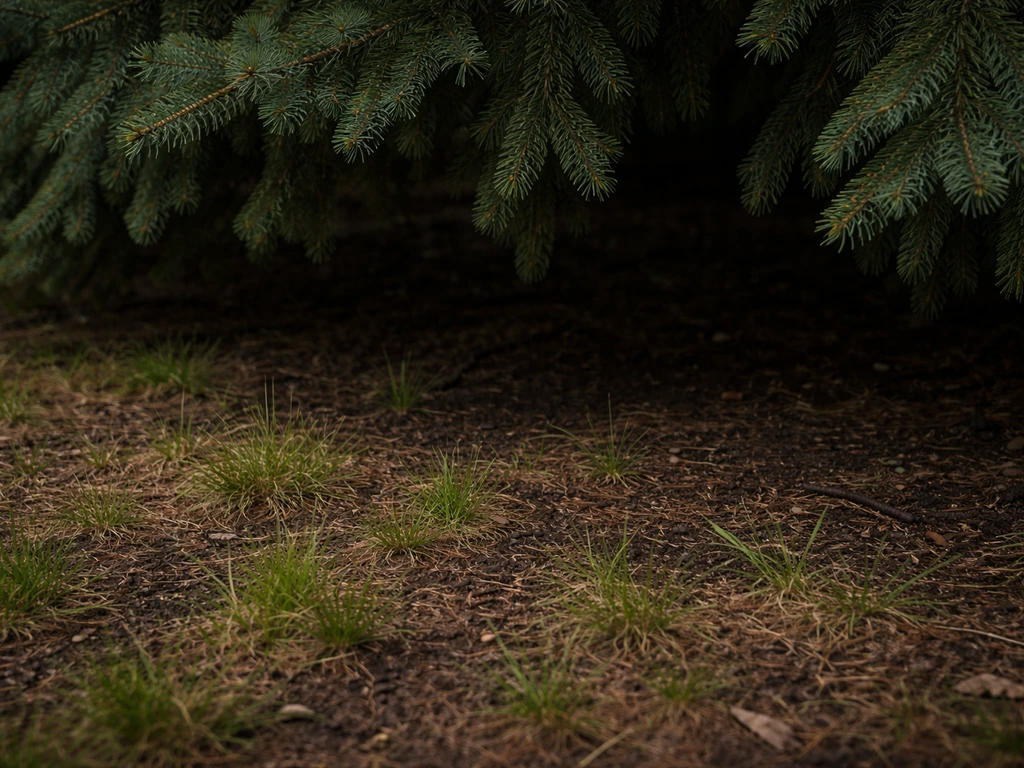
Spruce trees hold their needles year-round and typically branch low to the ground, which means the shading is much more consistent and complete than under a deciduous tree like a maple. The canopy also filters light quality, shifting the wavelengths available to grass, which further reduces photosynthetic efficiency. Even shade-tolerant grasses need some direct sun. Under a mature spruce with a broad, dense canopy, you may be working with less than 2 hours of usable light, and at that point, no turfgrass will survive long-term.
Needle litter buildup
Accumulated spruce needles create a dense duff layer that does several things, none of them good for grass. First, needle litter retains moisture irregularly, going from wet to bone-dry within days, which creates an unstable germination environment. Second, the duff layer can develop water-repellent properties over time, causing water to run off rather than infiltrate into the soil where roots need it. Peer-reviewed research indicates that plant litter can contribute to soil water repellency, affecting water infiltration and germination outcomes water-repellent properties over time. Third, there's evidence that conifer litter contains compounds with phytotoxic potential that can inhibit seed germination at the soil surface. The common belief that the problem is acidic needles lowering soil pH is actually a myth: researchers at the University of Saskatchewan and UNH Extension both point out that needle litter doesn't have the capacity to appreciably lower soil pH in most field conditions. The real issue with needles is physical and chemical surface disruption, not pH.
Root competition for water and nutrients
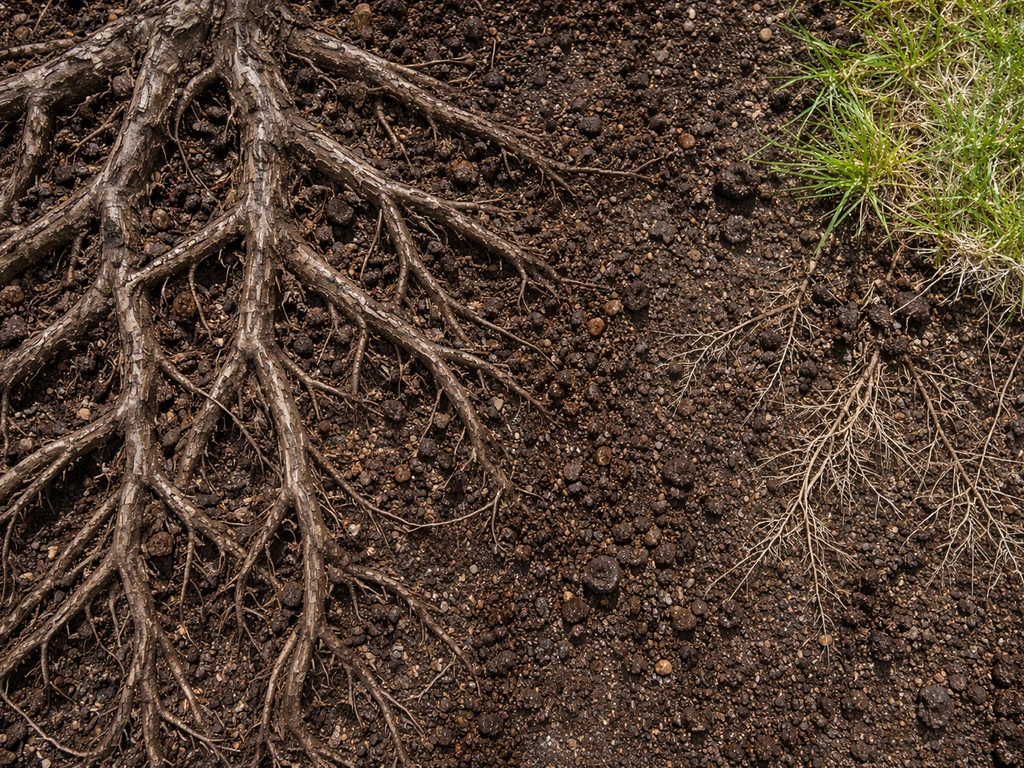
Spruce trees develop shallow, wide-spreading root systems that aggressively compete for both moisture and nutrients in the top 12 inches of soil, exactly where turfgrass roots are trying to establish. In dry summers, the tree always wins that competition. The soil under mature spruce often ends up dry and nutrient-poor, not because it started that way, but because the tree continuously draws resources down.
Compaction and poor soil structure
Between foot traffic and the mat of fine tree roots near the surface, soil under spruce tends to be compacted and low in pore space. That means poor oxygen availability, reduced infiltration, and a surface that grass roots simply can't penetrate well. Add the needle duff on top and you've got a system that actively resists establishment.
Read your site before you do anything
Before you buy seed or amend anything, spend a few days genuinely assessing what you're working with. I've seen homeowners skip this step and waste a full growing season on a spot that was never going to work. A quick honest evaluation takes maybe 30 minutes and tells you whether you're trying to grow grass in a tough-but-possible situation, or a genuinely impossible one.
Count actual sun hours
On a sunny day, check the spot every hour and record when direct sun is hitting the ground. Do this in midsummer when the sun angle is highest, because that's the most favorable it's going to get. Total up the direct sun hours. Three to four hours is the minimum threshold for fine fescues to have a reasonable chance. Under 3 hours, you should seriously consider groundcovers instead of grass. Over 5 hours, you have real options.
Test the soil and check drainage
Run a basic soil test through your local extension office. You're looking at pH, organic matter, and nutrient levels. Under spruce, pH is often 5.5 to 6.5, which is actually within a workable range for most cool-season grasses (fine fescues are tolerant of a fairly wide pH range). The bigger concern is whether the soil is hard and compacted. Do a simple compaction test: push a screwdriver into the soil by hand. If it won't penetrate more than 2 to 3 inches easily, you have significant compaction to deal with. Also pour a bucket of water on the surface and watch what happens. If it puddles and drains slowly, infiltration is a problem. If it beads up and runs off, you may be dealing with water-repellent soil from the duff layer.
Assess needle depth and root density
Scrape back the needle litter and measure how deep the duff mat is. A half-inch of loose needles is manageable. Two or more inches of compacted, decomposing needle mat is going to need serious work. While you're down there, look at how dense the surface roots are. If you see a thick mat of fibrous roots in the top 2 to 3 inches, you're in heavy competition territory and should plan accordingly.
Getting the soil ready
This is where most of the work happens, and it's the step people most often skip or underdevelop. Good soil prep under spruce is more involved than prepping an open lawn area, but it's what makes the difference between grass that establishes and grass that germinates and then dies.
Remove and manage needle litter
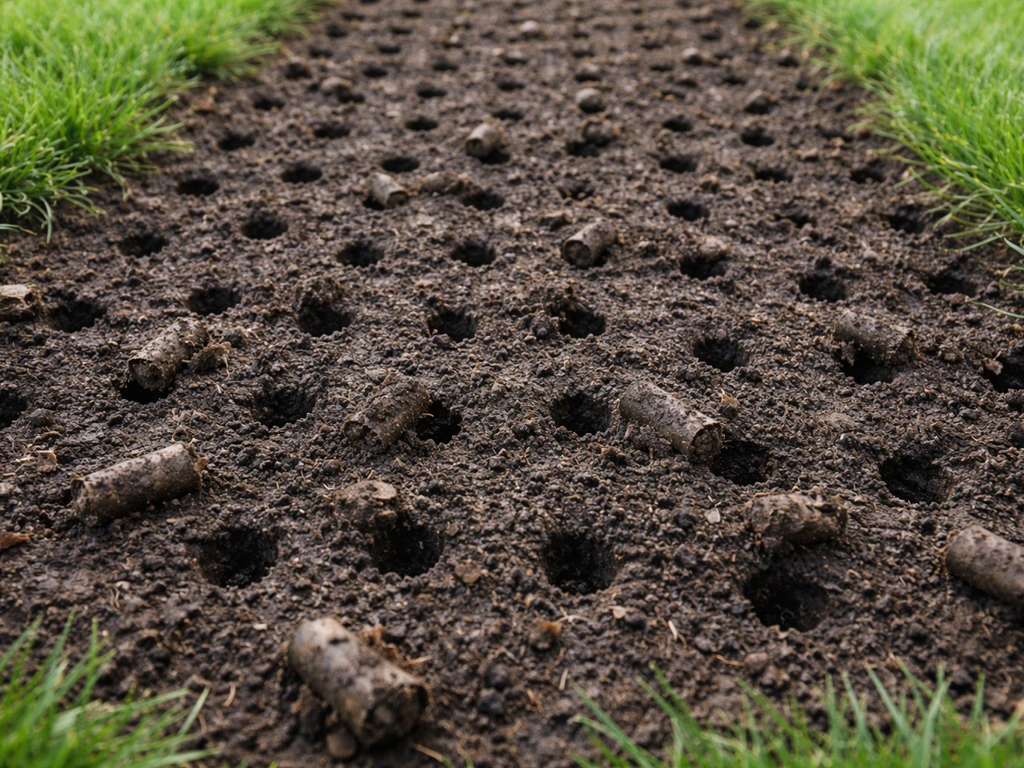
Rake out the needle accumulation before doing anything else. Get down to actual soil surface. Don't just scatter the needles around the edges; remove them from the area entirely. Research on litter legacy effects from Norway spruce shows that accumulated needle litter can meaningfully suppress initial vegetation establishment, so leaving even a partial mat in place stacks the deck against you. After initial removal, plan to keep needles raked off the area regularly throughout the growing season, especially in fall. This is ongoing work, not a one-time task.
Aerate aggressively
Core aeration is non-negotiable here. Rent a core aerator and make two passes in perpendicular directions. You're looking to pull cores around 1/2 to 1 inch in diameter at 2 to 3 inch spacing. If compaction is severe, set the tines as deep as they'll go, typically 3 to 4 inches. The goal is to break up the root mat and compaction, improve oxygen penetration, and create physical pathways for new seed to reach mineral soil. Be aware that if surface roots are very dense, aeration will be rough going, and you may need to do it in passes rather than all at once.
Amend the soil surface
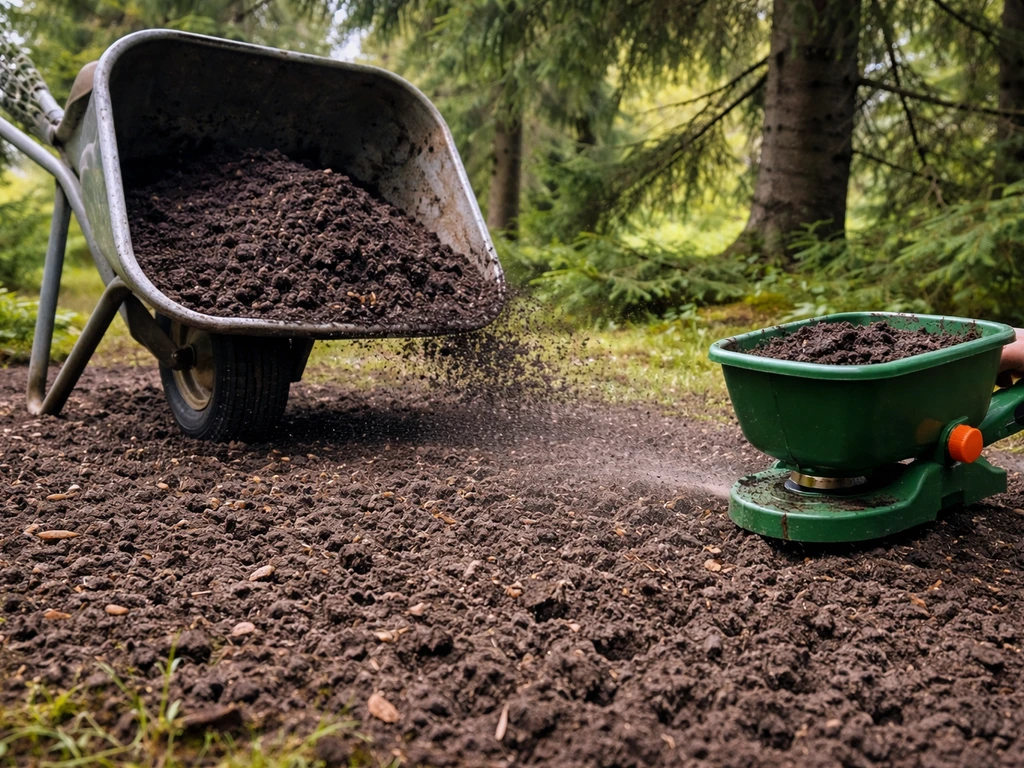
After aeration, topdress the area with a thin layer (about 1/4 inch) of quality compost. This adds organic matter, slightly improves moisture retention, and gives seedlings something to root into other than the existing compacted soil. If your soil test showed very low organic matter (under 2%), be more generous with the compost layer. Don't add thick layers of topsoil over the tree's root zone; a quarter to half inch of compost is sufficient and won't smother surface roots or create drainage problems. If pH came back below 5.5, add lime at the rate recommended by your soil test. Otherwise, skip the lime; fine fescues are tolerant of mildly acidic conditions.
What to plant: shade grasses and alternatives
For cool-season climates (most of the US outside the deep South), fine fescues are your go-to under spruce. Multiple university turf programs, from Minnesota to Colorado State to Kansas State, consistently rank fine fescues at the top for shade tolerance among turfgrasses. Within the fine fescue family, Chewings fescue and creeping red fescue are the most commonly available and most reliable performers. Hard fescue is another good option and needs even less maintenance. A blend of fine fescue species is generally better than a monoculture because it gives you some genetic diversity to handle variable conditions.
A practical shade mix that works well: 80 to 100% fine fescue with about 20% Kentucky bluegrass. The fine fescue covers the shade while the bluegrass fills in on any edges that get more light. For areas with 5 or more hours of sun, turf-type tall fescue is also an option; Clemson Extension notes tall fescue can manage with as little as 5 hours of sun per day. Avoid Kentucky bluegrass as a primary species in dense shade, and don't even try perennial ryegrass under spruce; it won't persist.
| Grass Type | Shade Tolerance | Minimum Sun (hrs/day) | Best Use Under Spruce |
|---|---|---|---|
| Fine fescue blend | Excellent | 3-4 | Primary choice for most sites |
| Chewings fescue | Excellent | 3-4 | Dense shade areas |
| Creeping red fescue | Excellent | 3-4 | Spreads to fill thin spots |
| Hard fescue | Very good | 3-4 | Low-maintenance option |
| Turf-type tall fescue | Good | 5+ | Edges with more light |
| Kentucky bluegrass | Moderate | 5-6 | Mix component only |
| Perennial ryegrass | Poor | 6+ | Avoid under spruce |
When grass is the wrong answer
If you're getting fewer than 3 hours of direct sun and the root competition is heavy, I'd tell you honestly to stop fighting for turf and choose a groundcover instead. Shade-tolerant groundcovers like pachysandra, wild ginger, hostas, or creeping Jenny are not giving up; they're making the right call for the site. Spreading a 2 to 3 inch layer of wood chip mulch is another solid option that looks intentional, suppresses weeds, and actually benefits the tree's root zone. The same logic applies to areas very close to the trunk where the canopy is thickest: mulch rings out to the drip line are better for the tree and more honest about what the light levels allow. Growing grass under evergreens more broadly shares a lot of these same challenges, and sometimes the solution that works for a neighboring cedar or pine tree will also work here. Cedar trees create similar challenges with shade, leaf litter, and root competition, so many of the same preparation and maintenance steps apply when learning how to grow grass under cedar trees.
Seed, sod, or plugs: which to use and how
Seeding
Seeding is the most cost-effective approach and works well for fine fescues, which establish reliably from seed. For cool-season grasses, late summer to early fall (late August through mid-September in most of the northern US) is the best window. Soil temperatures are still warm enough for germination, moisture is more reliable than in spring, and you're not asking newly germinated seedlings to survive summer heat and drought right away. Spring seeding is possible but riskier under spruce because dry conditions hit before the grass is established.
Seeding rates for fine fescue: target 4 to 5 lb of pure live seed per 1,000 square feet for new establishment. For overseeding thin areas, 3 to 4 lb per 1,000 square feet is sufficient. Spread seed after aeration and compost topdressing. Use a drop spreader or hand broadcast, then lightly rake to ensure good seed-to-soil contact. Keep the surface consistently moist with light, frequent irrigation for the first 3 to 4 weeks until germination is complete. Fine fescues typically germinate in 7 to 14 days under good conditions.
Sod
Sod gives you instant coverage and eliminates the germination window when competing tree roots are pulling moisture away from the soil surface. The downside is cost, and it's harder to find shade-specific fine fescue sod than seed. If you go the sod route, source sod grown in similar light conditions if possible; sod grown in full sun can struggle to adjust to a shaded environment. Install sod in early fall after completing all soil prep, keep seams tight, and water heavily for the first two weeks to help roots penetrate the existing soil through the aeration holes. Don't expect the sod to send deep roots quickly; tree root competition will be a persistent stress.
Plugs
Plugs are a middle-ground option and work well for filling in persistently bare spots after a main seeding effort. They're particularly useful under spruce because you can place them precisely in the spots most likely to succeed (areas with better light or less surface root competition) without treating the whole area uniformly. Plant plugs in early fall, water them in well, and give them the same low-nitrogen establishment feeding as seeded areas. Expect slower coverage than sod but better establishment success in tough pockets than seed alone.
Realistic expectations
Don't expect a thick, lush lawn. A successful result under spruce looks like a thin but persistent, mow-able stand of fine fescue that stays green and covers the ground. It will be less dense than open-area turf. Density will decline over time if conditions don't support the grass, so plan to overseed every 2 to 3 years to maintain coverage. Consider this a maintenance routine, not a failure.
Watering and fertilizing in low light
Irrigation
Watering under spruce is counterintuitive. The canopy intercepts rain, so even after a decent rain event the soil under the tree can be dry. But the reduced evapotranspiration in shade means the soil can also stay wet longer when you do water. The goal is consistent, moderate moisture, not heavy saturation. Water deeply but infrequently once grass is established: about 1 inch per week total (from rain plus irrigation), applied in 2 to 3 sessions rather than daily light watering. Daily shallow watering keeps the surface wet but encourages shallow roots that can't compete with tree roots. During establishment (first 4 to 6 weeks), water lightly and frequently to keep the top half-inch of soil moist. After that, shift to the deep, infrequent schedule.
Fertilization
Shade grasses need less nitrogen than full-sun turf, and over-fertilizing shaded grass is a real mistake. OSU Extension and K-State both recommend cutting nitrogen rates by about 50% compared to full-sun applications. That translates to roughly 0.5 lb of actual nitrogen per 1,000 square feet per application. For established fine fescue under spruce, two applications per year is usually sufficient: one in early fall (September) and one in late spring (May), skipping midsummer entirely. More frequent or heavier nitrogen applications in shade can cause a flush of soft, disease-prone growth without improving density.
During the first two months after seeding, apply a light establishment fertilizer: target 0.25 to 1.0 lb of actual nitrogen per 1,000 square feet total. Research at Purdue and UMN both found that going above 1.0 lb N per 1,000 sq ft in the first two months provides no meaningful benefit for fine fescue establishment and can increase risk. Use a slow-release nitrogen source to avoid burning shallow-rooted seedlings competing with tree roots for moisture.
Keeping it alive: maintenance and troubleshooting
Mowing height
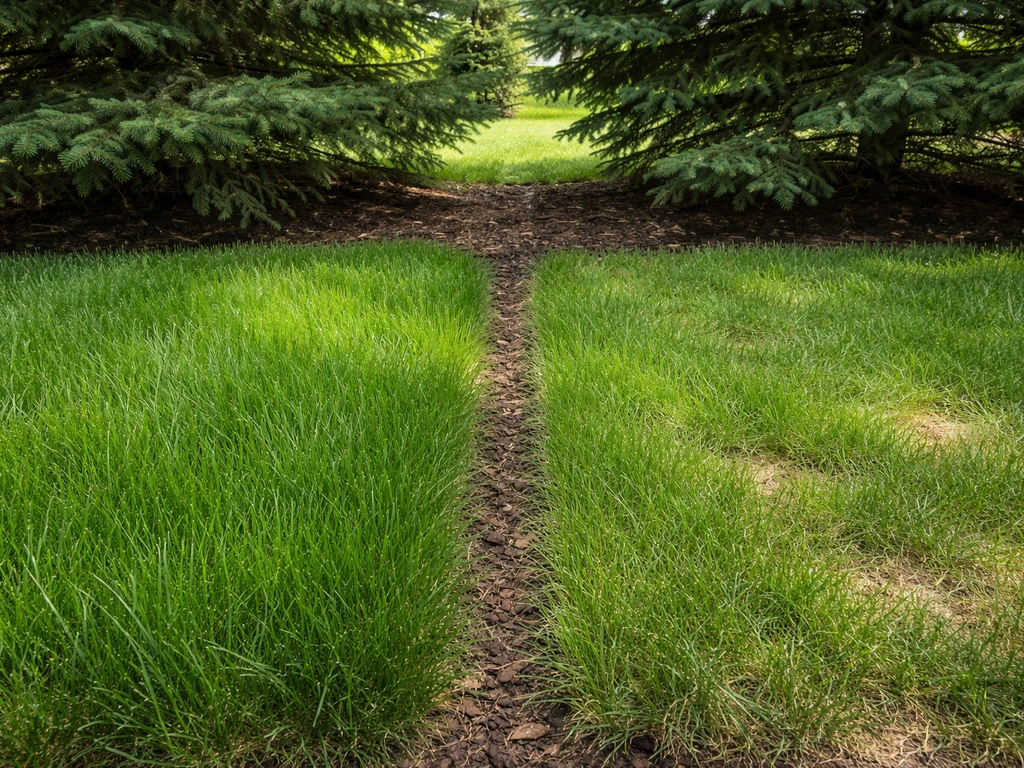
Mow high. Under spruce, fine fescue should be kept at 3.5 to 4.5 inches. Taller grass blades capture more of the limited light available and develop deeper roots that can better compete with tree roots. Cutting shaded grass short is one of the most common mistakes; it stresses the plant beyond what it can recover from under those conditions.
Managing bare patches
Bare patches will reappear, especially in areas with the densest root competition or poorest light. When they do, rake out any fresh needle accumulation, lightly scratch the soil surface, and overseed with fine fescue at 3 to 4 lb per 1,000 square feet. Purdue Extension advises that improving shaded lawns includes managing irrigation and keeping falling tree leaves off newly seeded turf to maximize light reaching young plants. Do this in late summer every year or every other year. Don't try to patch in spring; late summer gives you the best germination window and allows the new grass to establish before winter.
Weed control
Thin turf under spruce is vulnerable to weed invasion, particularly shade-tolerant weeds like ground ivy, creeping Charlie, and violets. The best weed control in this situation is a dense grass stand; thin turf is an open invitation. Spot-treat with a broadleaf herbicide in fall for persistent weeds, but be careful with pre-emergent products near fine fescue in shaded areas as some can affect fine fescue germination if you're planning to overseed. Hand pulling before weeds go to seed is tedious but effective for low-level infestations.
Annual maintenance tasks
- Rake needles off the grass area at least twice a year, in spring and fall
- Core aerate once annually in early fall before overseeding
- Overseed thin areas every 1 to 2 years in late August to mid-September
- Apply compost topdressing (1/4 inch) after aeration to maintain organic matter
- Fertilize twice per year at half the rate of your full-sun lawn
- Keep mowing height at 3.5 to 4.5 inches throughout the season
When to stop trying grass
Give the program a full two growing seasons before you decide it's not working. But if you've done the soil prep, seeded properly, managed needles, watered appropriately, and the grass is still failing to establish or dying back each year, that's the site telling you something. Dense shade, heavy root mats, and a canopy that intercepts most rainfall are a combination no amount of effort fully overcomes. At that point, switching to mulch or a shade-tolerant groundcover is the practical, honest choice, and there's no shame in it. If your site still refuses to cooperate, the adjacent alternative is learning how to grow grass under evergreen trees more lightly by adjusting shade, moisture, and soil preparation before giving up switching to mulch or a shade-tolerant groundcover. The goal is a yard that looks good and stays manageable, not a battle you fight every year and lose.
FAQ
Can I grow grass under spruce if I only get morning sun, not afternoon sun?
Often yes, as long as you still hit the ground with at least 3 to 4 hours of direct sun in midsummer. Morning-only sun can work better than people expect because the tree canopy and seasonal sun angle change through the day, but measure at the ground level and total the direct-sun hours, not the time the sun is shining on the yard.
What’s the fastest way to tell if the problem is too much shade versus root competition?
Run a small “test strip” of fine fescue seed after your normal prep (a 3 ft by 6 ft strip is enough). If seedlings germinate but thin out within 4 to 8 weeks, root competition and moisture draw are usually the issue. If germination is poor or uneven right from the start, needle duff, compaction, or surface water repellency is more likely.
Should I remove the mulch or leaves/needles immediately before seeding?
Scrape back to actual soil before seeding, and remove the needle layer from the seeded area. If you have existing wood chip mulch, keep it away from the seed bed, because thick mulch can prevent seed-to-soil contact and keep moisture too irregular for fine fescue seedlings.
Do I need to dethatch or treat for water-repellent soil under spruce?
If water beads up and runs off after you pour water on the surface, treat infiltration before you seed. Core aeration helps by breaking pathways and mixing compost into the top layer, but if the surface remains repellent after aeration, you may need a heavier compost topdressing (still kept thin) and more frequent light watering during establishment to keep the top 1/2 inch consistently moist.
Can I use a shade mix that includes ryegrass or other varieties besides fine fescue?
You can include them, but ryegrass and other less shade-tolerant turf typically fail in dense spruce shade. A blend can be fine, but fine fescue should be the dominant component, and any “repair” seed you add later should be compatible with your overseeding plan.
How do I water correctly when the spruce blocks rainfall?
Water to maintain moisture in the top half-inch during the first 3 to 4 weeks, using light, frequent irrigation rather than long puddling. Once established, switch to deep and infrequent watering that totals about 1 inch per week from rain plus irrigation (applied in 2 to 3 sessions), because daily shallow watering keeps roots too near the surface.
Is lime really unnecessary if soil tests show acidic conditions under spruce?
If your soil test is above about pH 5.5, you can typically skip lime for fine fescue, since it tolerates mildly acidic soil. If you are below 5.5, apply lime at the test-recommended rate, because improving pH can support nutrient availability, but avoid over-liming because excessive pH can cause other nutrient lockout problems.
What mowing height is safe if I want the grass to look thicker?
Under spruce, stay at roughly 3.5 to 4.5 inches. Cutting lower “to thicken it” is a common mistake in shade because shorter plants capture less available light and develop weaker competition. If you want a denser look, increase light by managing needles and spacing issues first, then overseed on schedule.
How often should I overseed, and what should I do about needle buildup between overseeds?
Plan on overseeding every 2 to 3 years to maintain coverage. Before overseeding, rake off any fresh needle accumulation so seed can reach mineral soil. During the fall, keep raking to prevent a new duff layer from forming, then overseed in late summer when germination is most reliable.
Will fertilizer burn seedlings under spruce trees?
It can if you apply too much or if fertilizer is applied too early. During the first two months after seeding, keep establishment nitrogen low (not more than about 1.0 lb actual nitrogen per 1,000 sq ft total) and use slow-release sources, because shallow seedlings and nearby tree roots compete for the same moisture.
What’s the safest weed strategy if my turf is thin under the spruce?
Start with hand removal before weeds set seed if infestations are light, and prioritize overseeding to rebuild density because thin turf invites weeds. If you use a broadleaf herbicide, time it so you do not plan to overseed immediately afterward, and be cautious with pre-emergent herbicides near fine fescue if overseeding is part of your schedule.
Should I wait for a full two seasons before reseeding, or patch sooner?
If bare spots are small, patch in late summer after raking needles and lightly scratching the surface, rather than waiting. If the entire area is thinning after initial establishment, give it the full two growing seasons before abandoning the effort, because fine fescue may take time to knit together under consistent prep and low-nitrogen maintenance.
Is sod ever a good option under spruce, or is seed always better?
Sod can work if you can get shade-adapted sod and you can complete thorough prep first, but it is expensive and still faces ongoing stress from spruce roots. Seed is usually more practical for fine fescue because it matches the shade tolerance goal and is easier to overseed in patches as conditions improve or shift.
When should I give up on grass and switch to mulch or groundcovers?
Switch when you consistently measure fewer than 3 direct-sun hours at ground level or when, after good prep and two full growing seasons, you still see poor germination and repeated dieback. If your site remains consistently dry under the canopy or has a dense shallow root mat, a mulch ring to the drip line or shade-tolerant groundcover is the more reliable long-term “wins for the effort” choice.
Next Articles
How to Grow Grass in a Wooded Area Step by Step
Step-by-step plan to grow shade grass in wooded areas, from light checks and soil prep to seed, watering, and maintenanc
Can You Grow Grass Over Gravel? How to Do It Right
Learn when you can grow grass over gravel and follow a step-by-step method for soil depth, drainage, seeding or sod, and
Do Wood Chips Help Grass Grow? When They Work and When Not
Learn when wood chips help grass grow, when they steal nitrogen, and step-by-step how much to apply and seed options.