
Yes, grass can spread under fences in Minecraft, and it can also grow along fence lines in real life, but both situations come with specific conditions that have to be met first. In Minecraft, fences are transparent to light, so the fence itself is rarely the problem. The usual culprits are insufficient light level on the dirt block, the wrong type of dirt, or a covering block that cuts the light. In real life, fence-edge grass failures almost always come down to shade, compacted soil, or poor drainage. Once you know which condition is failing, the fix is usually straightforward.
Can Grass Grow Under Fences in Minecraft and Real Life
Marcus Volkmann
19 Jun 2026
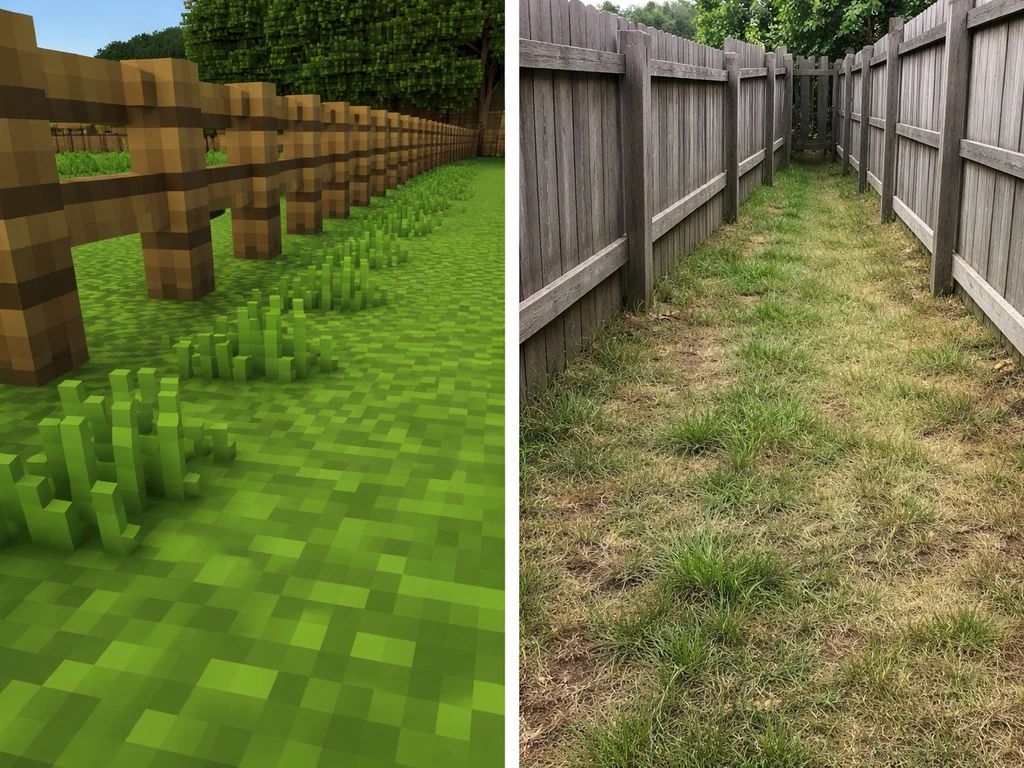
Minecraft rules: when grass can spread under fences
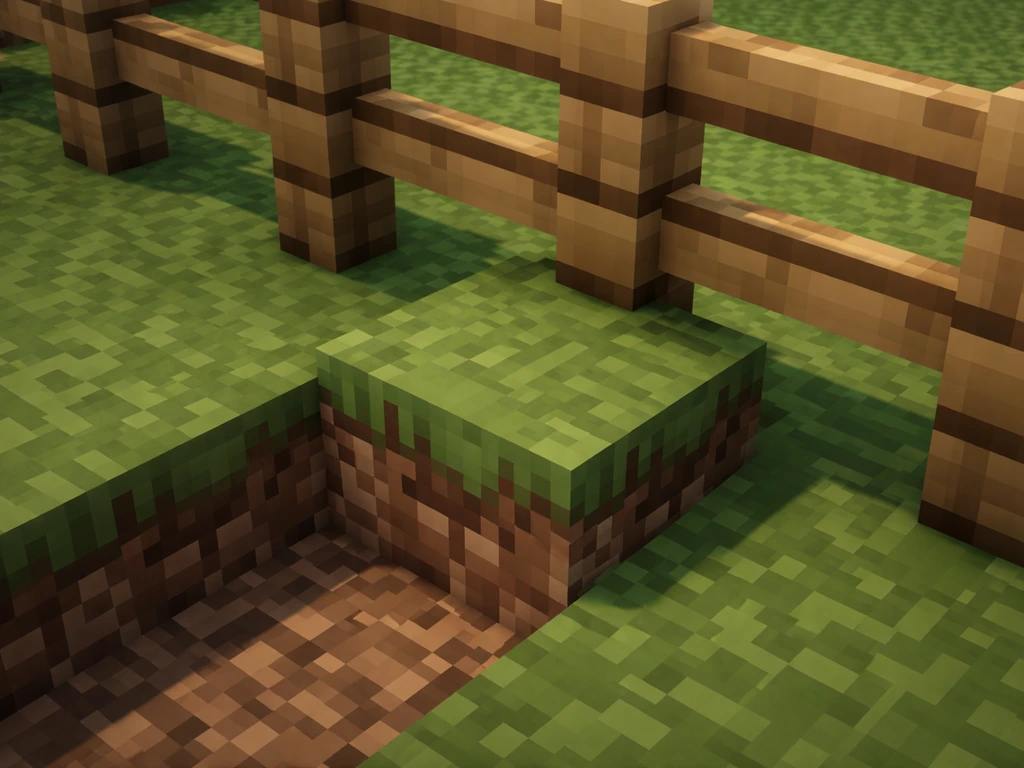
Grass spreading in Minecraft works through random ticks. At random intervals, a grass block gets selected for a tick update and checks whether it can spread to any adjacent dirt blocks nearby. For that spread to happen, a few things must be true at the same time: the source grass block must have a light level of at least 9 directly above it, the target dirt block must have a light level of at least 4 above it, and nothing covering the target dirt can reduce light by 2 or more levels. If all those conditions are met, the dirt converts to a grass block.
Here is the key point about fences specifically: fence blocks are transparent to light. They do not act like solid opaque blocks. So a fence post sitting on the ground next to a dirt block does not automatically block the light that dirt needs. The fence is not your enemy here. What can trip you up is anything placed on top of the dirt, or a dark corner created by nearby structures where light level naturally drops below the threshold.
Grass can only spread to plain dirt blocks. It cannot convert coarse dirt, rooted dirt, dirt paths, or similar variants. If you have placed the wrong dirt-type block in your fence line, that is enough to stop spreading entirely regardless of how good your lighting is.
What blocks and lighting affect grass growth under fence lines
Opaque blocks are the real light-killers. If an opaque block sits directly above a dirt block, it cuts sky light to zero for that block and the grass spread condition will fail. Fences, as mentioned, are transparent, but stairs and slabs can behave differently depending on their orientation. In Java Edition especially, certain block shapes create directional light-blocking behavior that can produce dark corners right at the base of a fence structure, even when the area looks reasonably lit to you visually.
Sky light in Minecraft starts at 15 and decreases as it passes through blocks or travels horizontally. Each step of horizontal propagation reduces the light level by 1. So if your dirt block is several blocks away from an open sky gap, and surrounded by structures on multiple sides, the light level above that dirt can easily drop below 4, which stops grass from spreading to it. This is the most common invisible reason why grass stubbornly refuses to fill in near busy builds.
One thing worth knowing: mycelium follows similar spread rules to grass, needing light level 9 on the source block and 4 above the target dirt. So if you have been testing with mycelium and ran into the same issue, you are likely dealing with the same lighting problem.
How to troubleshoot grass that won't spread near your fence
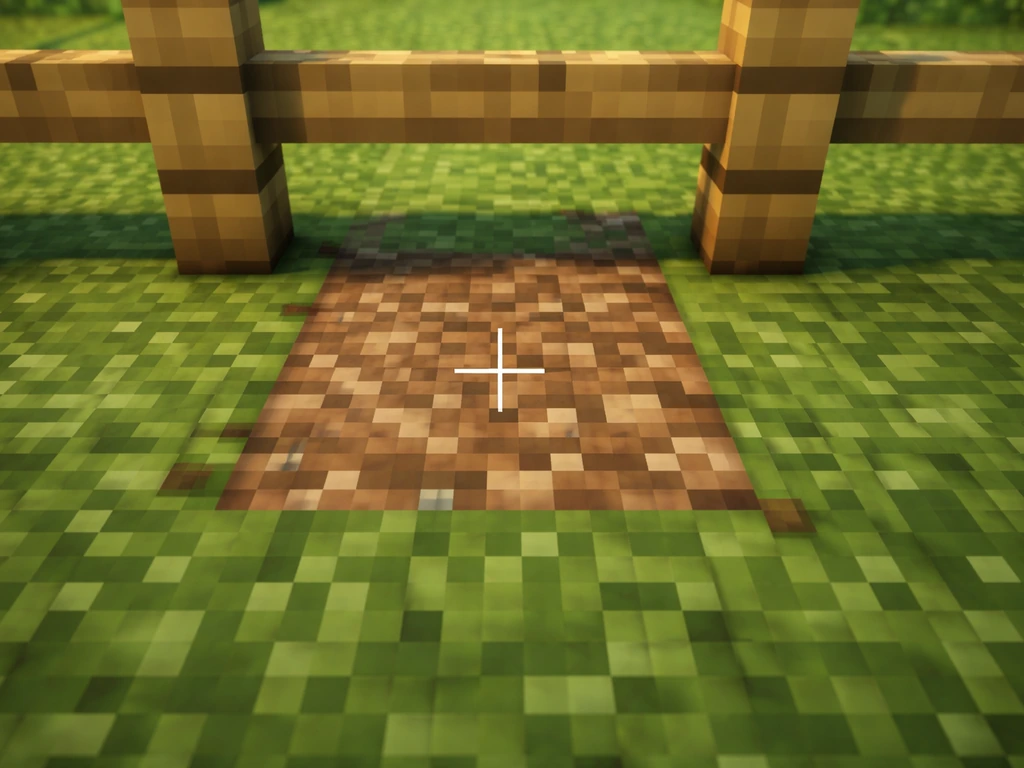
Work through these steps in order. Most fence-line grass problems in Minecraft get solved at step two or three.
- Check the ground block type. Press F3 and look at the block your cursor is pointing at. It must say 'minecraft:dirt', not coarse dirt, rooted dirt, or dirt path. If it's the wrong type, replace it with plain dirt.
- Check the light level above the target dirt. In Java Edition, press F3 and look at the 'Light' readout when hovering over or standing near the block. The sky light or block light level must be at least 4. If it's lower, your build is blocking light.
- Remove or adjust anything overhead. Even a partial block like a slab or stair above the target dirt can drop light by 2 or more levels. Clear the space above the dirt block and test again.
- Make sure a grass source block is close enough. Grass spread is a proximity check. There must be a grass block within roughly one block horizontally and vertically of the target dirt. The spread range is limited, so isolated dirt surrounded entirely by non-grass blocks won't convert.
- Keep the chunk loaded and wait. At default random tick speed (3), spreading can take an average of around 12,000 ticks to occur on any single block. That's a fair amount of in-game time. Stay nearby or keep the chunk loaded by being in the area.
- Speed up the test in a creative or testing world. Use the command '/gamerule randomTickSpeed 100' temporarily to dramatically accelerate random ticks, confirm the conditions work, then reset it to 3 for normal play.
Using bone meal and other methods when spreading still won't happen
Bone meal on a grass block does cause nearby activity: it grows tall grass and flowers on and around the block, and can trigger adjacent grass blocks within a 3D area to act as if they received a random tick. This can speed up spreading to nearby dirt blocks that already meet the light and adjacency conditions. But bone meal is not a magic override. If the light level is too low, or the dirt type is wrong, bone meal on an adjacent grass block still won't convert that dirt. The conditions have to be right first, and then bone meal can help push things along faster.
If bone meal is not helping, the fastest workaround is simply to place a grass block directly on the target location. In survival, you can do this by using Silk Touch to mine an existing grass block and placing it exactly where you want it. This bypasses the spread mechanic entirely. For decorative areas near fences where the lighting situation is tricky, this is often the most reliable approach rather than waiting and troubleshooting indefinitely.
Another option: if you have torches or other light sources available, placing one near the struggling dirt block can bring block light up enough to meet the minimum threshold, even if sky light is low. A torch provides light level 14, which is plenty. This is especially useful in covered builds or underground areas where the fence-and-dirt setup sits beneath a roof.
Real-life fence-edge lawn problems: shade, compaction, and drainage
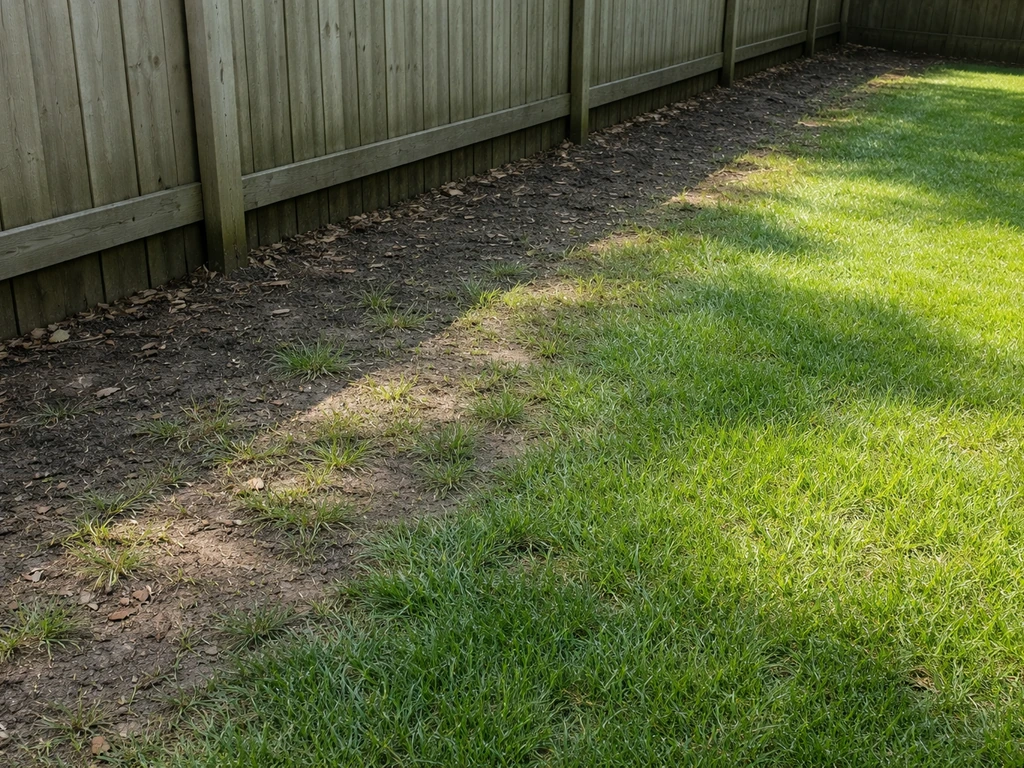
If you came here partly because your real yard has a dead or thin strip of grass along a fence line, you are dealing with a completely different set of mechanics, but the diagnostic process is similar: identify which condition is failing, then fix that specific thing. In Stardew Valley, grass can regrow, but whether it comes back depends on what is damaging the ground and how you manage the area.
Shade is the number one killer of fence-line grass. In Minecraft, you can also wonder whether grass can grow in the Nether, which uses very different rules than fence-line lawns grass in the Nether. Most turfgrasses need around 4 to 5 hours of full direct sun per day at minimum, and even shade-tolerant varieties like St. Augustinegrass need at least 4 hours of direct sun or a full day of high-quality filtered sunlight to stay healthy. A solid privacy fence on the south or west side of your yard can cast deep shade across a wide strip for most of the day, especially in late spring and summer when the sun angle puts the fence shadow right where you want grass to grow. If that strip gets fewer than 4 hours of direct sun, you are fighting a losing battle with standard turf.
Soil compaction is the second big problem, especially along older fences where foot traffic, construction activity, or even just years of freeze-thaw cycles have packed the soil down hard. Compacted soil restricts root growth and cuts off gas exchange, which means grass roots suffocate even when everything else looks fine from above. You can test for compaction by pushing a screwdriver or a thin rod straight into the soil. If it stops within a few inches, you have a compaction problem.
Drainage is often overlooked. Fence lines sometimes sit in low spots where water pools after rain, or where grading pushes runoff toward the fence base. Grass roots sitting in saturated soil for extended periods will rot. Check whether the soil drains within a few hours of a heavy rain. If it stays soggy for more than a day, drainage needs to be addressed before reseeding will ever stick.
Real-world fixes when grass won't fill in along a fence
The right fix depends on which problem you actually have. Here's how to handle each scenario:
If it's a compaction or soil quality issue
Aerate first, then amend. Core aeration pulls small plugs of soil out of the ground and opens up space for roots, water, and air. After aerating, topdress with a thin layer of compost or quality topsoil, which improves both drainage and soil structure over time. Then overseed at roughly 15 to 25 grams per square meter (about half to three-quarters of an ounce per square yard). Good seed-to-soil contact is critical, which is why the aeration holes help enormously. Water regularly until the new seedlings are established.
If shade is the real issue
Be honest about the light levels before you invest in reseeding. If the strip gets fewer than 4 hours of direct sun, switching to a shade-tolerant grass variety like fine fescue or St. Augustinegrass (in warm climates) is your best turf option. These varieties are genuinely more tolerant of reduced light, but they are not shade-proof. Keep in mind that shaded turf photosynthesizes less, grows more slowly, and tends to thin out over time, meaning you will likely need to overseed the area annually to keep it looking decent. LSU AgCenter notes that in shaded turf, reseeding or overseeding often has to be repeated because shaded turf photosynthesizes less and grows more slowly, which leads to thinning and eventual renovation shaded turf photosynthesizes less, grows more slowly, and tends to thin out over time.
If the shade is too heavy for any grass to survive, stop spending money on seed and switch to a shade-tolerant groundcover. Creeping jenny, hostas, liriope, or sweet woodruff all perform well in low-light fence lines and require far less maintenance than a losing battle with turf. A neat edge of groundcover along a fence often looks intentional and polished rather than like a failure.
If drainage is the problem
Improve grading so water drains away from the fence rather than pooling at its base. In some cases this means regrading the soil slightly, which can be done with a flat shovel and some added topsoil to build a gentle slope. If the drainage problem is more serious, a simple French drain or a perforated pipe running along the fence line can carry water away. Once drainage is sorted, amend the soil and reseed as above.
Comparison: your options when grass won't cooperate
| Option | Best for | Cost | Maintenance level | Realistic outcome |
|---|---|---|---|---|
| Overseed with shade-tolerant grass | Areas getting 4+ hours of direct sun | Low | High (annual overseeding likely needed) | Decent coverage if light meets minimum |
| Resod with shade-tolerant turf | Faster establishment in marginal light | Medium-high | Medium | Better short-term, still thins without adequate light |
| Shade-tolerant groundcover | Spots under 4 hours direct sun | Low-medium | Low | Reliable long-term, low-stress solution |
| Raised bed or border planting | Fence lines near structures or trees | Medium | Low-medium | Clean look, avoids grass struggles entirely |
| Aerate, amend, and reseed | Compaction or poor soil as main issue | Low | Medium | Strong results if light and drainage are adequate |
The Minecraft problem and the real-life problem actually have the same core lesson: grass needs the right substrate, the right light, and nothing blocking its path. In Minecraft, check your dirt type, confirm light levels, and use Silk Touch or a torch if the build makes organic spreading impractical. In the real yard, diagnose before you reseed, fix the underlying condition first, and be willing to use groundcovers when the light situation makes grass a poor long-term bet. If you are wondering about Stardew Valley, grass does not grow in fall, so planning ahead for another season helps grass does not grow in fall in Stardew Valley. Either way, once you know which condition is failing, the fix is usually simpler than it looks.
FAQ
If fences are transparent, why does my grass still not spread along the fence line?
Not directly. Fences are transparent, so they usually do not prevent spread, but the dirt block still must be valid for grass conversion (plain dirt only) and it still needs enough light at its height. If you have a fence post occupying the space where you expected light or you placed a block on top of the dirt, that is what typically blocks growth.
Can I speed up grass spreading under fences in Minecraft without cheating?
Yes, but spacing and timing matter. Grass spreads only to adjacent dirt blocks during random tick updates. If you want faster results, make sure the target dirt blocks are exposed to light and use bone meal on the grass source blocks, since it can trigger nearby tick-like behavior, but it still cannot convert invalid dirt types.
Why does grass spread sometimes but then stop under my fence line?
Intermittent behavior is often because random ticks stop in unloaded or poorly lit areas. If the chunks are not loaded, nothing will update. Also, if your light levels are right only at certain times (for example, daylight exposure in builds that partially block sky light), grass may spread on some days and stall on others.
Does Silk Touch placement work even when the lighting conditions are failing?
Yes for placement fixes. Using Silk Touch to move an existing grass block works even if the spread conditions are not satisfied, but it does not change the underlying problem. If the area is too dark, the next random tick cycle can still prevent further spreading, and patches may not expand.
Do stairs or slabs near the fence affect grass spread even if the fence itself does not?
It can, depending on what sits above the dirt and the block shapes involved. While fences themselves do not block light, stairs and slabs can create edge cases where directional light behaves differently, producing dark corners right at fence bases. Checking with a debug light view (or by testing with a torch near the dirt) is the practical way to confirm.
Will torches fix grass that is not spreading under my fence if the ground is the wrong dirt type?
If you put a different dirt type on the target (coarse dirt, rooted dirt, dirt path, and similar variants), grass spreading cannot convert it. In that case, torches may help lighting but they still will not make that dirt turn into grass, so you need to replace the dirt with plain dirt or place grass directly with Silk Touch.
How close do I need to place a torch to get grass to spread under a covered fence line?
A torch can help even when sky light is low. Torches provide block light (light level 14), which can raise the effective light above the dirt block enough to meet the minimum threshold for spread. Place a torch close enough that its light reaches the target dirt block height, not just the area you can see.
If I use bone meal on one grass block, will it eventually convert dirt under fences anywhere?
Yes, but you still cannot rely on it to override invalid conditions. Bone meal can grow tall grass and flowers and can cause adjacent grass-like behavior within a limited 3D area, but if the target is not plain dirt, or if light levels are below the minimum, conversion still fails.
Does mycelium fail under fences for the same reasons as grass?
For Minecraft, mycelium follows similar lighting and conversion constraints to grass, so the same issues usually apply. If it does not spread, check the source light level above the mycelium block, the target dirt type (mycelium needs suitable substrate to spread onto, similar to grass logic), and whether any opaque blocks or dark corners reduce the light.
In real life, what quick tests should I do first when grass is dying along a fence?
Real-world answers depend on whether your issue is shade, compacted soil, or drainage. For fence-line grass, the fastest real diagnostic is to check how long the soil stays soggy after rain, then test compaction by trying to push a thin rod into the ground. Fix the first limiting factor, then reseed, because reseeding into persistently compacted or waterlogged soil rarely works long-term.
When should I stop trying to reseed and switch to shade-tolerant plants or groundcover?
If the area gets less than about 4 hours of direct sun most days, switching to a shade-tolerant option or using groundcover is often the better long-term choice. Repeated reseeding usually just delays the inevitable, because turf photosynthesizes less in shade and thins over time even if you fix soil briefly.
Next Articles
Does Grass Grow Back in Minecraft? Fix Regrowth Fast
Yes, grass can regrow in Minecraft. Learn why it fails, regrowth rules, and quick fixes for grass and tall grass.
Can Grass Grow in the Nether? Real Rules and Steps
Find out if grass can grow in the Nether, the exact mechanics, and step-by-step ways to try it or get green alternatives
Does Grass Grow in Fall in Stardew Valley? What to Do
Yes, grass regrows in Stardew Valley Fall. Learn the exact conditions, why it may stop, and what to do next.