
Grass does not naturally grow sideways, but it absolutely leans, creeps, and spreads in that direction all the time, and for very specific reasons. Upright blade growth is the default when light, gravity, soil, and mowing conditions are all working in the grass's favor. When any of those factors are off, you get blades that tilt, stolons that creep across the surface, or whole patches that flatten and stay flat. The good news is that most sideways-growing grass is fixable once you know what is driving it.
Does Grass Grow Sideways? Diagnosis and Fixes for Lawns
Marcus Volkmann
29 Jul 2026
How grass actually decides which way to grow
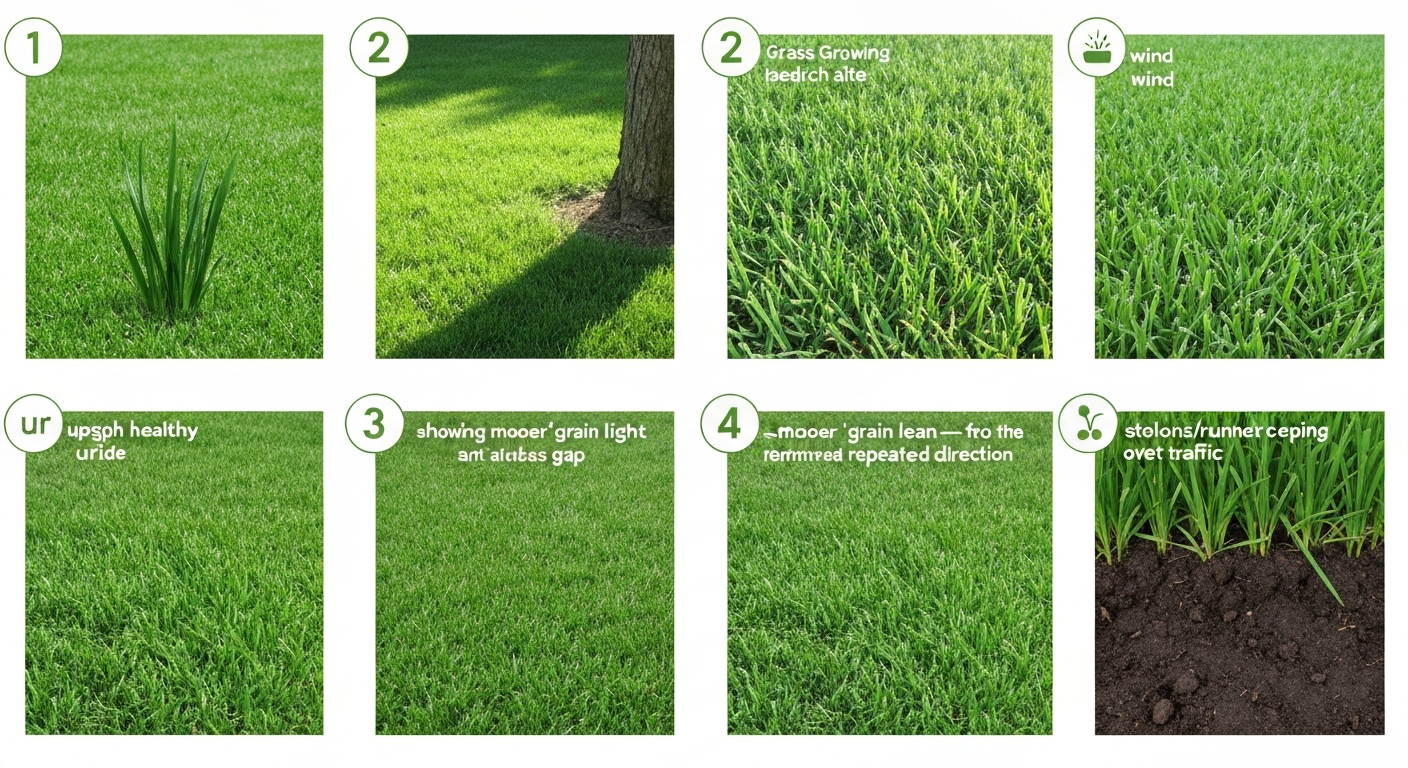
Two biological systems are constantly competing to keep a grass blade upright: phototropism and gravitropism. Phototropism is driven by blue-light receptors called phototropins sitting in the blade tissue. When light hits from one side more than the other, these receptors trigger a rapid redistribution of auxin (a growth hormone) toward the shaded side of the shoot. PubMed summary (PMID 16656878) describes phototropin-triggered lateral auxin redistribution beginning within minutes and continuing over hours as PIN and AUX auxin transporters are relocalized Lateral auxin redistribution in phototropism occurs within minutes and involves relocalization of PIN/AUX transporters.. Cells on that side elongate faster, and the blade bends toward the light. This can start within minutes of uneven light exposure and continues over hours.
Gravitropism is the plant's ability to sense which way is up. Gravity-sensing cells contain tiny starch granules called statoliths that settle toward the ground, triggering a similar auxin redistribution that produces upward curvature. The two systems interact constantly, and each grass species has a built-in gravitropic set-point angle (GSA), essentially a preferred lean relative to vertical. When light and gravity signals align, you get an upright blade. When they conflict, or when one signal is consistently strong in one direction, the blade grows at an angle.
In practical terms, this means a grass blade growing under a fence line with light coming from one side will always lean toward that light, and there is nothing wrong with the plant, it is doing exactly what evolution programmed it to do. The problem for homeowners is that leaning grass looks messy, mows unevenly, and can signal something deeper like compaction or shade stress.
Species growth habits that naturally look sideways
Not all lateral spread is a problem. Some of it is just how certain grass types are built. Understanding the difference between bunch grasses and spreading grasses saves a lot of unnecessary troubleshooting.
Bunch grasses
Tall fescue and perennial ryegrass grow in discrete clumps through tillering. They do not spread laterally to fill gaps. If a bunch-type lawn looks patchy or has bare areas with upright clumps surrounded by nothing, that is not sideways growth, it is just the plant's architecture. These grasses will not creep to fill in, so overseeding is the only fix for thin spots.
Stoloniferous and rhizomatous grasses
Bermudagrass, Zoysia, and St. Augustine spread by stolons, aboveground runners that visibly creep across the soil surface and into garden beds, cracks, and hard surfaces. Kentucky bluegrass spreads underground via rhizomes. Both types can make a lawn look like it is growing sideways because lateral spread is genuinely happening. Stolons in particular are often mistaken for a problem when they are just the plant filling in gaps the way it evolved to do. The issue arises when these runners pile up, lose soil contact, and start creating a thatch layer.
| Species | Spread Type | Visible Lateral Growth? | Fills Gaps Naturally? |
|---|---|---|---|
| Tall Fescue | Bunch (tiller) | No | No — overseed required |
| Perennial Ryegrass | Bunch (tiller) | No | No — overseed required |
| Kentucky Bluegrass | Rhizomatous (underground) | Minimal at surface | Yes, slowly |
| Bermudagrass | Stoloniferous + rhizomatous | Yes — visible runners | Yes, aggressively |
| Zoysia | Stoloniferous + rhizomatous | Yes — visible runners | Yes, moderately |
| St. Augustine | Stoloniferous | Yes — thick visible runners | Yes, moderately |
Physical and environmental causes of leaning or sideways grass
Once you rule out species behavior, there are eight common physical causes for grass that leans, flattens, or grows at an angle. In my experience diagnosing client lawns, at least three of these are usually present at the same time.
- Slope and erosion: On grades steeper than about 15 percent, grass shoots tend to lean downhill and roots anchor unevenly. Surface water erodes the soil from under crowns, making blades tilt as the ground shifts beneath them.
- Wind: Repeated wind from a consistent direction physically trains blades to lean persistently, in the same way repeated mowing in one direction does. Heavy rain can also lodge (flatten) patches of grass, particularly in warm-season species with heavy stolons.
- Mowing direction: This is the single most common cause I see in residential lawns. Mowing the same direction every time pushes blades one way and trains them to lean there permanently — turf managers call this 'grain.' The one-third rule (never remove more than one-third of the blade in a single mow) applies here too: scalping encourages the plant to grow low and lateral rather than upright.
- Foot and vehicle traffic: Foot traffic in regular paths compacts soil and physically presses blades flat. Vehicles create ruts that redirect water flow, adding erosion to the compaction problem. Traffic-stressed turf produces shallower roots, which makes the blades less able to right themselves.
- Seed or sod orientation: Fresh sod installed with an inconsistent or diagonal seam orientation often shows visible grain for weeks or months after installation. Newly seeded areas sometimes germinate with a lean if the seedbed was not level or if heavy irrigation washed seeds to one side.
- Soil compaction: Bulk density above about 1.4 g/cm³ in sandy rootzones — or high penetrometer resistance — restricts roots to the upper soil layer. Shallow roots mean the crown is poorly anchored, and blades are more likely to lie flat under their own weight or any external pressure.
- Thatch: A thatch layer thicker than about 0.5 inches creates a spongy, unstable base that decouples the crown from firm soil. Crowns sitting in thick thatch rock and tilt easily, and the roots growing into thatch rather than mineral soil provide poor anchorage.
- Shade: Unilateral shade from trees, buildings, or fences sends a directional light signal that triggers phototropic bending. Shaded grass also etiolates — the blades grow longer and thinner in search of light, which makes them too weak to stand upright.
Root damage from pests or disease is worth adding to this list. Nematodes, Pythium, Rhizoctonia, and take-all root rot all weaken roots and crowns. Healthy roots are white and fine; diseased or nematode-damaged roots are dark, rotten, or stubby. Turf with compromised roots simply cannot hold blades upright, and patchy flopping is often the first visible symptom before any obvious discoloration appears.
Quick troubleshooting flow, narrow the cause in 60 seconds
Before pulling out any tools, walk the lawn and answer these questions in order. Most causes reveal themselves within the first two or three steps.
- Is the leaning uniform across the whole lawn, or only in specific patches? Uniform lean across the entire lawn almost always points to mowing direction or a consistent wind/light source. Patchy lean points to compaction, traffic, shade, thatch, or root damage in those zones.
- Do the lean lines match your mowing path? If yes, mowing grain is the primary cause. Change direction and raise the mowing height before investigating further.
- Is there a tree, building, or fence casting shade on the leaning area? If yes, phototropism toward lateral light is driving it. Assess shade tolerance of your species and consider a shade-tolerant variety.
- Does the leaning area get heavy foot or vehicle traffic? If yes, compaction and physical flattening are the leading causes. Proceed to the compaction test.
- Does the affected area feel spongy underfoot? If yes, thatch is a likely contributor. Dig a plug and measure it.
- Are there bare patches or dark, weak roots visible when you tug the grass? If yes, root disease or pests may be involved. Send a plug to your local extension lab before treating.
Step-by-step diagnostic checklist and simple field tests
These are the actual tests I run on a lawn before recommending any fix. Each one takes two to five minutes and gives you real data rather than guesswork.
1. Light test
Stand at the edge of the leaning area at mid-morning and mid-afternoon. Note where the brightest light is coming from. If blades consistently lean toward a tree gap, a fence opening, or a gap between buildings, phototropism is the driver. Take a photo from the same spot on two consecutive days to confirm the direction is consistent.
2. Root pull test
Grab a small handful of grass and pull firmly. Healthy turf with good root depth resists pulling and requires real effort to extract. If clumps come out easily with short, dark, or mushy roots, you have a root health problem, either compaction, disease, or both. Healthy roots should be white, fine, and extend several inches into the soil.
3. Compaction test
Push a standard screwdriver or a penetrometer vertically into the soil in the affected area and in a healthy reference area nearby. If the screwdriver meets resistance within the top 2 to 3 inches in the problem zone but goes in easily to 4 or 6 inches in the healthy zone, compaction is present. For a more precise reading, a cone penetrometer is the tool extension offices use, elevated resistance in the top 4 inches combined with bulk density above 1.4 g/cm³ in sandy soils confirms compaction-driven rooting restriction.
4. Thatch measurement
Dig a small plug about 3 inches deep using a trowel or a cup cutter. Look at the cross section. The brown, spongy layer between the green blades and the dark mineral soil is your thatch. Measure it with a ruler. Anything under 0.5 inches is acceptable and actually beneficial for cushioning. Over 0.5 inches and you have a thatch problem. Over 1 inch and dethatching is overdue.
5. Sod seam and orientation check
On lawns installed from sod within the past one to two years, look for visible seam lines at low sun angles (early morning or late afternoon light works best). If the lean follows seam lines or if adjacent sod panels lean in different directions, installation orientation and crown alignment are the cause. This is cosmetic and usually corrects itself within one growing season with alternating mowing patterns.
6. Traffic pattern mapping
Walk the lawn and note where people, pets, or vehicles consistently travel. Mark these areas on a phone photo or a simple sketch. Compare to where the leaning or flattening occurs. Overlapping zones confirm traffic as the cause. Also check for ruts, even shallow ruts of half an inch collect water and redirect drainage, compounding compaction.
7. Slope and erosion inspection
Walk the perimeter of any leaning area on a slope and look for exposed crown tissue, soil displacement at the base of plants, or small gullies forming after rain. If crowns are partially lifted out of the soil downhill, erosion is actively worsening the lean. On slopes with more than about a 15 percent grade, erosion control (terracing, erosion blankets, or switching to a slope-appropriate species) is usually a better long-term investment than repeated reseeding.
What the test results actually mean
Each test result points to a specific next step. Here is how I read the combinations I encounter most often.
| Test Result | Most Likely Cause | Primary Next Step |
|---|---|---|
| Blades lean toward one light source consistently | Phototropism from shade or unilateral light | Improve light or switch to shade-tolerant species |
| Easy root pull, short or dark roots | Root disease, nematodes, or severe compaction | Send plug to extension lab before treating |
| Screwdriver resists in top 2–3 inches | Soil compaction | Core aerate; consider topdressing |
| Thatch layer 0.5–1 inch | Thatch buildup starting | Power rake or vertical mow; increase aeration |
| Thatch layer over 1 inch | Severe thatch | Aggressive dethatching; overseed after |
| Lean lines match mowing path | Mowing grain | Alternate mowing direction every session; raise height |
| Lean matches traffic lanes | Physical compaction + wear | Restrict traffic; aerate; consider turf reinforcement |
| Lean on sod seam lines, recent install | Sod orientation artifact | Alternate mowing; self-corrects within one season |
| Downhill lean with exposed crowns | Slope erosion | Terracing, erosion blanket, or slope species switch |
Fixes that actually work: mowing, aeration, and beyond
Mowing practices to stop blade training
The single most impactful change most homeowners can make is alternating mowing direction every single session. Mow north-south this week, east-west next week, diagonal the week after. This breaks the grain pattern that develops when blades are repeatedly pushed the same way by a mower deck. At the same time, raise your mowing height. Cutting too low starves the blade of leaf tissue and forces the plant into a lateral, low-growing posture. Mowing at the upper end of your species' recommended range keeps blades long enough to stand upright under their own structure. Always follow the one-third rule: never remove more than one-third of the blade length in a single mow, especially in heat or drought stress.
Sharp mower blades matter more than most people realize. A dull blade tears and shreds the grass tip rather than cutting cleanly. Torn tips are weaker and more likely to fold. Sharpening or replacing blades at least once per season, more often on large properties, is one of those boring maintenance tasks that quietly prevents a lot of leaning problems.
Core aeration for compaction
If your compaction test confirmed restricted rooting, core aeration is the fix. A hollow-tine aerator pulls 2-to-3-inch plugs from the soil, reducing bulk density and opening channels for roots to go deeper. For high-traffic lawns, aerate once a year in the active growing season, fall for cool-season grasses, late spring or early summer for warm-season. For moderately trafficked lawns, every other year is usually enough. Follow aeration with a light topdress of compost or sand (matched to your existing soil type) to keep the channels from collapsing.
Dethatching and crown restoration
When thatch exceeds 0.5 inches, a power rake or vertical mower pulls up the accumulated organic mat. This is aggressive work and it looks alarming, the lawn will look rough for two to three weeks. But restoring crown-to-soil contact gives the plant a stable platform to anchor from, which is what makes blades stand upright again. Overseed immediately after dethatching in cool-season lawns to fill the gaps. Warm-season grasses typically recover from their own stolons and rhizomes without overseeding.
Shade management and species selection
If phototropism from shade is causing the lean, you have two realistic options: increase light or switch species. Selective pruning of lower tree limbs (raising the canopy) can increase light by 30 to 50 percent in moderately shaded areas. If that is not possible, fine fescues and turf-type tall fescue perform best in shade among cool-season species. For warm-season lawns, St. Augustine and certain Zoysia cultivars tolerate moderate shade better than Bermudagrass, which needs near-full sun to thrive. If shade is deep and consistent, less than 3 hours of direct sun per day, replacing grass with a shade-tolerant groundcover is often a more honest solution than fighting the biology.
Slope, erosion, and traffic fixes
On slopes steeper than 15 percent, installing terracing or erosion blankets before reseeding is the only approach that gives grass a fair chance. Seeding or sodding on an uncontrolled slope just moves the problem downstream. Sod installation on slopes should follow TPI specifications, typically laid perpendicular to the slope contour and rolled firmly after placement to maximize soil contact and prevent the sod from shifting before roots establish. For traffic lanes, redirecting paths when possible is the simplest fix. Where traffic is unavoidable, turf reinforcement mesh embedded in the soil allows grass to grow through a grid that prevents the surface compression that kills roots.
Root disease and pest management
If the root pull test revealed dark, rotten, or stubby roots, do not guess. Send a turf plug to your local cooperative extension plant diagnostic lab before buying any fungicide or nematicide. Treating without a confirmed diagnosis wastes money and risks additional damage. Once a pathogen is confirmed, whether Pythium, Rhizoctonia, take-all root rot, or nematodes, the lab report will recommend the appropriate product and timing. Cultural improvements like reducing prolonged leaf wetness through irrigation timing adjustments, improving drainage, and aerating to reduce compaction all lower disease pressure regardless of which pathogen is involved.
Maintenance schedule to keep grass growing upright
Prevention is easier than repair. A consistent maintenance rhythm stops most leaning problems before they start.
| Frequency | Task |
|---|---|
| Every mow | Alternate mowing direction; follow one-third rule; check blade sharpness |
| Each growing season | Check thatch depth with a plug; inspect root color and depth in problem areas |
| Annually (high traffic) | Core aerate during active growing season; topdress after aeration |
| Every 2 years (low traffic) | Core aerate; assess whether species still matches site conditions |
| Every 2–3 years | Soil test; adjust fertility and pH based on results; not before |
| As needed | Overseed bare or thin areas with a species appropriate to site light, traffic, and climate |
| After any renovation | Roll or firm sod/seed areas; monitor mowing direction for first 3–4 sessions |
When to stop fighting and choose an alternative
Some sites are genuinely not well-suited to traditional lawn grass, and the leaning or patchy growth you are fighting is the lawn telling you that. Deep shade under dense tree canopies, steep slopes with chronic erosion, high-traffic commercial zones, and heavily compacted urban soils are all situations where groundcovers, mulch beds, permeable pavers, or reinforced surfaces will outperform any grass species long-term. If you're wondering whether grass can grow under solar panels, see does grass grow under solar panels for practical guidance. Artificial turf is a legitimate option in zero-maintenance applications, though it carries its own heat, drainage, and replacement-cost trade-offs worth evaluating honestly.
The same principle applies to unconventional growing environments. Questions about whether grass can grow indoors, upside down, underwater, in a terrarium, or under solar panels share a common thread with sideways growth: the biology is fixed, and the environment either meets the minimum thresholds or it does not. For specific cases like whether mondo grass can survive submerged conditions, see can mondo grass grow underwater. For related practical advice and experiments, see can grass grow upside down. If you want a focused discussion on whether grass can grow inside, see the article on can grass grow inside for practical guidance and requirements. Grass will always try to grow toward light and against gravity, that drive is non-negotiable. The job of the homeowner or landscaper is to either create the conditions that let that drive produce upright growth, or accept that a different plant or surface material is a better fit for the space.
FAQ
Short answer: does grass grow sideways?
Yes — grass can and does appear to grow or lean sideways. Blade and shoot orientation is set by the interaction of phototropism (bending toward light) and gravitropism (response to gravity), plus mechanical and cultural factors. Some leaning is reversible with cultural changes; persistent sideways growth usually indicates a physical cause (mowing/wind/traffic/orientation) or a biological/soil problem (root weakness, compaction, thatch, disease, or unsuitable species).
What biological mechanisms make grass lean or grow at an angle?
Two plant growth programs set shoot angles: phototropism (blue‑light receptors redirect auxin to bend shoots toward unilateral light) and gravitropism (statolith‑based sensing that redistributes auxin to set the gravitropic set‑point angle). Species differ in their default shoot angles, so the net orientation is the sum of those responses and the species’ growth habit (bunch, stoloniferous, rhizomatous). These processes act over minutes–hours for phototropism and hours for gravitropic curvature.
What physical and cultural causes produce sideways or flattened turf?
Common causes: repeated mowing in one direction (creates grain), slope and sod orientation, strong unidirectional light (shade from one side), prevailing wind or rain causing lodging, high pedestrian/vehicle traffic causing compaction and rutting, soil compaction restricting roots, excessive thatch decoupling crowns from soil, poorly oriented or newly laid sod, and root‑weakening pests or diseases.
How do turf species and growth habits affect sideways growth and filling in?
Bunch grasses (tall fescue, perennial ryegrass) tiller but don’t spread — leaning patches persist and gaps don’t self‑fill quickly. Rhizomatous (Kentucky bluegrass) and stoloniferous (Bermuda, St. Augustine, Zoysia) species spread laterally and can reorient stolons/blades across the surface, masking small leaning areas. Choose species appropriate to slope, shade and traffic to reduce persistent leaning problems.
Step‑by‑step diagnostic checklist (quick flow) to find the cause
1) Visual: note pattern — linear (mower), downslope (erosion/installation), uniform toward a tree/building (shade), patches (disease/compaction), or random flattened areas (wind/traffic). 2) Pull a small plug: inspect roots (white/fine = healthy; dark/rotten = disease or rot). 3) Measure thatch (dig and measure spongy layer; >0.5 in is excess). 4) Check compaction with a penetrometer or try a screwdriver test (hard to push = compaction). 5) Review history: recent sod, mowing pattern, traffic, storms, irrigation changes. 6) If suspect pests/disease or nematodes, submit samples to extension lab.
Simple tests homeowners can run themselves
Screwdriver/rod test for compaction (push into soil; resistance indicates compaction); thatch test (slice a plug and measure spongy layer); wet/dry test (does area dry faster or stay soggy?); lawn plug root check (pull small patch and examine roots); change mowing direction for a week to see if grain relaxes; and temporarily block traffic to see if recovery follows. For disease/nematodes, collect a plug and send to local extension for lab diagnosis.
Next Articles
Can Grass Grow Inside? Setup, Light, Soil, and Fixes
Step-by-step plan to grow real grass indoors, including light needs, soil setup, watering, and fixes for yellowing and m
Can You Grow Grass in a Terrarium? Setup Guide
Yes, but only with the right light, soil, drainage, and airflow. Learn step-by-step setup and fixes for terrarium grass.
Can You Grow Grass Over Gravel? How to Do It Right
Learn when you can grow grass over gravel and follow a step-by-step method for soil depth, drainage, seeding or sod, and